Material World is a weekly roundup of innovations and ideas within the materials sector, covering news from emerging biomaterials and alternative leathers to sustainable substitutes and future-proof fibers.
Caravel Bio

Backed by a $7.8 million award from the National Science Foundation, biotechnology startup Caravel develops the first unified platform for protein delivery and discovery.
Related Stories
Caravel Bio has secured a $7.8 million award from the U.S. National Science Foundation (NSF) for protein discovery and delivery—otherwise known as the entire process of creating novel, valuable biological materials (aka proteins) and then successfully deploying them into real-world products and industries.
The Portland, Ore.-based startup is the first to offer a single, unified, end-to-end platform to handle every stage of that process.
“Think of cell-free protein synthesis like building with Legos; you can mix and match biological parts to create entirely new, more powerful proteins,” said Trevor Nicks, founder and CEO of Caravel. “But until now, you could only build and test one combination at a time.”
The award—NSF’s Directorate for Technology, Innovation and Partnerships (TIP)—is through the government agency’s directorate for accelerating the translation of scientific research into real-world applications.
Caravel’s biotechnology is rooted in research originally funded by the Department of Energy and conducted by Nicks at Tufts University. Its joint platform enables new applications of synthetic biology by addressing traditional protein engineering’s core challenge: the confines of nature’s 20 “canonical” amino acids. But, if Caravel’s delivery technology can harness potentially hundreds of additional, non-canonical amino acids, the company can “unlock superior protein performance. By unifying “discovery and delivery,” Caravel can address the industry fragmentation that has historically been treated as separate challenges with separate tools for separate teams and institutions. This integrated approach aims to reduce costs, expand real-world applications and prevent breakthroughs from staying “confined to academic labs,” Caravel said.
“Caravel changes the game,” Nicks said. “We make it possible for engineers to build and test millions of cell-free systems in parallel, unlocking the scale needed to train machine learning models that will make the entire process smarter and faster.”
Rubi Laboratories is listed among several strategic partners involved in the project, which aims to develop and scale first-in-class products across three distinct markets: DNA synthesis, animal health and non-pollutive chemical manufacturing. The carbon-negative textile manufacturer will serve as a key validation partner by testing Caravel’s newly developed enzymes in real-world manufacturing applications.
In pursuit of pollution reduction—and the potential shot in the arm of industrial growth—Caravel aims to engineer new enzymes and processes that facilitate low-cost, low-energy chemical manufacturing. Rubi’s contribution to testing these new enzymes ensures that the developed technologies move from research institutes to commercially viable products and processes.
On the multi-institutional collaboration front, Caravel will directly receive $2.2 million of the NSF grant to lead a three-year project in collaboration with fellow grant recipients—academic institutions providing expertise in synthetic biology and genetic code expansion, as well as technoeconomic analysis to guide cost-effective research goals—alongside additional strategic partners.
Educationally speaking, Oregon State University professor Ryan Mehl will work on the design and testing of cell-free systems for protein development. In contrast, Caltech professor Kaihang Wang will contribute to the design and testing of cell-free systems to build new proteins.Rutgers University professor Yalin Li will develop research goals to drive down costs that, ultimately, enable commercially viable products and processes.
Haelixa x TextileGenesis
Swiss traceability technology company Haelixa has partnered with software-as-a-service (SaaS) provider TextileGenesis to “bridge the gap” between physical and digital traceability.
“Traceability must go beyond trust—it must be verifiable,” said Gediminas Mikutis, co-founder and CTO of Haelixa. “By embedding natural DNA markers at the fiber level, we offer forensic proof of origin. When paired with TextileGenesis’ digital platform, brands gain unprecedented visibility and assurance over the authenticity of their materials throughout the supply chain.”
The Lectra-owned company has introduced a fiber-to-retail feature that now allows suppliers to upload Haelixa DNA/forensic traceability certificates into its digital module. The integration combines Haelixa’s DNA markers—which are embedded at the fiber level—with TextileGenesis’ blockchain-inspired chain of custody tracking.
“Supply chain transparency demands both depth and integrity,” said Amit Gautam, founder and CEO of TextileGenesis. “This integration with Haelixa is a powerful example of how digital and physical traceability methods can complement one another. It allows brands to consolidate all traceability data, transactional, certified and forensic, into a single, trusted system of record.”
Hyosung
Hyosung TNC, the world’s largest manufacturer of spandex by market share, presented a customized range of denim textile solutions to the denim community from Oct. 15-16, during Kingpins Amsterdam.
The textile solutions provider will showcase several innovative stretch offerings for denim, including its expanded Regen Bio Spandex offerings, as both are now made with a higher amount of renewable resource content.
“Brands take diverse approaches to sustainability from recycled to bio-based to recyclable materials,” said Simon Hong, Hyosung’s global denim marketing director. “It’s essential that we provide solutions tailored to their unique needs.”
The Seoul-based company also highlighted its Regen spandex, made from industrial waste, as well as its Creora offerings: the Creora 3D Max Spandex, made with a tiny portion of spandex content that allows the garment to be recycled, per the Jeans Redesign Project; and Creora Slip Free Spandex, featuring improved seam slippage that reportedly reduces waste.
Asian Pacific Fibers x Blocktexx
Indonesian polyester filament yarn manufacturer Asian Pacific Fibers has partnered with textile recycling technology company BlockTexx to develop and supply T2T rPET products.
“BlockTexx’s mission has been to develop low emissions technology to deliver commercial scale recycled products that are price comparative to virgin products,” co-founder Graham Ross said, noting the fabrics will be showcased in Europe this month. “We value the technical development expertise of the team at Asia Pacific Fibers and we appreciate their commitment to being an industry driver of textile-to-textile recycled products.”
BlockTexx uses its separation of fiber technology (SOFT) process to extract high-value raw materials from post-consumer unwanted blended textiles and clothing, creating two recycled polyester offerings, PolyTexx and CellTexx.
“Our flagship product Re-petitive, made from PolyTexx rPET exemplifies our commitment to sustainability, offering our value chain partners a truly circular solution that minimizes water usage, chemical pollution and landfill waste,” said Vasudevan Ravi Shankar, CEO of Asia Pacific Fibers. “By closing the loop on end-of-life textiles, we empower our customers and brands to meet their environmental goals while maintaining uncompromising standards in design and performance.”
Algenesis Labs
The Center for the Polyurethanes Industry (CPI) of the American Chemistry Council (ACC) announced material science company Algenesis Labs and its Soleic technology as the winner of the 2025 Polyurethane Innovation Award at the 2025 Polyurethanes Technical Conference, held last week in St. Louis.
“This recognition validates our mission to create high-performance materials that not only meet the needs of industry but also safeguard our planet,” said CEO Stephen Mayfield. “At Algenesis, we believe science can solve the problem of persistent plastics; this award is a testament to the hard work and passion of our team and partners who share this vision.”
The award annually recognizes outstanding technical advancement in the polyurethane industry. It honors “companies and individuals whose vision and determination lead to the creation of technologies that enhance lives and advance the industry.”
Everlane
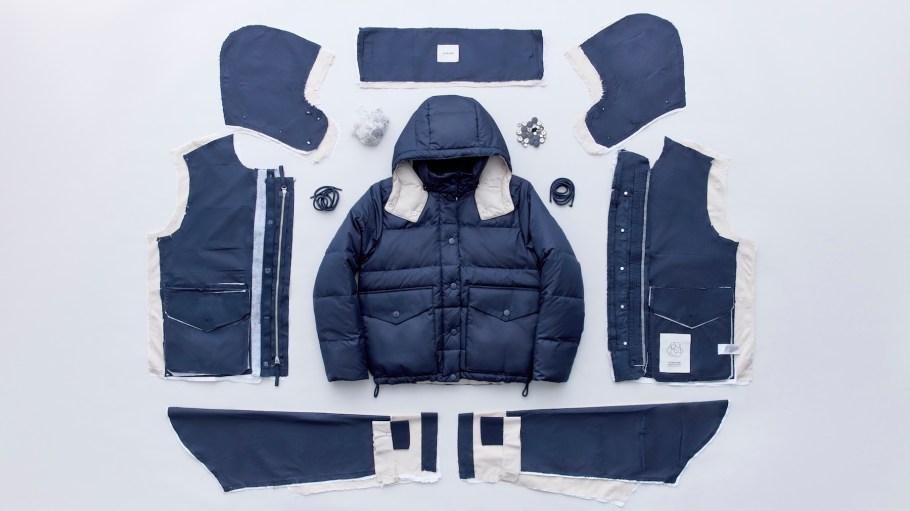
San Francisco-based retailer Everlane has dropped the EverPuff: the brand’s most circular outerwear offering yet, made almost entirely from certified recycled materials.
Nearly every element—from the insulating fill to the lining and sleek outer shell—is Bluesign certified, PFAS-free and re-engineered for recovery. The remaining virgin materials—three small trim pieces for the zipper pull, snaps and drawstring—are slated to be phased out.
“This jacket embodies our commitment to reducing waste and keeping materials in use for as long as possible. Crafted from almost entirely recycled materials—with the exception of three small metal trims—the EverPuff was designed for performance, durability, longevity and circularity,” the company said. “Every detail—from construction to care—is rooted in the belief that the most sustainable product is the one you keep wearing.”
Made in Bac Giang, Vietnam, the puffer features at least 80 percent Re:Down. With this repurposed, recycled down and feathers from post-use bedding and outerwear, the EverPuff provides the same lofty warmth as virgin down—at 700 fill power—while giving existing materials a second life and reducing environmental impact. Its recycled shell is both water-repellent and water-resistant, as well as Bluesign certified and PFAS-free.
“The EverPuff is built to stay with you season after season; if it ever needs a little extra care due to normal use, our repair services are here to extend its life even further,” Everlane said. “When it finally reaches the true end of use, we’ll take it back to recycle and repurpose the materials—ensuring we maximize material recovery and minimize textile waste.”