For years, technology in fashion has been discussed as a catalyst for transformation. Today, the more relevant question is how technology is being used to tighten operations, protect margins, and reduce exposure to risk.
Fashion leaders aren’t losing margin because they lack creativity, they’re losing it because they lack line‑of‑sight into their own operations. That lack of visibility leads to lost revenue from things like stockouts, overproduction, and unpredictable inventory swings. The brands pulling ahead are not adopting more tools—they’re using connected data to make fewer, better decisions earlier in the process.
Related Stories
The bottom line is that brands don’t need more data, they need better, more connected, decision‑making data tied to the resources that are actually at risk.
Integrating technology as an operating model across the business
The most effective fashion brands are no longer treating technology as an overlay; they are restructuring how decisions flow through their organization. Technology is the key to enable that so that data is shared across design, sourcing, production and distribution. When measurements, materials, supplier capacity, and demand assumptions all live in one place, an organization can stop questioning which set of numbers are the most accurate, and instead can start resolving issues before they become expensive.
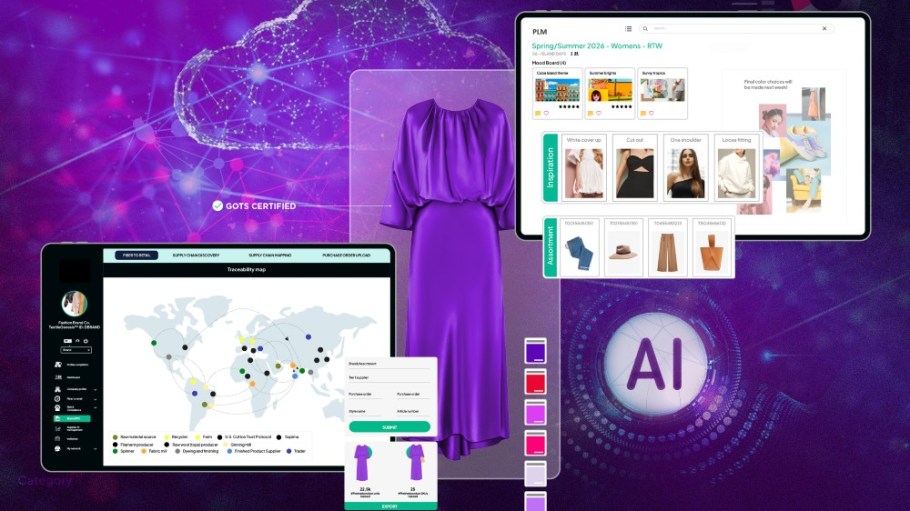
This is where platforms like PLM and connected production systems deliver ROI—not because they add flashy new features, but from their ability to apply the same data, rules, and processes consistently across teams and seasons.
In practice, this looks like development timelines compressing because approvals and feasibility checks move earlier. Production outcomes become more predictable because there are fewer handoffs across teams and manual reconciliations. Speed‑to‑market improves because friction is removed that used to be accepted as “this is just how we work.” For management teams, they get a single dataset to reference to help power portfolio‑level decisions.
Traceability’s expanding role in cost and risk management
Traceability is often discussed in the context of sustainability and regulation, but its operational value can be just as significant. When brands can see materials and components moving through suppliers and tiers—and can link that movement to SKUs and POs—they reduce uncertainty, which is the most expensive variable in fashion. For example, if a quality issue emerges at one supplier, orders can be re-routed before finished goods are impacted.
This enables brands to meet regulatory expectations while also improving sourcing efficiency and resilience. Material substitutions can be validated against compliance and performance data, not just price. Supplier scorecards shift from anecdote to evidence. And for over‑extended leadership teams, compliance becomes a byproduct of normal operations, not a last‑minute scramble.
The implication for management is also strong. Having a unified traceability layer provides a real‑time map of where money, materials, and risk sit across the network.
Predictability as the new goal post for AI and data
In practice, AI’s most immediate value in fashion is not about automation, but predictability. Predictable operations yield fewer expensive buffers: less excess inventory, fewer rush orders to catch up, fewer last‑minute sourcing changes that blow up cost and disrupt timelines. The result is not just more efficiency, but stronger financial control across the value chain.
For example, Chicago Protective Apparel, a U.S. manufacturer that has implemented an AI‑enabled, connected production system, has been working to increase their visibility from order intake through cutting. By centralizing its data to optimize production sequencing and material usage, they have been able to shorten lead times, reduce overall fabric consumption across their supply chain, and strengthen its ability to respond quickly to shifting demand while protecting margins.
Ultimately, AI equips brands with what they need most—the ability to see risk before it becomes costly. When every team operates from the same data foundation and AI amplifies that visibility with stronger forecasts and smarter allocation, the entire value chain becomes more predictable, and more profitable. It’s this shift from reacting to anticipating that defines the true ROI of AI in fashion.
As technology adoption matures, the competitive gap in fashion will widen—not between “digital” and “non-digital” companies, but between those that operate predictively and those that remain reactive. The brands that turn traceability, operational data, and AI into a single, profit‑protecting system will be the ones to outpace their competition. As economic uncertainty becomes the new baseline, the biggest risk for fashion brands isn’t failing to innovate—it’s operating without visibility.
John Brearley is President, Americas at Lectra and has been a member of the Executive Committee since October 1, 2025. Throughout his 40-year career, John has played an instrumental role in shaping a responsive, customer-centric culture within the organizations he has served. He began at Investronica where he managed the business in the U.K., before moving to the US in 2001 to lead the North American division. Following Investronica’s acquisition in 2004 by the Lectra group, John took over the responsibility of growing the Consumables and Parts activity. His expertise in customer relations earned him the role of Vice President of Customer Care for Lectra Americas in 2007. In 2020, John was promoted to Senior Vice President of Customer Success for the region.