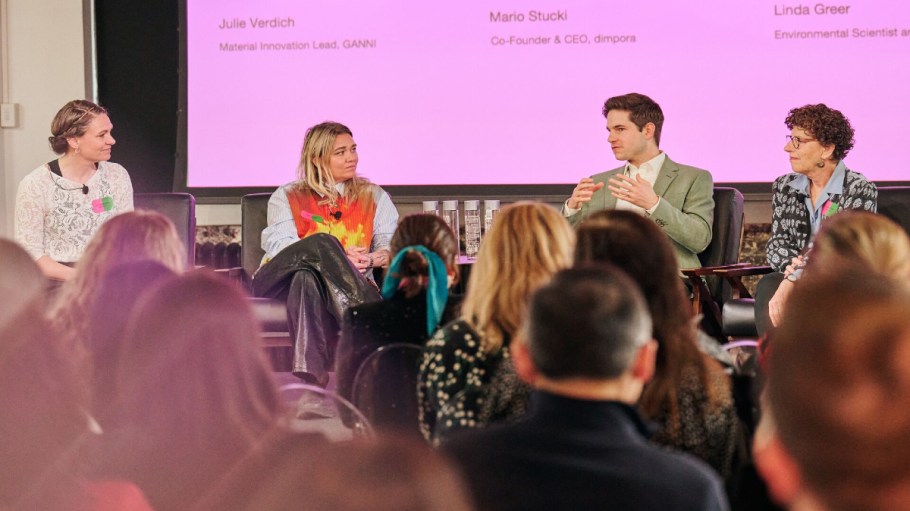
As entrepreneurs find the fashion and apparel industries threaded with challenges, brands, startups and suppliers alike have found that partnering can help weave a way to a more sustainable future.
To discuss the opportunity to collaborate and celebrate its 2023 Global Change Award winners, the H&M Foundation gathered a group of entrepreneurs, brands and sustainability experts at its Open Perspectives event in New York on April 19.
Last year’s winners, which have now graduated from the cohort, boast solutions from eco-friendly dyes to sortation technology for textile recycling, seaweed-based fabric and more. When they entered the GCA cohort, they were all early-stage startups looking to make connections with investors, brands and suppliers.
Related Stories
But sustainable innovation can be a difficult game, especially as brands struggle to convince consumers of the costs and benefits of sustainability in their day-to-day lives.
Suzanne Lee, founder and CEO of Biofabricate, acknowledged that 2023 proved a tough year for startups and said the future will continue to challenge small companies, even as brands try to ramp up their sustainability strategies.
“Let’s be honest—2023 was not the best year for sustainable solutions in fashion. First, we had the shocking news that Bolt Threads would not be scaling its most senior material, Mylo. Then came the Renewcell announcement,” she said.
“2024 may be a tough year, too. If you’re a startup, top of mind will always be, ‘Do we have enough capital to achieve our goals?’ And if you’re a brand, I’m sure you have constant pressure to improve your bottom line whilst also achieving sustainability goals,” Lee added.
One of the major holdups speakers mentioned throughout the day was startups’ limited access to resources. While many early-stage companies want to broker relationships with brands as a first step, supplier relationships may actually prove more important.
Linda Greer, an environmental scientist and impact advisor said startups often struggle to test—and subsequently scale—the innovations they’ve worked to prototype because they struggle to gain access industry suppliers’ infrastructure and equipment.
“We’ve spent too much time disproportionately pitching the brands because the brand relationship with their suppliers is sometimes very transactional—one order at a time. They’re here today, gone tomorrow, and the suppliers are very well aware of that,” Greer said. “We need a parallel track, and since the supplier track has been underemphasized to date, we really need to double down on making this work from a supplier perspective and not just from the storytelling [perspective].”
Christiane Dolva, H&M Foundation’s strategy lead, said in the seven years since the non-profit launched the GCAs and worked with founders, it has become clear to her that suppliers play a major role in startups’ ability to be successful. That’s especially true when the entrepreneur’s end solution focuses on altering the supply chain directly, which can be a hallmark trait of material innovation startups, she noted.
Thinking through how suppliers play into an emerging company’s growth is beneficial for multiple stakeholders, because suppliers have expertise in what may be feasible and scalable in their facilities and for brands’ use, Greer said.
But for entrepreneurs, it can be difficult to have a direct conversation with a supplier without a brand’s backing or demonstrated market demand.
“It’s one thing that it’s a great solution for the planet, but there’s also the business aspect of it. At the end of the day, there needs to be a demand for the solution for a supplier to see the viability of it,” Dolva told Sourcing Journal. “Some of those conversations need to be this tri-part conversation of understanding that it’s the supplier and the innovator that’s going to make the magic happen, and the brand is there to represent the future demands.”
Ganni has begun working to bridge the gap between its suppliers’ abilities and its sustainable aspirations by signing long-term relationship agreements with its Tier 1 suppliers, according to Julie Verdich, a material innovation lead for the Danish company.
She said that due to its size, the company could otherwise lack the leverage it needs to work with suppliers on innovations that add costs to the supply chain. But in expanding the company’s relationships and working with innovators the brand has already started to see success.
“One of the things that we really want to do with the same suppliers is working on innovation—so both materials, process, chemicals, everything, and that’s one of the demands we have when we initiate a partnership,” she said. “A lot of the manufacturers we work with really want to do this, and they really want to be a part of that integration or that process.”
Dolva said the type of approach Ganni takes to supplier relationships could substantially benefit the entrepreneurs she works with every day. If brands can effectively communicate about their short- and long-term sustainability targets and goals with suppliers that they’ve committed to a relationship with, that could trigger suppliers to bring innovations to brands’ attention, she said.
While the H&M Foundation’s GCAs have, up until now, been an annual program, the foundation did not put out a call for innovators interested in joining a 2024 GCA cohort. Instead, the foundation has taken a step back to review its program and better understand how it can serve the industry’s at-large needs—like, for instance, leveraging suppliers in a more hands-on way.
After the pause, it has plans to begin recruiting startups later this year for its 2025 GCA cohort. Dolva said as the foundation continues to evaluate the industry’s needs through research, collaborations and more, it will focus some of its innovation-based resources on solutions that could have a positive impact on emissions.
“What we have realized during this past year is the importance of supporting the industry on the transition of halving its emissions every decade. Now more than ever, I think that will be an important starting point for [future GCA] winners,” she said. That transition and those reductions that need to happen really need to happen justly and fairly, while actively promoting the wellbeing of people and other planetary issues.”