Next-generation materials could deliver up to 39 percent of the emissions cuts needed for fashion to reach net-zero, according to The Sustainability Directive, a resource-aggregating company for those interested in finding solutions to fight climate change.
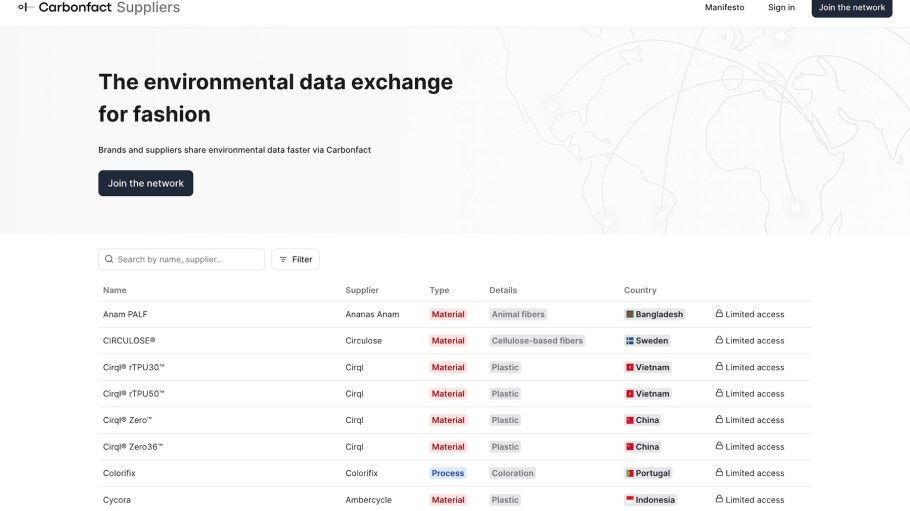
And yet, understanding next-gen’s genuine impact is still surprisingly hard, Carbonfact found. The carbon management software, built for the apparel and footwear industry, has launched Carbonfact for Suppliers, which the Paris-based startup calls the environmental data exchange system connecting brands with suppliers.
Related Stories
“Brands struggle to compare innovative materials and processes because every supplier’s LCA looks different and often requires an NDA to access,” said Martin Daniel, co-founder at Carbonfact. “At the same time, suppliers worry about exposing sensitive details and spend hours managing access and updates; everyone ends up stuck in manual back-and-forth instead of focusing on reducing the industry’s footprint.”
The free public directory is where brands can discover innovative, lower-impact materials and processes—and where suppliers can go to have a safe way to share verified and comparable environmental data. Per the French firm, the need was clear.
“Innovative materials and processes can play a big role in reaching net zero, but understanding their real impact is hard,” said Jonathan Davies, product marketing and content lead at Carbonfact. “We built Carbonfact for Suppliers to fix this.”
More than 20 top material creators like Circulose, Manteco and Recover have already made their profiles and uploaded their environmental data. New suppliers can ask to join, send in their reports to be checked for free, or, if needed, ask Carbonfact’s science team to make a new report.
“Let’s take Manteco’s MWool fabric, for example,” Davies said in a video demonstration. “As a brand, I can go into Manteco’s profile—which has been claimed and already filled out with a bit of information—and I can request access. Once I’ve been granted access, I’ll be able to view the environmental data of the MWool fabric.”
Upon onboarding to the platform, suppliers are given a public profile and a page for each material, plus the option for any verified LCA results to be shown in a comparable and straightforward format—including control over who sees the comprehensive methodology’s detailed data. And once suppliers have claimed their profile, they can go in and update their vitals—details like composition, certifications and color—all of which are directly reflected in the following page containing environmental impact data.
“This section is confidential,” Davies said. “It’s only accessible to the brands that the supplier has decided to share it with—and, by the way, suppliers can share the environmental data with individual brands, with all Carbonfact customers, or make it publicly available.
The platform includes detailed environmental breakdowns, system boundaries and lifecycle assessments, all completely Carbonfact certified—which Davies said means that the company’s science team goes in and does a thorough (and free) review of the uploaded LCA. “This makes sure that all of the information within carbon factor for suppliers is verified and comparable,” he said.
“Carbonfact’s new supplier platform finally gives us a secure and credible way to share our LCA data with brands,” said Giuseppe Picerno, head of innovation and sustainability at Manteco. “We stay fully in control of what we share—and with whom—while becoming visible in the exact workflows where brands evaluate materials.”
Copenhagen-based Samsøe Samsøe, too, found that using the Adore Me partner’s Carbonfact for Suppliers solution simplified and streamlined the process for reviewing next-gen materials.
“The fact that the data is verified and comparable means we can evaluate options fairly,” said Femme van Gils, head of sustainability at the Scandi streetstyle-inspired label, “and accelerate our ability to scale lower-impact materials.”