“Why does fashion need another tool?” Christina Iskov, director of impact at Global Fashion Agenda, asked Cecilia Dall’Acqua, sustainability lead at Deloitte Spain, at the Global Fashion Summit in Copenhagen in June.
The question, as it turned out, was largely rhetorical. It was Global Fashion Agenda, the Danish think tank behind sustainable fashion’s highest-profile event, that had partnered with the international arm of the business consultancy to develop a Fashion Impact Toolkit, a seven-month effort in the making that was officially unveiled to the public on Wednesday.
Related Stories
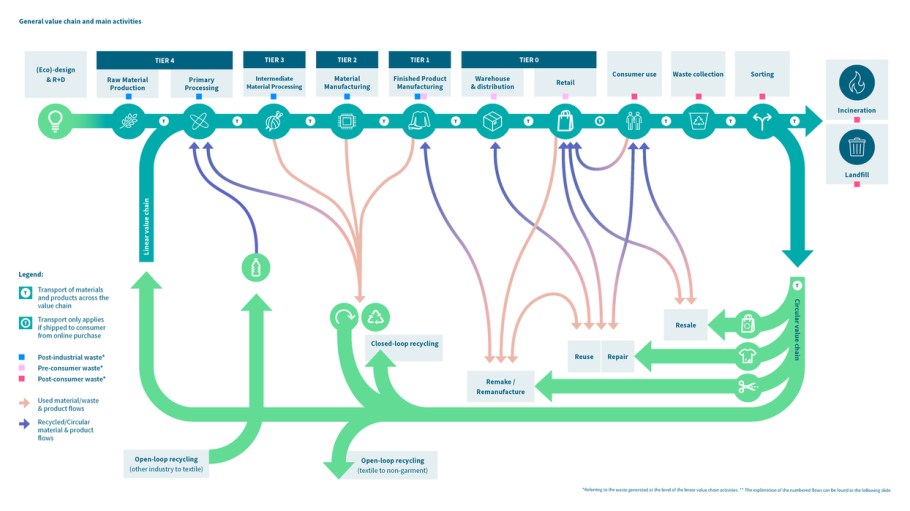
Fashion’s fragmented, geography-spanning and multi-tiered supply chain makes identifying sustainability impacts—of which there are potentially 3,000, both positive and negative—an intractable challenge that stymies consistent, collaborative action, Dall’Acqua said at a press conference preceding the two-day event. The free-to-use interactive resource was designed to serve as a “starting point” to help raw material producers, retailers and end-of-life waste managers map their areas of influence at each stage of the value chain based on materials, processes and location. The idea, she said, is to translate sector-wide impacts into company-specific ones.
“We believe that if companies understand where the impacts that they are generating, and identify these risks and opportunities, they are not only able to report to other stakeholders, promoting the transparency, but also promoting more resilience across their business,” she said. “It also promotes trust. If you are able to report and communicate around the impact that you generate, you can generate more confidence on how you are going to respond to the demands of your stakeholders, and, furthermore, drive proactive strategies around sustainability and accelerate the transformation that we are looking forward on this in on this industry.”
If it all sounds a bit squishy, it’s because this isn’t anything we haven’t heard before. Plenty of resources already exist to help companies make more responsible sourcing decisions in a more robust and rigorous manner, from Textile Exchange’s Materials Impact Explorer to Cascale’s Higg Index suite of facility measurement tools to B Corp’s impact assessment questionnaire. There are also a multitude of digital platforms with “trace” in their name, many purporting to provide real-time monitoring of critical hotspots for any business willing and able to pony up. The brands and retailers that have any interest in doing this work have been at it for years.
But Dall’Acqua, answering Iskov during a panel on the “action” stage, said that many existing assessments unpack only a “specific part” of the value chain. What Global Fashion Agenda and Deloitte have set out to do, she said, is take a more holistic tack, helping companies compile a type of “impact inventory” by toggling through the 20 main activities and 88 sub-activities.
“When we talk with different players in the industry, they were having like a silo vision,” she said. With the tool, on the other hand, a retailer can pick “retail” as a main activity and dive into the positive and negative impacts of having a physical store (waste, biodiversity loss, increased job opportunities) or it could think in terms of the broader value chain and cycle into “raw material production,” choosing, say, “cotton” to pull up the social and environmental footprint of farming (soil pollution, increasing water scarcity, potential forced labor) and harvesting (contribution to pollution, land degradation, potential child labor).
There are some caveats, however. Because the Fashion Impact Toolkit doesn’t cover risks or opportunities along the value chain, it should not constitute a full double materiality assessment, the organizations said. Nor is it intended to provide a quantitative evaluation of the identified impact. In short, its scope is only possible impacts, listed in a generalized, somewhat rudimentary, but also less finger-pointery way.
This could be enough for companies that are still honing their sustainability roadmaps or don’t know what to prioritize because resources are in short supply, Dall’Acqua said. Such strategies must “focus on where they will have higher impact, or in which they have the biggest opportunities,” she said. “So from our side, this tool will help make these conscious decisions inside the company.”
“In a more collaborative landscape, you can identify, from your suppliers, from your raw material providers, what are the impacts, and work together with a common goal,” she added. “It’s not only about requesting data. It’s about working together to minimize the impacts or even leverage the opportunities that you have found. So this tool will enable and inspire that as well.”