In early December, more than 1,000 attendees descended on the Hilton Istanbul Bosphorus in Turkey for the sixth edition of Sustainability Talks Istanbul, which bore the theme of “Shared Responsibility, Shared Future.” More eyes than ever are being trained on Europe’s second-largest textile supplier, which is facing pressures from high production costs, inflation and an overvalued lira, all of which have undermined its competitiveness.
Despite the challenges, Turkey is neither down nor out. With the United Nations climate change conference known as COP31 due to take place in Antalya at the close of 2026, the country is keen to showcase an advantage based not on margins but on circular innovation, sustainable leadership and adaptability to policy shifts from Brussels and elsewhere.
Related Stories
It’s why Turkey remains attractive to brands like On, which has built a five-year plan based on innovation, quality and sustainability, said Danielle Petesic, senior director of apparel and accessories product development and sourcing during one of the keynote speeches. For the footwear maker, long-term relationships with suppliers that “go beyond transactions to include innovation and material development” are crucial. Sustainability is “not a race; it’s a team sport,” she added.
Here are some of the other conversations that took place during the event.
Responsibility is a group effort
For Ahmet Öksüz, chairman of the Istanbul Textile and Raw Materials Exporters Association, the need for systemic transformation is no longer some future-facing hypothetical, but rather an existential imperative that demands both innovation and conscience. At the same time, he added, sustainability is a “chain, and the burden of this chain cannot be placed on a single link.”
With nature now “screaming out” under the strain on water, land and other resources, brands “must share the responsibility in a fair way, acting together with all the other stakeholders as a community to protect the planet and preserve it for future generations,” Öksüz said.
In sustainable production, he added, “technically tolerable” deviations that don’t impair quality—such as minor variations in color or fabric weight—should not be automatic grounds for rejection.
“It is no longer enough to grow; we must grow sustainability,” Öksüz said, contrasting the fashion industry’s $1.8 trillion market size with its annual generation of 92 million tons of textile waste.
The EU and Turkey need to reduce trade frictions
The European Union and Turkey’s textile industry are mutually interdependent in terms of innovation, capacity and a broader “EU-Turkish ecosystem,” said Dirk Vantyghem, director general at the European Apparel and Textile Confederation, the trade group better known as Euratex.
As discussions in Brussels over bringing production closer to the European single market intensify, improving EU-Turkey relations is more important than ever, he said. But there are a few “trade frictions,” including anti-dumping measures and the need to overhaul a nearly 30-year-old customs union agreement.
“So we need to work together and we are trying to do that with the Turkish government, to make sure that there is a smooth, fully integrated supply chain in the textile industry,” Vantyghem said. “We need to have a modern framework within which our EU and Turkish textile companies can work together because the competition game is well beyond Europe and Turkey. It’s about competition with Asia. It’s about competition with the U.S.”
Turkey’s strongest muscle is no longer price
In recent years, bruising labor and operations costs—not to mention a sky-high inflation rate—have forced thousands of Turkish textile producers either to relocate overseas, primarily to Egypt, or to shut down entirely. As Ali Koçali, chief marketing and innovation officer at Aster Textile, put it, “price is no longer Turkey’s strongest muscle,” which is why it needs to continue to add value and assurance through green infrastructure and processes.
“We have many other muscles to be strong,” he said. “There is a very serious human resource here. Let’s talk about our innovation competencies. Let’s talk about our ability to make high-quality products. Let’s talk about our transformation skills. Let’s talk about our resilience. Let’s talk about our flexible and agile structure. We have dozens of other things we can talk about. Do not compare us to countries that are not our equal.”
And Aster Textile, which operates six integrated printing, embroidery, washing and production facilities across Turkey, doesn’t shy away from change, Koçali said. “I can say that our company is very dynamic in this respect,” he added. “We need to constantly innovate.”
Lacoste is betting on Turkey
Five years ago, Turkey wasn’t anywhere on Lacoste’s sourcing radar. Today, the French polo purveyor has made the country its No. 1 sourcing destination, surpassing China.
A key reason for the shift, said Raynald Anquet, vice president of quality and CSR operations at Lacoste, was a desire to invest in nearshoring—that is, producing locally for the local market, in this case Europe, to guard against policy shifts such as tariff increases.
A second is something he termed “value chain elevation.” Some 70 percent of Lacoste’s raw materials hail from organic or recycled sources, making it important for the company to monitor its entire supply chain in terms of sustainable performance—a standard its Turkish suppliers have met. Another plus? The availability of high-quality Turkish cotton. “We use a lot of cotton,” Anquet said. “To have everything in your country is very convenient for us.”
Radical transparency means admitting mistakes
Armedangels prides itself on using only chlorine-free wool from certified organic farms. But four years ago, the German label ended up with the “wrong wool” because of monitoring lapses, said Sarah Vollmer, its senior climate and circularity manager.
“It was still coming from Patagonia, from the right area, sourced from the right partners, but it was conventional wool,” she said. “But we communicated about this super-openly. We informed our partners, we informed the customers and it was also a huge success for us.”
Besides tightening its processes and setting up a traceability certificate system, Armedangels also used the profits from the collection to invest in digital monitoring solutions based on secure blockchain technology. In 2025, the brand transitioned to digital product passports. Traceability, Vollmer said, is not only about compliance, but it’s also a tool to engage with stakeholders and drive impact.
Circulose has a new partnership model
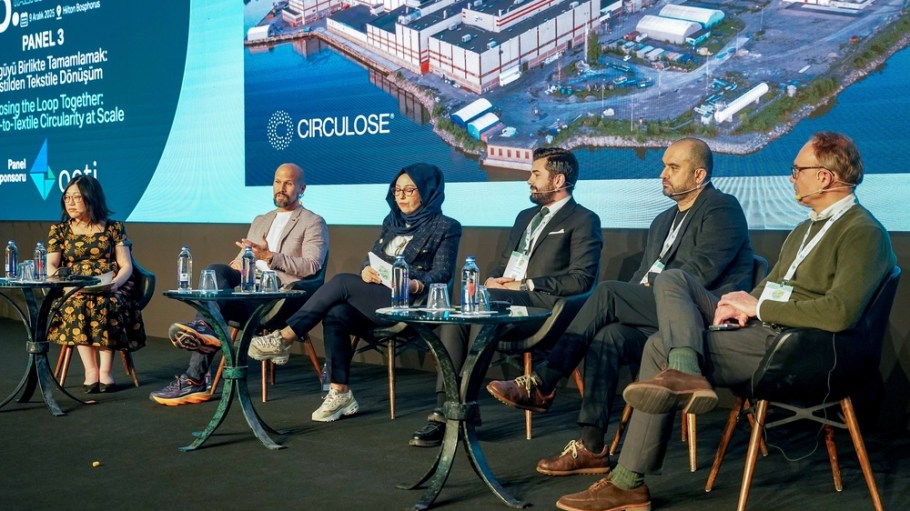
With a 60,000-ton pulp capacity in Sundsvall, Sweden, Circulose is neither a “project nor a concept” but a commercial reality beyond test orders and capsule collections, said Pierre Börjesson, commercial director of value chain partnerships at the company formerly known as Renewcell. Previously focused on working fiber producers, Circulose is now counting on partnerships with brands to drive success “going forward,” he said. This includes paying a license fee.
“Circulose will only be available for brands having a partnership agreement with us,” Börjesson said. “Paying this kind of license fee from these partner brands is also enabling fiber partners of ours to have a pre-fixed discounted base price on the fiber that they are selling to spinners. It also makes it a strong incentive for the brands to actually fully utilize the commitment they’ve made on volumes.”
It’s by implementing this base price that will serve as a “game-changer” for Circulose in terms of how it can scale the material because it requires “real skin in the game,” he added. Already, scaling partners include the likes of Bestseller, C&A, Filippa K, John Lewis, Marks & Spencer and Reformation.
Kipaş Textiles is tackling the post-consumer problem
Kipaş Textiles, one of Europe’s largest fully integrated textile manufacturers, is making a foray into textile-to-textile recycling with FibR-e, a platform that it developed with chemical company Meltem Kimya to transform post-consumer garments containing at least 70 percent polyester into new filament yarns and staple fibers—or, if they have trims still attached, into Global Recycled Standard-certified resin chips.
“The resulting polymer is of the same quality as virgin polyester,” said Kıymet Kübra Kaya Denge, R&D center manager at Kipaş Textiles. “Without losing this quality, it can be recycled an infinite number of times. It’s a real closed loop. One of the most important advantages of this approach is that even the most difficult threads of the textile can be incorporated into the system.”
Because the system breaks polyester into its molecular building blocks, it doesn’t matter if the material is “pre-consumer or a post-consumer, made with elastane or colored or not,” she said. “The only condition is that 70 percent polyester is used to make it meaningful in the environmental sense. Otherwise, there is no limiting value to the process,” which is monitored using GRS criteria.
No shortage of eco-friendlier options
When it comes to less environmentally damaging solutions, the industry is practically spoiled for choice, said Michel Waegli, head of industrial applications at Livinguard Technologies, a Swiss material science company. Take dyeing, for instance.
“There are microbial pigments, there are natural dyes, there is waterless and pressure-based dyeing technologies emerging,” he said. “At the end of the day, the biggest limiting factor, and therefore the biggest enabler for scaling into adoption, is cost, or the ability to at least provide a cost-neutral business case to a mill.”
Unfortunately, while everybody wants sustainability, no one is “really willing to pay for it,” Waegli said. What this means, he added, is that sustainable innovation must be geared toward the efficient use of resources that translates into cost savings. One example: Livinguard Technologies’ cationization pre-treatment for cellulose, which comes at a cost because “additional chemistry isn’t free.”
“But at the same time, that process then allows reductions in energy consumption, water consumption, effluent and also time and the capex that is needed,” Waegli said. “And at the end of the day, we really try to work with our partners toward a business case that is cost-neutral or even beneficial for the mill. Because even once we have reached a point where the opex is at par, implementing this technology still takes a lot of startup investment and trials.”
Sustainability could lose its meaning
Without care and investment, sustainability not only risks becoming a buzzword, said Burak Orhan Arifioğlu, a board member of Karacasu Tekstil, but it could also become little more than a marketing tool.
Arifioğlu had cause to be frustrated: 2025 hasn’t been a good year for the green transition, with shrinking profits and contracting markets exposing a “serious gap” between intention and action. “Sustainability was expensive,” he said. “And it is still expensive.” Again, it comes down to who is willing to foot the bill.
Karacasu Tekstil did its part, launching its Spinnovation collection of yarns that use half as much water and produce half as many carbon emissions. But uptake has been slow, reflecting a broader industry-wide reticence to shell out. Once, the company fielded requests for more sustainable products. Now, Arifioğlu said, the calls are for lower prices, even though the need to act has never been more acute.
“Beyond everything, there is a social part to it,” he said. “This 1.5-degree warming target is already going to be exceeded. And when it comes to this 1.5-degree increase in temperature, some parts of Turkey will not be able to live.”
A Circle of Fashion Partnership is launching in Turkey
Global Fashion Agenda’s entry into Turkey marks its fourth Circle of Fashion Partnership, an H&M Foundation-funded initiative that works to develop a domestic system to capture and recycle post-industrial textile waste. Previous iterations, which ran in Bangladesh, Cambodia and Indonesia, digitally traced more than 21,000 tons of textile waste and connected over 100 factories and 20 global brands to recycling partners.
Because the context changes “from country to country,” the Danish think tank has appointed Rematters, a local engineering and consultancy firm, as its national lead, said Christina Iskov, Global Fashion Agenda’s director of impact. The program will also receive the support of implementing partners such as Reverse Resources, Closed Loop Fashion and Circle Economy Foundation.
Turkey is in a position to scale waste segregation, fiber-to-fiber recycling and domestic recovery because of its vertically integrated industry, proximity to the EU and adherence to policies aimed at reducing waste and pollution, Iskov said.