Perhaps one of the most incisive questions raised at a fashion event during Climate Week NYC was: why?
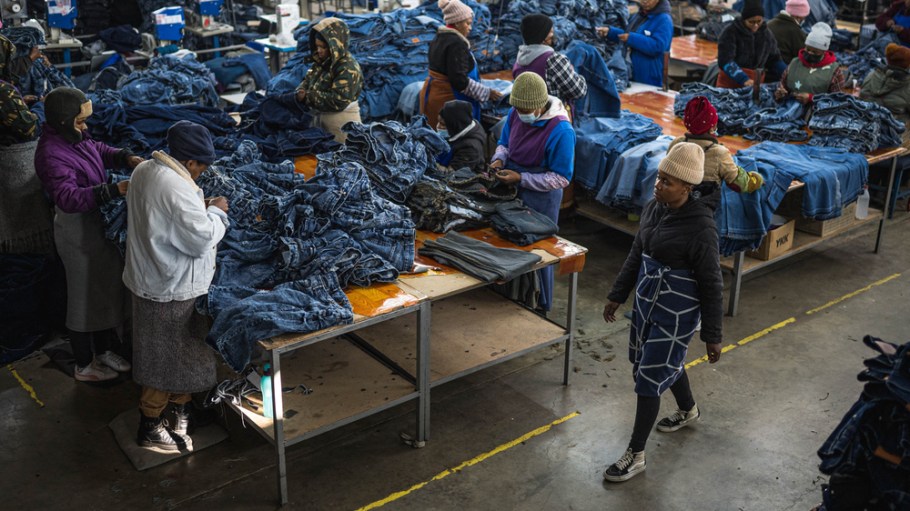
Why isn’t the industry moving faster—or working harder—to stave off what is almost certain supply chain collapse in the face of the climate catastrophe? Why, for all its talk about collaboration, has meaningful action struggled to coalesce? Why is the wealth that’s concentrated in the office suites of the global North failing to reach the production floors of the global South, where it can have the greatest impact?
Related Stories
The reason is simple, if cynical. Big brands that rise and fall on the strength of their quarterly returns rarely have a long-term strategic mindset, particularly if they’re being rattled—as they are now—by geopolitical and economic tremors. Neither do investments that drive efficiency or reduce emissions in factories they don’t actually own, but rather share with rival businesses, immediately translate into increased shareholder value.
At the same time, up to 99 percent of a clothing purveyor’s carbon footprint can lie in its supply chain. To put it another way, there are only so many lightbulbs a company can swap out in its distribution centers before it has to grapple with the bulk of its emissions outside its own operations, particularly in the material processing phase that accounts for 55 percent of Scope 3’s greenhouse-gas pie.
“The trick is to find a way to bridge the long term with the immediate and short term,” Ulrika Leverenz, head of green investment at H&M Group, said at a panel with The Fashion Pact on Thursday. “At H&M Group, we link the financial value to the value impact. And that could be cost per ton or how much this particular project will benefit the total targets. You could also frame it as risk minimization. We are only as resilient as our supply chain. What we need to look into is, how much are we willing to pay today to avoid that risk for tomorrow?”
The Swedish retailer is a member of Fashion Pact’s Future Supplier Initiative. Launched a little over a year ago in collaboration with the consultancy Guidehouse and the Apparel Impact Institute, the project seeks to leverage the power of collective financing to dole out low-interest loans, supplied by Singapore’s DBS Bank and “de-risked” by the likes of H&M Group, Gap Inc., Bestseller, Mango and, more recently, Marks & Spencer, Ralph Lauren and Tchibo, to help manufacturers in countries such as Bangladesh and India decarbonize their operations through the installation of, say, solar panels, heat pumps or, somewhat controversially, biomass boilers.
It was H&M Group, acting through then-CEO Helena Helmersson, who also happened to be co-chair of The Fashion Pact at the time, that initiated the FSI, Leverenz said, because it recognized that the project would stretch further if the company didn’t try to do it on its own. Even with the four original brands, she said, working together meant that each dollar would “reach four times as far” in terms of carbon reductions. This is the type of “easy math” that would “convince any CFO,” Leverenz added.
Gap Inc.’s CFO needed more convincing, admitted Dan Fibiger, the company’s vice president of global sustainability. The truth, he said, is that there is a finite amount of capital that can be freed up from the books for something like this. Brands in FSI put up what are known as risk guarantees in the form of cash deposits or guarantee fees, making them legally liable if a supplier defaults on payments or, worse, goes out of business.
“And so then the pressure on us is to make sure that we have the right evaluation framework because if [the resources are] finite, how are you getting the most impact for the amount that you put on the table to deploy?” he said. “And that is still a work in progress. Certainly, it’s been a very dynamic year for all of us in terms of trade regime and whatnot. So it’s [about] making sure that if you have an amount, that amount needs to deliver disproportionate value relative to anywhere else you can put it.”
While the precise figures brands will put up, as well as the specific lending terms, aren’t yet public, a typical loan for a factory could fall within the $1 million to $2 million range, though there isn’t a cap on the amount. Eva von Alvensleben, executive director and secretary general of The Fashion Pact, described FSI as a “new way to think about decarbonization in our supply chain” because it’s about a “shared financial mechanism.”
“It’s not about every one of us going with their own program to their suppliers to say, “Hey, [this is a] super idea, why don’t you do this?’” she said. “No, it’s a shared one where actually we will come together and say, ‘Hey, listen, this is what we want to do together, and we help you with technical support and financial support,’ which has clear benefits for the suppliers because they get access to low-cost loans, but also they see the brand standing behind that program. It’s clear supplier engagement.”
Operationalizing sustainability
To be sure, it’s the lack of engagement between brands and suppliers, coupled with differing expectations and limited financing, that has resulted in progress sputtering between the assessment and deployment stages of even the best-laid plans. Money also continues to speak the loudest in the boardroom. And for every brand that steps up, dozens more opt for inaction.
“Unfortunately, we’re still driven by cost initially,” Lewis Shuler, head of innovation at Alpine Group, a vertically integrated fiber-to-fashion supplier for household names such as American Eagle Outfitters, Gap Inc., The North Face and Under Armour, said at a Fashion for Good panel about its Future Forward Factories initiative. “Everything goes through that first filter of how does it impact cost? And then it goes into impact. And one thing where we’re finding success is you can’t just tie it to impact. You have to find as many different points that you can kind of upsell.”
Like FSI, FFF wants to find a workaround for what is frequently described as “pilot paralysis.” It thinks that while renewable energy, wastewater treatment and coal boiler phaseouts are all well and good, gaps still remain in integrating “disruptive” innovations in material processing, where textiles are dyed, treated and finished, that can reduce the amount of energy used altogether. And all while also ensuring a “just transition” for workers through additional training and development.
But the issue, said Priyanka Khanna, Fashion for Good’s innovation director, isn’t just about testing, validating or even delegating new innovations and making sure they can jibe with existing ones, but also about “bending the sustainability cost curve” and “looking at all the barriers of scaling and moving them from adoption to scaling phase.” FFF, she said, aims to “set up a new format” for Tier 2 by setting up blueprints for what new facilities employing innovation on both the process and utility sides could look like.
Beyond so-called “catalytic” funders such as the Laudes Foundation, Aii and IDH The Sustainable Trade Initiative, H&M Foundation, the philanthropic vehicle funded by H&M Group’s founding family, announced Monday that it is committing 53 million Swedish kroner, or $5.6 million, over five years. Beginning with an Arvind-backed facility in India, the idea is to create blueprints for each production geography that suppliers can use to develop new facilities or fully retrofit existing ones.
“It’s not just about a vision,” Khanna said. “It’s about operationalizing and really creating actual impact in the industry. Part of it is working, demonstrating and building these facilities with suppliers, but the other part is looking at making the plans open source, so anonymizing certain data and creating blueprints at the country level and product level. And the whole purpose of doing a demonstration on this scale is to make it easier for the rest of the industry to adopt.”
The project promises to be transformational. Its “north star” facility in India could see a 93 percent emissions reduction compared with conventional factories in the region. By establishing seven demonstration plants, Fashion for Good estimates it could cull 400,000 metric tons of carbon dioxide equivalent a year.
Still, there’s a catch: New technology, especially ones that haven’t been proven yet, comes with a big price tag. The first few manufacturers who adopt such machinery will likely bear the brunt of the cost, creating a “first mover disadvantage.” How to share the risk across the supply chain has been “quite a topic” of discussion, Khanna said.
“I think through the last six, eight months of exploration, as we set up this blueprint, the learning was, yes, we need brands to step up to take and share that risk, whether it comes from a financial perspective or a commitment perspective,” she said. “But we also need other stakeholders. We need public finance, from subsidies to potentially innovation-based grants, and then we need catalytic capital. With the data that we’ve now accumulated, it feels like for every dollar of catalytic capital, we can unload about $4 of public and private funding. And that’s a topic that we want to popularize and get more and more investments from catalytic investors here into these kinds of spaces.”
How long the return-on-investment period should be is another subject of contention. Earlier this month, Aii launched what it calls its Deployment Gap Grant, a grant mechanism designed to bridge the gap between suppliers’ two-year ROI threshold and the longer payback period of proven decarbonization technologies, thereby enabling greater uptake.
Through its Fashion Climate Fund, which derives its funding from H&M Foundation, H&M Group, Lululemon, the PVH Foundation, Target and The Schmidt Family Foundation, Aii has contributed $1 million of seed funding to pilot the mechanism with eligible suppliers that attended the India Activation Event in April. Projects include the installation of a renewable energy-powered hot water heat pump to help home textile firm Welspun meet its process steam requirements. Trident, which produces bedsheets and towels, will be installing solar sludge dryers with automated climate control.
“Obviously, we don’t have unlimited money with the Fashion Climate Fund, so we have to be very specific about how we get started,” said Lewis Perkins, Aii’s president and CEO, at a panel on Wednesday in reference to its $250 million decarbonization coffer’s 70 percent financing gap. “But we recognize that some of these new technologies, particularly around heat pumps, aren’t proven yet in our sector, and so we’re going to subsidize them to create the case studies and then a flywheel around what’s proven and what’s working.”
FFF’s potential to snap the industry out of pilot mode it has long been mired in was what led H&M Foundation to shell out, said Sophia Halliday, its project manager for innovation, research and demonstration.
“What we really look for is these types of demonstration projects that go beyond the pilot phase,” she said. I think this is also really important, that this is an example of a project that combines many different innovations and really looks at the interplay between them and the way that we can really scale and test viability in real life. It’s also a great example of a project that can really multiply its impact across the industry and many actors involved.”
Getting people to pony up requires other pieces to fall into place, said Amol Mehra, director of industry programs at Laudes Foundation. The truth is there isn’t much interest in the fashion sector from the philanthropy community because the issues can feel “sort of opaque,” he said. Part of that has to do with the nature of the supply chain. Another is the emphasis that has been placed on changing consumer behavior.
“It’s really critical that we have sort of engagement with and high-touch alignment with policy environments around innovations like this, for them to have even a chance of succeeding,” he said. “And the second thing is we have to really get serious about how we’re actually building financial vehicles and financial mechanisms to support these because it is going to be costly, and philanthropy is not going to pick it up, and there’s not enough of us to do so. So the question is, how can we think about innovative structures to try to drive some of that financing to lower the sort of entry-level cost of this?”