Denim continues to amp up its efforts to be sustainable—and the intersection of physical and digital technologies are helping the industry achieve that.
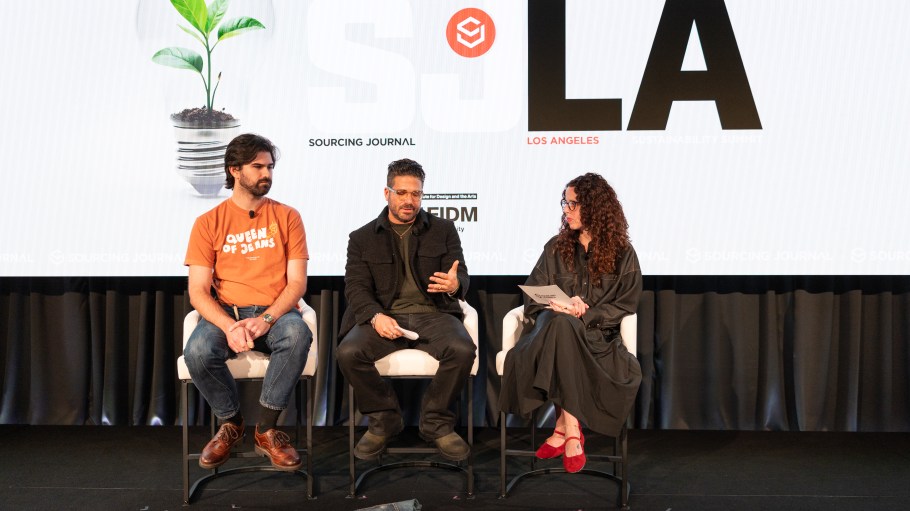
Thomas Leary, global sales director & business partner at Baytech-HMS, and Dustin White, co-founder and CEO of Lab Denim, joined Angela Velasquez, executive editor of SJ Denim, to discuss the how the solutions their companies have respectively developed are faring for sustainability use cases in the denim industry.
Lab Denim makes indigo-free denim complete with bio-based finishing, which can create patterns or an aged look without ever needing to use chemicals, bleaches, lasers or harmful dyes.
Related Stories
“We have a technology around reproducing the exact finished look of denim without using any water, using any chemistry—there’s no indigo; there’s nothing harmful in these garments—as well as a finishing technology. So the machine essentially brings the fabric from white woven fabric all the way to cut and sew,” White said.
Baytech-HMS has developed a replacement for pumice in the washing portion of the denim sector; it creates a recomposite stone that Leary said creates “a product that’s roughly 35 to 40 times more durable than pumice,” allowing it to last longer. The replacement also reduces water use by one-third and helps simplify supply chains, Leary noted.
Lab Denim, which works with Levi’s, helps companies axe the cost of finishing from the creation of denim through its use of biotechnology, while Baytech-HMS helps mitigate costs associated with removing pumice sludge.
Despite the outcomes both companies can procure, bringing sustainability to a legacy industry at scale can be a challenging prospect. White said that, while the industry has started to warm to pilots with more sustainable outcomes, it can be an uphill battle to convince brands to invest in technology that disrupts the status quo.
“One of the challenges is that something’s been done for 150 years a certain way, it’s hard to show up on the scene and be like, ‘Oh, this is the future,’” he said. “Even if you have the solution, which we do, there’s all the processes around it…and that has to be taken into consideration.
For Leary’s team, which works with Levi’s Eureka Lab and has been having conversations with the likes of Kontoor Brands and H&M, it’s less about capex and more about technique differences.
Both experts said that disrupting the processes brands and manufacturers have had in place for decades is a difficult ask to make. White said that, for sustainable innovation to truly take hold, it has to touch every step in the process of making denim.
“We know that the chemistry and the technology is something that is going to add a lot of value to the planet and to producers and to brands, but without the partnership of the people in the industry to build all the other technology around it—from software, all the way through cutting and sewing—it’s hard to get that momentum,” White said.
And as the technology starts to catch more momentum, some of the conversation circles around comparing notes with other sustainable solutions providers. Both Leary and White said that while some pieces of their business remain proprietary, they’re happy to share what’s involved with making technology like theirs work in a highly process-oriented industry.
“If you have something great, and you’re doing it great, you can kind of stand on your own and not worry so much about the competitors,” White said.
Both White and Leary said the industry has come into a moment where small brands and large brands alike can buy in on transformation. said the best way forward is to help the industry procure more sustainable outcomes while simultaneously simplifying operations.
“Simplifying [companies’] daily work, as well as the supply chain overall, [is] just going to make that conversation about switching to sustainability much easier,” Leary said. “If you’re coming in with a sustainable solution that’s making their lives harder, what’s the point?”