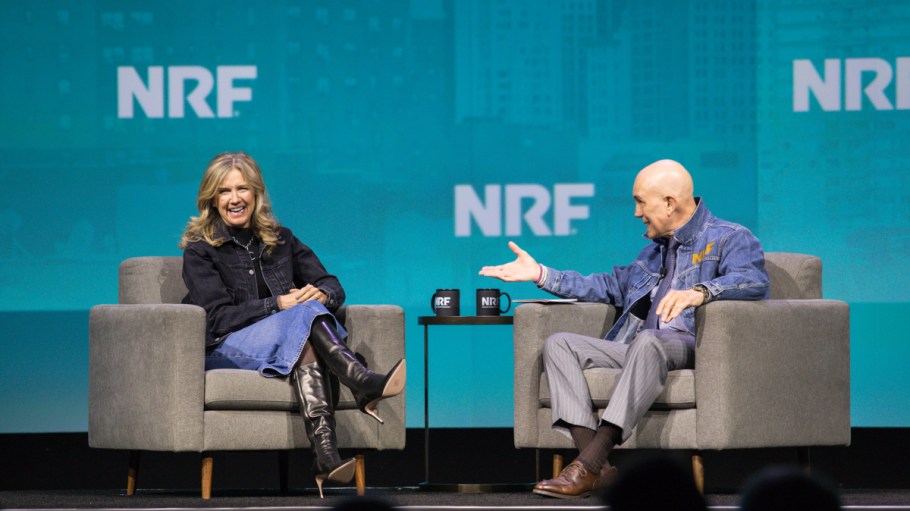
Michelle Gass, Levi Strauss & Co.’s incoming CEO, joined National Retail Federation (NRF) President and CEO Matthew Shay at Retail’s Big Show on Sunday to discuss the state of the business.
Gass, currently the president of the Stony Creek Colors partner, will take the company’s reins from current CEO Chip Bergh on Jan. 29, upon Bergh’s retirement. Gass joined Levi’s in December 2022 as part of a public CEO transition process.
Gass, a veteran retailer with experience at Procter & Gamble, Starbucks and Kohl’s, said in 2024, the denim giant, most famous for its blue jeans and Levi’s 501s, will work to own greater market share in other product categories.
Related Stories
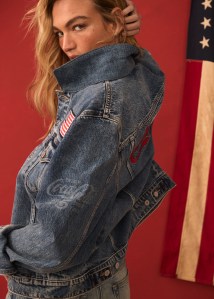
“We are now going heavy after what we call denim dressing,” Gass said, noting that, “The top-to-[bottom] denim look is really in right now.”
She said the brand would be working to highlight items like denim skirts and denim dresses, products which she said Levi’s currently offers but consumers might not think of when they consider the Levi’s brand at large.
But Levi’s interest in diversifying its assortment means it will lean into fabrications beyond denim. Gass said Levi’s “should own the best woven, button-down shirt for men that’s the perfect pairing to your jeans.”
And as Levi’s works to engage its consumers with a more diverse assortment, Gass said the brand has also been eyeing some more nascent markets—primarily in Asia.
“In some ways, in some of these markets, it feels like we’re just getting started,” Gass said. “Chip and I made 15 trips around the world this year, three trips in particular to Asia. Asia, I couldn’t be more excited about.”
She highlighted several large Asian countries as places where she believes Levi’s franchises could be booming. The brand currently has about 3,000 stores. It independently owns and operates about 1,000 of them globally; franchisees own and operate the rest.
“India is a good example of where we have a lot of franchise stores. We are just getting started in a market that’s going to be much, much bigger,” Gass told Shay during the keynote. “I could say the same thing for China, as an example, and many of these Asian countries.”
In 2022, the brand opened more than 100 stores in Thailand and updated stores in Japan, Malaysia, Singapore and Indonesia.
For Gass and team, the market expansion opportunities seem to be global. She highlighted an interest in continuing to grow in Mexico and Latin America.
But the core of the business today exists in the United States and Europe, and the heritage denim purveyor hasn’t forgotten its roots. In Europe, Gass said, the brand is honing its focus on creating “an even more elevated, premium expression,” while in the U.S., it will invest capital in opening more stores.
The soon-to-be CEO said the brand saw some hardship with its wholesale business in the U.S. in 2023. But Gass expects that to be on the up and up this year—she said she believes Levi Strauss’ “warehouse congestion” issues are “largely behind [it].”
Gass said she expects consumers’ interest in Levi’s will remain sustained.
“I’m not the expert on the consumer, but what I will tell you is that, in good times and bad, consumers always gravitate to brands that they know and trust.…And who doesn’t know Levi’s?”