Denim has long been branded one of the most climate-adverse, chemical-heavy, water-wasting fabrics to mill and manufacture. But a new class of innovators aims to turn that reputation on its head, replacing conventional indigo dyeing with digitally driven printing processes that capture characteristics consumers have come to crave without the ecological impact.
January saw the introduction of LAB Denim, a multinational biotechnology firm specializing in bio-based, indigo-free, post-weave colorization.
Related Stories
If that sounds like a mouthful, it’s because there’s ample science behind the technology, which creates denim nearly indiscernible from conventional jeans using an entirely modern process.
“Denim as a fabric has been done a certain way for a long time; you dye the indigo yarn and weave it with the non-dyed yarn, and you create the fabric. And when you do that you end up with a rich color, and then you’ve got to strip that color out of it,” CEO Dustin White explained. “Each step has its challenges, and I think that there’s been a lot of progress in many ways, in how to improve those processes.”
Co-founded alongside Dr. Mickael Mheidle, a Swiss expert in digital printing and biosciences for textiles, the technology reframes denim manufacturing through a 21st-Century lens.
“Denim is analog, and we’re moving to digital. When you do that, obviously the first thing you start with is you’re no longer going to dye the individual yarn and then weave it, because that that defeats the purpose,” White said. “You’re going to take a pre-woven fabric and you’re going to feed that into some type of a colorization system.”
But rather than go with traditional digital printing processes, in which pigment ink is applied to fabric using a binding agent or reactive inks are applied to chemistry-treated fabric, the group has created a process all its own.
A proprietary indigo replacement made with patented chemistry and bio-based color enhancers (derived from inputs like algae) is applied to cotton or cotton-elastane white fabric using a digital colorization machine, spitting out fabric with the same quirks and charm as a pair of old Levi’s, for example. Using digital design tools, creatives can create the unique details and characteristics typically found on vintage jeans or create new styles all their own without being hemmed in by the ecological impacts of traditional washing and finishing.
“Dr. Mheidle looked at, ‘How do I fix the denim industry, knowing that it’s one of the worst offenders of pollution? What do we have to eliminate?’” White said. Limiting water use was the No. 1 objective. “So how do you do that? You have to create a chemistry that doesn’t require using water to either pre-treat or post-treat the fabric.”
Unlike a traditional reactive dye, which might rely on urea or soda ash to pre-treat fabric to optimize the dyeing process (and copious amounts of water to wash away the chemistry post-dyeing), Mheidle’s “New Blu” class of inks can achieve a range of colors and effects without water, White said.
“He’s created not just a color, but a process that eliminates the pre-treatment and post treatment, meaning there is no fixation or washing off process,” he added. “You simply take the woven fabric, run it through the system, and out comes true denim, but with 97 percent less energy and over 99 percent less water.”
LAB Denim’s patented technology encompasses a process called Digital Ring dyeing, in which a unique technical and chemical process is used to stop the ink from penetrating all the way through a fiber in order to match the functionality and wear of analog rope dyed denim.
Of course, laser processes can be used post-printing to achieve the true texture of a worn pair of jeans. The group sees ample opportunity for partnership with some of the denim industry’s leading finishing innovators, who have worked to replace stone-washing techniques—which are polluting and water-guzzling—with lasers to achieve whiskering and distressing.
White said LAB Denim’s potential is catching on with the industry—and quickly. With a design center in Los Angeles, a production facility in Germany, continued research and development in Switzerland, and a sample production hub in Tampa, Fla., the firm is looking to make inroads across production markets. One large San Francisco brand has its own LAB Denim machine on campus.
“The goal is to show up in these markets and bring our dedicated equipment, bring in the fabric from wherever it’s coming from, colorize the fabric, and then use the local market for cutting and sewing,” White said.
Each medium or large-scale machine can produce between 1,500 to 3,000 pairs of jeans per hour, answering the question about scalability. “It’s just about building the machines,” he added, noting that each one takes about three months to produce. The company is looking at locales like Bangladesh and Pakistan—already denim production hubs—as its next targets, along with the U.S. and the EU. New machines are scheduled to be built by August.
With and industry momentum behind it, White said LAB Denim could be the push the denim sector needs to move away from polluting processes and embrace a more sustainable future.
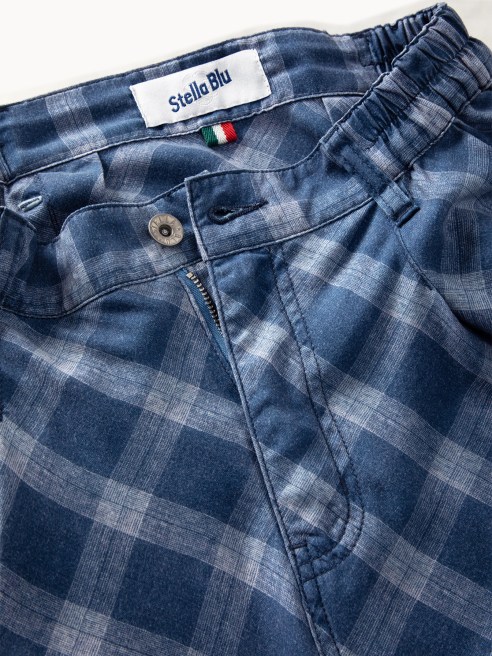
Meanwhile, indigo-dyed fabrics innovator Stella Blu has been flirting with digitalization for years. The Italian producer—a division of Prosperity Textiles—modernized its offering by installing a waterless textile coloration system called Cooltrans two years ago.
Developed by Shanghai based textile manufacturing firm NTX, the process can add color to nearly any textile without employing heat or water. Not much, at least—Cooltrans is said to cut down on water usage by 90 percent.
“By utilizing the Cooltrans technology in the production process, we significantly reduce water usage and chemical waste, making our denim production more sustainable and eco-friendly,” a spokesperson told SJ Denim.
“Our technology is particularly well-suited for use with cellulosic fabrics, especially those made from cotton and Tencel, which are key components of typical denim fabrics,” they added. “This includes both standard and stretch materials, enhancing versatility across different products.”
Though the technology opens up “a wide range of design possibilities, it represents a distinct product line that can’t be directly compared with traditional denim methods,” the group said. “Nonetheless, it excels at replicating complex wash effects, achieving a faded look similar to conventional denim but with its own unique characteristics.”
That distinct quality comes from the technology’s ability to achieve a look that traditional denim methods can’t easily match—”This includes more vibrant colors, sharper patterns, and an overall distinctive aesthetic appeal,” a Stella Blu spokesperson said. “While it might be hard to visualize without seeing it firsthand, these products offer a fresh take on classic denim looks while being more sustainable.”
The efficiencies gained through the unique printing process also help save resources, and can shave off costs.
“In terms of cost differences between Cooltrans products and those made with traditional processes, Cooltrans tends to have a competitive edge due to reduced water usage and chemical waste, which lowers environmental impact and potentially production costs,” the spokesperson said.
Currently, the group is focused on optimizing and expanding the application of Cooltrans within its existing product lines. “As for future expansions or exploring alternative printing technologies, it will depend on ongoing research and market demands,” they added.
This article was published in SJ Denim’s spring issue. Click here to read more.