Welcome to the era digital craftsmanship: where the bottlenecks emerging designers face—communicating product ideas, validating design decisions and securing buy-in before physical sampling—mirror those faced by enterprise teams. At least, according to Make the Dot, a AI-native platform streamlining fashion product development for mass and mid-market retailers.
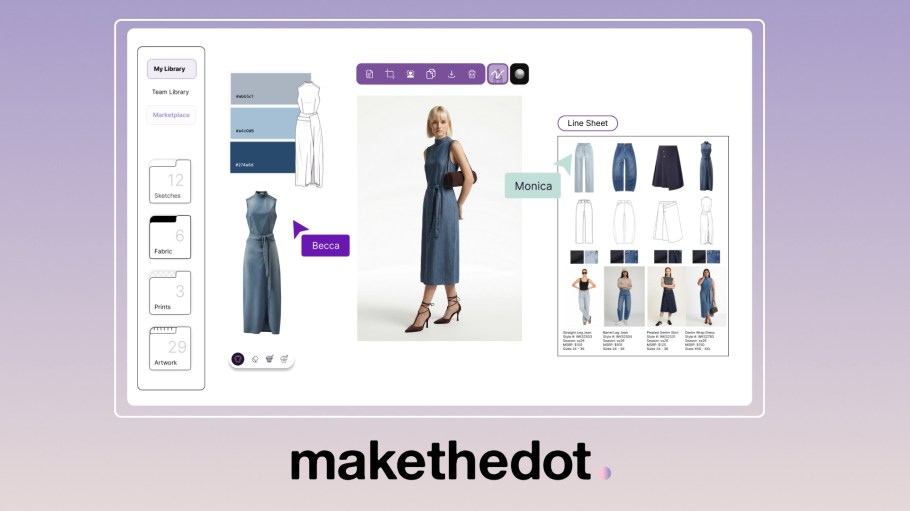
To address the industry’s emerging digital-first demand, Make the Dot’s platform brings design, development and merchandising into a single workflow—all in attempt to bridge creative intent with commercial reality. By offering earlier visibility into how products are likely to look and perform, teams can visualize line architecture and product presentation before committing to physical mockups.
Related Stories
Founded in 2022 and operating between New York and Hong Kong, the platform has been used to develop products that are stocked at the likes of Walmart and Target as well as Macy’s and Kohl’s. Positioned as a collaborative digital workspace, Make the Dot claims it can deliver up to three times faster time-to-market and reduce physical sampling by as much as 60 percent.
How? Artificial intelligence, mostly.
Those gains are driven by a suite of generative AI-enabled tools, including photorealistic rendering, digital fabric libraries and live collaboration features. The result, according to the Li & Fung partner, is a system that produces digital samples that are practical and producible—and, notably, repeatable.
“Fashion teams are under pressure to move faster, reduce waste and still deliver strong creative and financial results,” said Theren Moodley, co-founder and chief growth officer. “Our platform reflects how decisions are actually made—connecting design intent, material choices and merchandising logic in one system.”
Why? Because independent designers face the same structural challenge as large wholesale operations, according to co-founder and CEO, Emilie Ho: How to present ideas convincingly before physical production.
“A solo designer pitching boutiques with a suitcase of samples and a tailor flying across the country with fabric swatches for a single client meeting are navigating the same bottleneck that Make the Dot already solves for enterprise clients,” Ho said. “The difference is scale, not workflow.”
That question of scale is central to the company’s next test: its inaugural fashion presentation on Feb. 24 in New York City. In partnership with Supima, “Rendered In Real Life” will demonstrate just that—if (and how) the same digital architecture used by independent labels can power global retail giants.
“Supima has long been committed to supporting emerging designers by introducing them to the quality, versatility and performance of Supima cotton,” said Buxton Midyette, vice president of marketing and promotions at Supima. “Together with Make the Dot, we’re proud to support designers with strong creative voices who are shaping what’s next.”
The presentation will feature original looks from three independent labels—LaTouché, LeBlanc Studios and Lab 74 designer Alexzander Hershel—each developed using the Make the Dot platform and translated into finished garments made from Supima cotton. The exercise is intended to show how advanced digital tools can be used to iterate and pressure-test ideas while keeping material choice and craftsmanship central to the development process.
LaTouché is a Haitian-born fashion designer recognized for designing the 2021 NBA Draft look for Jonathan Kuminga and festive attire for Steph Curry. Hailing from Santo Domingo is the Caribbean brand LeBlanc Studios, a conceptual luxury label founded in 2014 by Angelo Beato and Yamil Arbaje, known for using fashion as a form of decolonial realism.
By translating digital development into finished garments made from Supima fabrics, the exercise aims to show how emerging designers are using advanced product development tools to iterate and pressure-test ideas.
“We’re excited to work with designers who are redefining not just how fashion looks, but how it’s made,” Ho said. “This presentation reflects our commitment to supporting the next generation as they adopt new tools without losing sight of creativity, quality or identity.”
Beyond industry adoption, Make the Dot has also earned acceptance in education. The platform is used in classrooms at institutions including the Savannah College of Art and Design, the Rhode Island School of Design (RISD), the Academy of Art University, Berkeley College and the Fashion Institute of Technology (FIT).
According to the company, students using the platform are three times more likely to graduate with portfolio-ready work tied to real projects. An FIT case study found that 60 percent of students earned average grade improvements of roughly 20 percent when using the platform.
“Using Make the Dot last semester led to higher quality work submitted by students,” said Mikelle Drew. “It was more cohesive, had more depth and was on the whole more professional—all of which will be expected of the students when they graduate and work for a brand.”
Nitya Devgan, a fashion design student at FIT, said that expectation is aided by the “Save to Make the Dot” extension; the tool captures, curates and organizes images from any website into any collaborative workspace.
“The best part of the platform was how easy it was to use overall and how quickly I could add content…the extension was my favorite,” Devgan said. Fellow student Anmol Bedi added that the digital moodboard helped “brainstorming and presenting my concept” and made for an “amazing experience.”
The platform’s built-in colors feature allows for color extraction without external conversions; the Fabric Library is directly linked to physical stores such as Fabscrap and Mood. By using the same tools as enterprise clients—like the aforementioned Walmart and Target—students can enter the workforce already familiar with AI-native product development.
“We created Make the Dot with fashion designers at the center of our product vision,” said Ho. “We saw that most teams spent more time fixing AI outputs than actually designing. Our goal is to deliver tools that are optimized for design teams, allowing them to go from idea to production faster.”