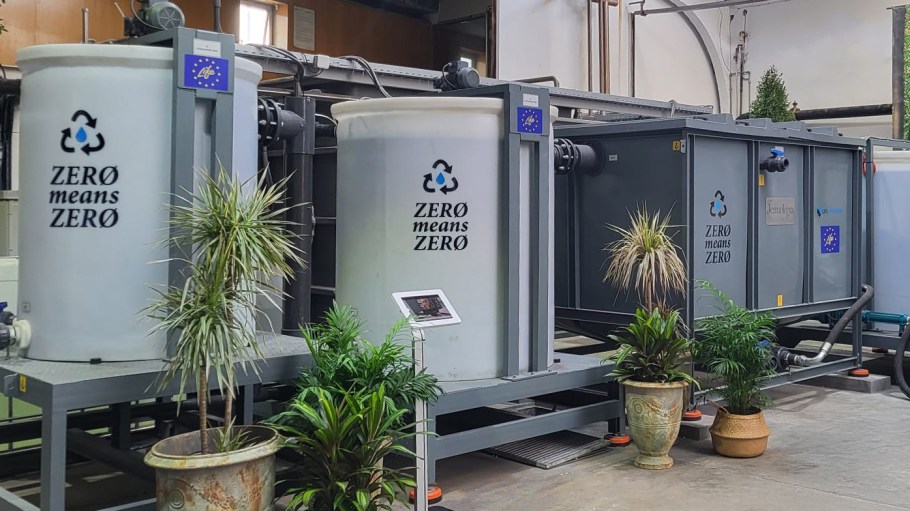
Jeanologia and partners unveiled the results of Life Anhidra, an innovative closed-loop system for treating and reusing textile wastewater. The technology addresses the estimated 93 billion cubic meters of water consumed by the textile industry annually.
Designed and built by the Spanish technology firm, Life Anhidra focuses on the garment finishing stage of textile production. The closed-loop water recycling system recovers 95 percent of the water used, returning it to the system in optimal conditions for reuse in washing and finishing processes. The process also reduces energy consumption up to 15 percent.
Related Stories
The technology is based on the early prototypes of Jeanologia’s H2Zero technology. “With Life Anhidra, we have substantially improved the system, creating the perfect water recovery and recycling plant. This innovation establishes an ecosystem to support brands and their suppliers in water management,” a company spokesperson told Rivet.
With zero discharges, zero contamination, and no complex treatments, Anhidra not only minimizes environmental impact but also reduces the operational costs associated with traditional water management, making it a competitive and eco-friendly solution, Jeanologia stated.
Additionally, the project explores how to transform fibrous fragments collected during water treatment into new textile products, reinforcing the project’s commitment to the circular economy.
“Anhidra not only transforms water management in the textile industry but also proves that sustainability and competitiveness can go hand in hand. This system sets a new global benchmark,” said Vicent Albert, Jeanologia’s product and technology director.
Jeanologia worked with AITEX, the Textile Industry Research Association and Portuguese textile company, Pizarro, on the project. Funded by the European Union’s LIFE program, the project demonstrates how business cooperation and technological innovation can provide effective solutions to major environmental challenges.
The project plans to implement Anhidra in at least 36 industrial facilities over the next three years, aiming to expand to 100 systems internationally within five years. “We have established a consortium agreement among all parties, including clients who are already interested in starting the implementation,” the spokesperson said.
The partners presented the results last month at the Pizarro facility in Guimarães, Portugal. During the event, attendees observed the various stages of the system in action at the Pizarro pilot plant. Guests were invited to exchange ideas about the technical, environmental, and economic impact of the technology.
“Anhidra represents a radical shift in how we address environmental challenges in a resource-intensive industry like textiles. It is a sustainable, efficient, and essential solution,” said Manuel Pizarro, CEO of Pizarro.