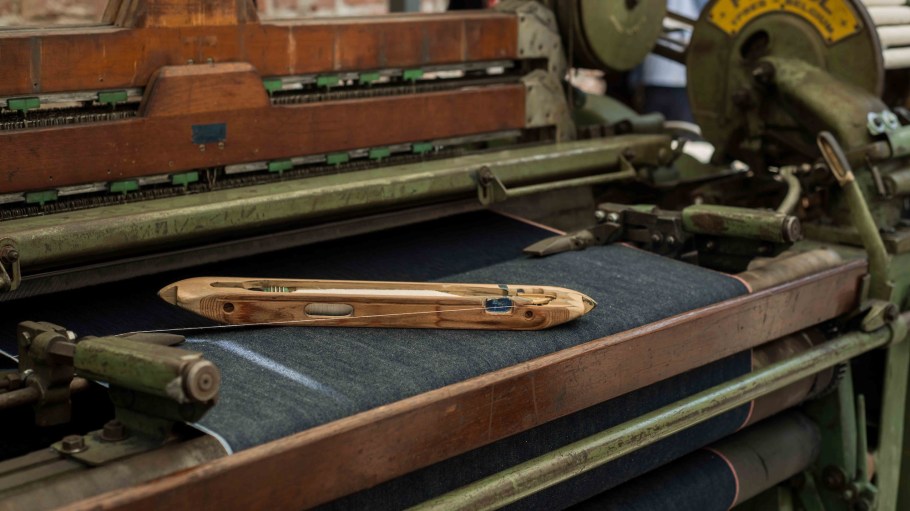
Japanese selvedge denim is celebrated by enthusiasts as the pinnacle of quality in the denim world. From Kuroki, Kurabo and Kaihara to Sanyo-Senko, Showa and Sakamoto, the fabrics from these manufacturers are praised for their quality, color and craftsmanship. At the same time, their selvedge IDs are a symbol of clout.
Japan’s distinction comes from the fact that many Japanese mills still use authentic indigo pigments, dyeing and shuttle weaving machines, said Tilman Wröbel, founder and creative director of Monsieur-T, a denim lifestyle studio.
Related Stories
“This winning combination can’t be found anywhere else, and that makes the difference to me,” he said.
Kaihara selvedge denim changed how Mohsin Sajid, co-owner of Endrime, creative director and denim historian viewed denim. In 2002 he was developing a collection for Levi’s Japan with Kaihara selvedge. “I was blown away from the quality, shade, slub pattern—even the smell. Then I slowly discovered many more Japanese denim mills [like] Kurabo, Nihonmenpu, Collect (Japan Blue) and Kuroki.”
Every fabric created on old and modern looms has a selvedge—or “self edge” which folds back onto itself, or an overlocked fluffy edge, Sajid explained. “But what’s confusing is when we say selvedge in the denim world, it indicates a fabric woven on an old shuttle loom, typically 28-34 inches wide. Most would also associate it red line selvedge linking back to quality and craftsmanship Cone Denim and its introduction of red line selvedge from 1927.”
However, Japanese mills have been developing the best selvedge fabrics since the slow demise of ‘made in USA’ selvedge around the early 1980s, Sajid said. “The lack of quality ring-spun denim versus open-end coming out of America in this period caused our Japanese friends to start developing their own selvedge denim on converted kimono looms,” he said Along with this, Sajid noted Japanese mills reintroduced natural indigo, which disappeared after the introduction of chemical indigo around 1894 and began to use organic long staple cotton varieties from Pakistan, India and parts of Africa.

“Since the late 1990s, for sure since the start of my career in 2002, the best selvedge denim fabrics have been coming from Japan. Most notable Kurabo in 1972 after seven other attempts made the famous KD8 selvedge denim,” he said.
While there’s no argument from denim heads that fabrics from these mills are among the crème de la crème, mills in other manufacturing countries are proving how the big blue world of denim is large enough for everyone to indulge in selvedge.
“We admire the high quality and refined details of Japanese selvedge denim, as well as the heritage of Italian denim,” said Simon Giuliani, Candiani Denim’s global marketing director. “Our mill is proud to be the only one still producing denim in its birthplace, using rare vintage shuttle looms to create selvedge denim. We continually update these fabrics with the latest sustainable innovations to maintain or enhance authentic denim aesthetics while minimizing the impact on the environment and society. We don’t see Italian and Japanese selvedge denim as direct competitors. They are two distinct products with unique, fascinating, and intertwined histories that should be recognized and appreciated.”
Selvedge roots
Selvedge is one reason why Candiani Denim is beloved by denim heads. Despite pioneering sustainable dyeing and stretch technologies, denim’s history is at the Italian mill’s core.
Though the fabric is commonly associated with Japan, Candiani conducted a study with the city of Genoa, Italy and historians to find out that selvedge denim originated in Italy over 500 years ago. The fabric—a 3×1 cotton right-hand twill with indigo-dyed warp—was first woven in Genoa in the 16th century. It went by the name “fustian.”
Giuliani said the fabric was initially used by sailors to cover shiploads, produce sails and eventually worn as workwear. Genoese fustian was exported throughout Europe. The word “jeans” was derived from “Gênes,” the French name of Genoa.
In 1873, the iconic 5-pocket jean was born in the U.S., as Jacob Davis and Levi Strauss patented a riveted trouser in jeans’ fabric. When U.S. brands began mass-producing jeans in the 1960s, Japanese artisans sought to preserve the quality of U.S. denim, earning the association of frontier selvedge denim with Japan, Giuliani said. Post-WWII, Japanese artisans meticulously crafted accurate replicas of U.S. jeans, valuing U.S. culture and paying close attention to detail.
“Selvedge denim, the most traditional type, is crafted using shuttle looms,” he said. “Genoese fustian was initially produced using manual shuttle looms, which later became automatic with John Kay’s invention of the flying shuttle during the Industrial Revolution in 1733. Shuttle looms produce a distinctive white edge with colored stitching in the middle—often red as it was the traditional color used by Levi Strauss & Co. However, in the 1960s, they were largely replaced by faster and more efficient projectile looms to meet the surging demand for jeans. Japanese manufacturers began producing selvedge denim in the subsequent decade to uphold the authentic denim heritage.”
Despite selvedge being ingrained in denim’s history, the fabric is a unicorn in most stores and closets.
Yardage yield is a challenge. The regular yard yield of a pair of a 5-pocket selvedge is 3.5 yards versus 1.6 yards with wide-width fabric, said Kelvin Sin, Cone Denim’s senior denim designer. The fabric also lacks flexibility for all silhouettes since the side seams must be straight.
Selvedge denim is more expensive than full-width denim due to the slower production and smaller fabric output of shuttle looms. Given the scarcity of the equipment in the textile industry, specific knowledge and expertise are essential for maintaining the looms and producing the fabrics, Giuliani said.
Additionally, he said there’s a distinct method for cutting different denim qualities. “Including the edge of selvedge denim in the finished garment, particularly in the inner seam of jeans, requires attention to detail and craftsmanship, which is becoming increasingly rare in the manufacturing process of selvedge jeans,” he said. “So, selvedge denim is definitely favored by value- rather than volume-oriented brands.”
Wröbel likens selvedge denim production to a symphony. As opposed to modern day rapier machines that weave at high speeds with value cotton, he said selvedge fabric represents a specific level of quality that can only be achieved with a traditional shuttle loom.
“What counts is the slow rhythm, the humming, the quality of the soft weave. Slower makes a better texture, nicer fabric… Extra-long cotton fibers, rope-dye with lots of dips and traditional dry pigment indigo create long lasting, durable, textured, beautiful fabrics,” he said.
Wröbel travels across Japan to find the “ultimate rare artisan” fabrics for Handz, the brand he co-owns with Themis Goudroubis. His goal is to find fabrics that can be worn for ages, fade naturally and have the qualities that are unique to Japanese denim like long fiber cotton, true indigo dye and textured surfaces. His goal is to make “true collectible denim.”
“Some collect Porsche 911s from a specific period with a specific motor sound while most car owners drive a Toyota. And some collect proper, beautiful selvedge denim while the majority wear…” he said.
Innovating history
Candiani Denim’s selvedge business fluctuates between 5-10 percent. The mill’s selvedge fabrics are available in a wide range of options. Most feature 3×1 weaves in both right-hand and left-hand twill. Dyes range from a variety of indigo shades to black and ecru. “Their authentic, vintage, loose constructions recall denim’s classic ring character, while their more compact, high-density yarn constructions create a more straightforward, clean, and sophisticated workwear look,” Giuliani said.
Additionally, he said selvedge fabrics are built into Candiani’s R&D process. The mill usually applies new sustainable innovations to selvedge fabrics first and from there to full-width denim.
Candiani’s use of selvedge as a base for R&D is one example of how mills outside of Japan are innovating the fabric.
“The best selvedge denim is not always coming from Japan anymore,” Sajid said.
“As the selvedge category evolves, more regions and mills are introducing competitive alternatives with innovations in dyeing, weaving, and finishing,” said Zeeshan Ahmed Ch, GM of product development for Pakistan-based Neela by Sapphire. “This has made selvedge denim more accessible and diverse, offering a wider range of styles from different parts of the world.”
“Japan has a distinct approach to selvedge denim, which we deeply respect. However, Isko brings diversity in color, stretch, elasticity, construction, composition, and sustainability to the table,” said Hakan Vercan, Isko category manager in selvedge.
Isko is moving the needle with performance and circularity. The Turkish mill produces selvedge products with no virgin cotton and heritage-inspired red selvedge denim with invisible stretch. “These fabrics not only offer comfort but are also enhanced with innovative coatings and responsible practices, making them both stylish and sustainable,” Vercan said.
US Denim’s selvedge denim business is operating at a capacity of 50,000 meters. The Pakistani mill’s new Roots collection uses Eco-Zero, a dye process that reduces water, energy and emissions. “The collection revives the time-honored craft of selvedge shuttle looms, blending the authenticity of natural indigo with modern advancements like lighter weights and stretch for enhanced comfort,” Ali said.
The possibilities for selvedge are expanding, he added. US Denim’s Writing selvedge has distinct detailing. Broken Twill selvedge is known for its textured pattern and durability. The mill’s Color Denim selvedge offers different color casts, not just the classic indigo. “This evolution blends selvedge’s heritage appeal with modern innovations, offering more versatility to meet a wider range of consumer preferences,” Ali said.
Sajid noted that Pakistani and Turkish mills have “caught up” with Japanese mills, by learning from the past and making denim more sustainable. “They’re picking up the baton and, in most cases, overtaken our Japanese friends in innovation in spinning, dyeing, fiber development, even down the building safety, LEEDS certification for building and worker’s rights,” he said.
Mills in China, Vietnam, and Thailand are also producing superior denim now, he added.
Sajid said it’s frustrating how more industry people don’t recognize these manufacturing companies in the name of “staying true to the trope of Japanese supremacy in selvedge denim.”
“The internet is full of specialists and trend forecast companies that mainly tell stories with an angle or agenda. Many have never visited a denim mill or know how denim fabric is created. Whenever selvedge denim is mentioned, they only seem to mention Japanese mills or the closer of Cone Denim’s White Oak,” he said.
Cone debuted selvedge denim in 1905 and still produces the fabric. “As a historical American company, we have created our own character that has influenced the denim market and our own way of making selvedge. Japanese denim mills have their own specialties and things they are known for and are best at,” Sin said.
Selvedge represents three percent of Cone’s overall business, primarily driven by small premium brands from Europe, China, and the U.S. with specific capsule collections. The mill, operating in Mexico and China, produces selvedge fabrics using hemp and recycled cotton, available in a diverse range of weights, from lightweight shirting to robust 15.5 oz. constructions.
Recently, Cone introduced selvedge fabrics featuring Colourizd sustainable dye technology, which significantly reduces water usage and eliminates harmful chemicals. Sin said this innovative process not only allows for a broad spectrum of colors and textures but also enhances efficiency and sustainability in textile coloration.
Additionally, selvedge has been the base for Cone Community, a fabric collection that aligns with different causes.
The selvedge customer
Purchasing selvedge jeans is a thoughtful and nuanced decision that reflects a deeper understanding of quality and craftsmanship. Wröbel chalks selvedge’s niche appeal up to education, adding that there is an “incredible information gap” between denim jeans and the average consumer.
“Selvedge denim means better quality, but it has been somewhat overexposed the last 10 years,” Sajid said. “The fact that you can go to Uniqlo and buy a £30-40 selvedge jean made from Kaihara from Japan made authentically with concealed rivets and chainstitch constructions in all the correct places has somehow confused buyers. When you go to specialist stores and see a £350-400 jean it for sure opens a lot of questions.”
Capsule collections are opportunities for mainstream brands to tell the story of selvedge. Last year Madewell launched two women’s collections with Kaihara, including jean styles made with selvedge. At the time of the launch Mary Pierson, Madewell SVP of denim design, said the brand’s customers are increasingly informed about mills. “We make efforts to educate them about who our partners are, highlighting the quality ingrained in our denim. We are so fortunate to work with some of the most premium denim mills in the world, and our customers recognize and value that quality,” she told Rivet.
Wrangler also bowed a collection made with remnant selvedge fabric from White Oak. The fabric, a 3×1 right hand twill, 14 oz. 100 percent cotton raw indigo with red selvedge ID, was used to create rodeo-inspired styles.
“The demand for selvedge denim is growing significantly, with more brands showing interest. This shift reflects a broader trend towards craftsmanship, quality, and authenticity in denim,” Ali said.
Call it an effect of the analog economy. “While fast fashion continues to dominate demand, there is a growing interest in vintage items like selvedge denim, similar to the resurgence of CDs and vinyl records,” Vercan said. “Consumers are becoming more knowledgeable about selvedge denim, and enthusiasts seek premium quality and uniqueness. They expect vintage, authentic selvedge garments that also provide comfort. Additionally, some customers are even customizing their garments to add a personal touch.”
The selvedge aesthetic (a.k.a inky colors and clean, raw fabrics) is gaining traction as well seen in recent collections by Zimmermann, Cinq à Sept and Monse.
Though Neela by Sapphire currently doesn’t have a machine to produce the traditional selvedge edges, the Pakistani mill utilizes a homespun technique to create a more organic, rustic feel for its selvedge fabrics. “The imperfections in this process give the fabric a unique, handcrafted, old-world charm,” Ahmed Ch said. “Additionally, we’re improving performance by adding comfort stretch to our selvedge denim, providing flexibility and a more relaxed feel while keeping the classic rigid appearance. If we make this fabric water-repellent, it will be a game-changer.”
Selvedge is highly favored by denim enthusiasts and heritage brands seeking to uphold and enrich the most genuine aesthetics. “Selvedge jeans are viewed as an investment that appreciates over time, as they get better with age, when the indigo fades by the wearer’s habits, thereby narrating their unique story,” Giuliani said. “Some of these brands exclusively utilize selvedge denim, which is often linked to superior quality and increased durability. For the same reasons, many luxury brands are favoring selvedge denim fabrics as well.”
Sajid said “an interesting shift is taking place” with most Japanese denim mills forgoing tradeshows like Kingpins that serve the broader denim market. Instead, they’re showing at more boutique shows like Denim Première Vision or taking an indirect approach through collaborations. For example, Kaihara recently partnered with Lenzing and Roica by Asahi Kasei to create a collection of stretch fabrics made with recycled fibers including selvedge.
Most work directly with brands, however. “Kaihara in Japan, from my understanding, has pretty much always gone direct to brands,” Sajid said.
Denim enthusiasts are changing their views of where it needs to come from, however. “If you spoke to me 10 years ago, I would say I only wear Japanese selvedge, then tell you an essay about how it’s made,” Sajid said.
Practical factors like price and sustainability are informing new opinions. “Now I’m a lot more conscious, and think carefully on the advancements on zero water, modern man-made cellulosic fibers like Tencel, the advancements of 100 percent recycled denim, the reintroduction of cottonized hemp and the exciting advancement—bio- and bacteria-based dyes,” he said.
A new generation of denim designers and buyers is being educated about denim mills in Pakistan, Turkey, India, Vietnam, China, and Thailand as well. “Hopefully the tunnel vision from the past is shifting away with the more conscious view that explores the wider narrative, which will help educate designers, buyers and enthusiasts. As much I love Japanese denim, the best is not always coming from Japan anymore,” Sajid said.
This article was published in Rivet’s winter issue. Click here to download the issue.