Fiber innovators took center stage at Kingpins Amsterdam, showcasing how rethinking material science can reshape the denim industry. Companies like Lenzing, Hyosung, and The Flax Company are pushing boundaries by addressing longstanding performance and sustainability challenges in fiber production.
Companies are driving innovation by pinpointing weaknesses in existing products and transforming them to meet specific application needs.
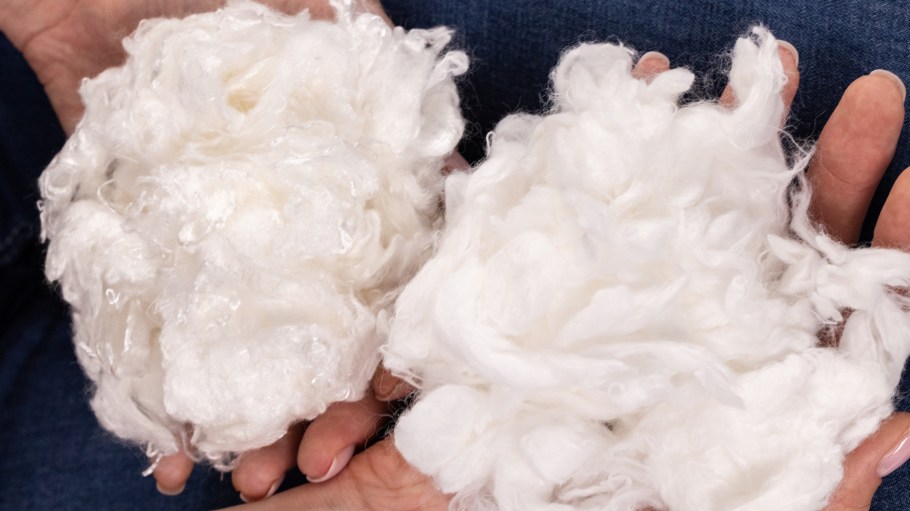
This fall Lenzing debuted Tencel Lyocell-HV100, a solution to texturize manmade lyocell so the fibers have a more natural cotton-like look in denim.
Related Stories
Whereas traditional Tencel fiber is uniform—same length, same size, same shape—Tencel Lyocell-HV100 fibers are cut various lengths. “Instead of making them all uniform, we make 50 percent of the bale 28 millimeters, like a carrier fiber, and remaining 50 percent is the variety of cut length 10 to 20 millimeters. You have some irregularity to show some character,” said Tuncay Kilickan, Lenzing’s head of global business development – denim.
With Tencel Lyocell-HV100, Kilickan said Lenzing has fixed four common issues denim manufacturers voiced about Tencel fibers.
“We’re not shiny anymore. We look like cotton. The indigo dye uptake is just like regular cotton. You don’t need to increase the recipe to get the same shade. And the wash down is just like cotton,” he said.
Though Hyosung’s Creora fiber is an oil-based product, Andreas Puchert, Hyosung’s European marketing manager of textiles, said stretch fiber solutions are in a state of transition, shifting from petroleum-based ingredients to recycled and bio-based alternatives. The company’s Regen Bio-Based spandex, a sustainable material that mitigates carbon emissions and eliminates resource scarcity concerns, is crafted from industrial corn. The company said it demonstrates performance on par with our conventional Creora products.
From 2026 onward, Puchert said the company will pivot to a sugar cane base to sustainability and performance reasons, resulting in a 98 percent bio-based material for the fiber without any compromise to fiber quality.
Eliminating the need for new machinery was an important factory for The Flax Company as it developed the cottonization process for Marmara Hemp. The process brings hemp fibers down to 35 millimeters so it can be spun in a blend on existing cotton spinning systems.
“We don’t involve any water, any chemical—nothing—just a mechanical process,” said Denis Druon, The Flax Company CEO.
Most brands integrate between 6 percent and 30 percent hemp into their blends, depending on the aesthetic and price point they aim to achieve. Druon noted that incorporating as little as 10 percent hemp can make a denim garment eligible under new EU regulations.
However, some obstacles are beyond brands’ control. For example, Druon explained that one ton of hemp straw yields only about 30 percent usable fiber. This limited yield is one of the key reasons that hemp remains more expensive than cotton, though he pointed out that The Flax Co. has the infrastructure to supply large volumes.
Brands’ willingness to invest in new fibers and technologies, on the other hand, remains the key factor in why sustainable solutions fail to scale. “The price is an issue for all the brands. It is our biggest concern,” Druon said, adding that recently a client from a large brand gushed over the benefits of Marmara Hemp but asked to make it the same price as cotton.
Druon also posed the question if the denim industry is using non-cotton fibers effectively. At Kingpins Amsterdam, he noticed how mills increased the price of fabrics with 6 percent hemp by only five cents.
“This is the questions we have with all the brands. Is it better to have 25 percent hemp in a capsule collection? Or is it better to have 6 percent more in all the collections? Personally, I’m not talking about my business. I’m talking about the real impact on our carbon footprint for just five cents,” he said.