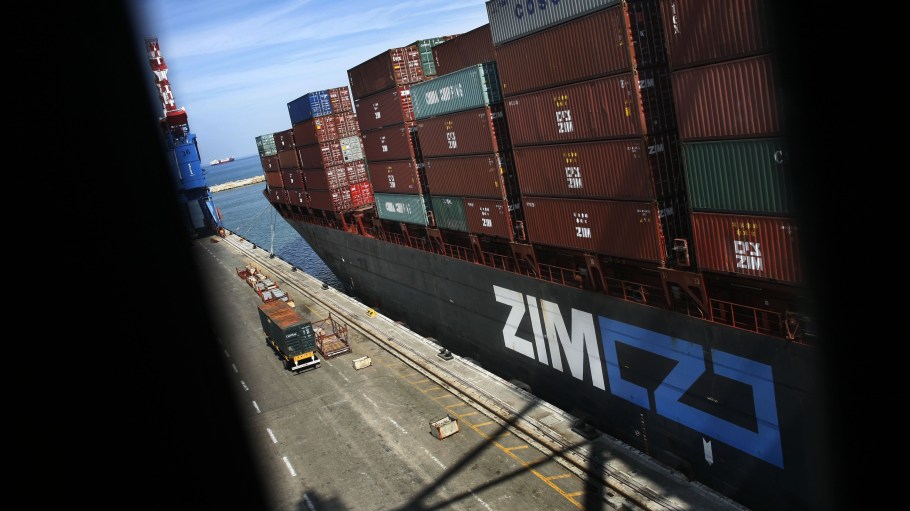
The Israeli government has warned ZIM that it could still block a sale of the container shipping company as it weighs its strategic options.
In a letter to chairman Yair Seroussi, Israel’s Government Companies Authority (GCA) expressed that “the state has the right to oppose” a potential sale of more than 24 percent of Zim’s shares, according to a report by Israeli tech publication Calcalist.
ZIM stock sank more than 5 percent after the report was published Monday, before rebounding 6 percent during Tuesday trading.
Related Stories
Although ZIM is publicly traded on the New York Stock Exchange in the U.S., the company remains subject to the “golden share” restrictions held by Israel. This provision is designed to protect the country’s interests in private companies deemed essential for national security, infrastructure and transportation, like its national air carrier El Al and oil refineries in port cities Haifa and Ashdod.
With its golden share, any transaction that exceeds 24 percent of ZIM’s issued shares would require advanced notification to the state. Israel’s government has veto powers over these transactions if it believes a deal poses a risk to national security or other state interests.
The golden share requires ZIM to keep 11 container vessels available for state use in emergencies, such as the Israel-Hamas war. At the outset of the conflict in Gaza, ZIM offered up the fleet to facilitate imports of munitions and defense cargo, and it helped keep the Israeli military supplied throughout the nearly two-year operation.
The provision also requires the ocean carrier to maintain a majority-Israeli board and an Israeli chairman.
Any sale of that magnitude would require official approval of Prime Minister Benjamin Netanyahu and Transportation Minister Miri Regev.
Galit Widerman, senior deputy director general at the GCA, penned the letter viewed by Calcalist. Widerman said any amendment to ZIM’s articles of association made without the government’s consent would be invalid, and implicitly warned against company attempts to circumvent the rights attached to the golden share.
There has never been a guarantee that ZIM would sell the company after its board of directors opened its strategic review. The board, which recently added two new members to settle a proxy fight with an activist investor, has maintained it will not issue further updates until either a deal is reached or the review is otherwise concluded.
ZIM has had multiple suitors, including its own CEO Eli Glickman, alongside reports of multiple ocean carriers showing interest.
Glickman first co-led a proposal in the summer to buy out the liner for $2.4 billion, but the board of directors rejected the move. The board then rejected a second, revised proposal from the buyout group in December, saying the offer “significantly undervalued the company.”
Hapag-Lloyd has reportedly bid on the rival carrier, while Maersk was tied to an interest in the company.
Partner ocean carrier Mediterranean Shipping Company (MSC) was initially tied to a bid last month, but the Swiss logistics giant has denied any interest in a takeover.
Hapag-Lloyd never denied the reports despite not commenting on the speculation, which set off the workers’ union at ZIM as well as other groups including Israel’s Naval Officers’ Union and its largest national trade labor group, the Histadrut.
All three unions have expressed concern that ZIM would exchange hands to a foreign entity. Hapag-Lloyd’s reported bid set off alarms due to the company’s part ownership by state-owned funds in Qatar and Saudi Arabia—two countries with historically tenuous relationships with Israel.
In late December, a regional branch of the Histadrut based in Haifa said it notified ZIM that it planned on taking strike action starting Friday in opposition to a potential foreign sale.
Leaders of ZIM’s workers union and the Naval Officers’ Union, which represents hundreds of former naval officers, met with the ZIM board in December.
“During the war, ZIM brought back to Israel hundreds of doctors who were stranded in Germany. It delivered food and medicine to the country. I’m not sure an Indian ship’s officer would agree to enter an Israeli port with missiles whistling overhead, as happened during the Iron Swords war,” Naval Officers’ Union leader Assaf Hadar told Calcalist last month.
The leadership of Israel’s National Emergency Authority (NEA) also opposes the idea of a foreign sale.