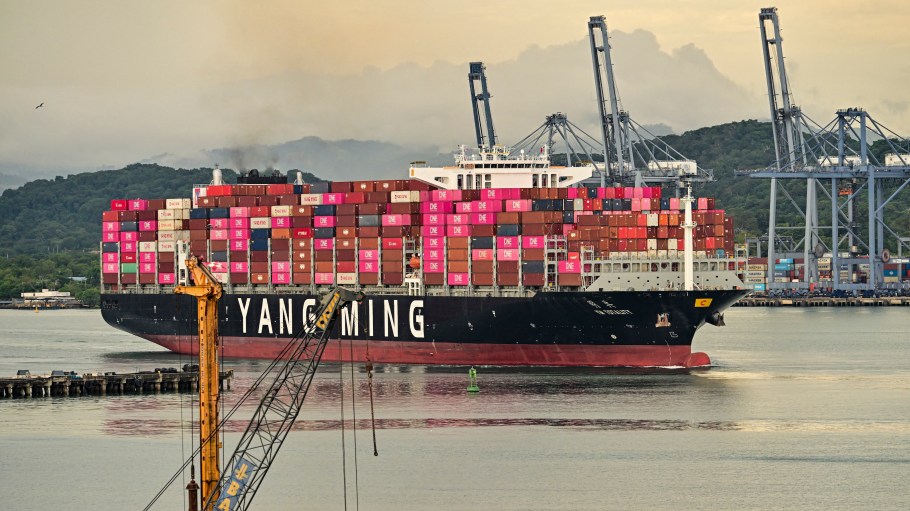
Ocean carriers that are part of the Premier Alliance are preparing to return to the Red Sea, but a full resumption of shipping through the waterway is not in the cards quite yet, according to Yang Ming president Cliff Pai.
Despite the individual trials of container shipping giants like CMA CGM and Maersk, a “true return to the area will take some time,” said Pai in a recent briefing.
Pai echoed the sentiment of his fellow carriers, indicating that safety of the crew, cargo and fleet comes first, with expectations for a return to be gradual. Additionally, the coordination of fleet schedules requires work in advance, he said.
Related Stories
“We are not looking at isolated sailings but at a coordinated, sustainable resumption of services, Pai said. Container shipping companies have largely sailed around Africa’s Cape of Good Hope since December 2023 after Yemen’s Houthis began attacking commercial ships in the Red Sea.
If smaller-scale transits resume, Premier Alliance carriers may start by transporting smaller volumes or deploying selective services to test conditions, according to Pai.
The phase-in process of any full Red Sea return is likely to further clog European ports that have already dealt with significant congestion in 2025. A six-week phase-in would boost cargo levels 10 percent across European ports compared to their peak in March, according to Sea-Intelligence data.
“If all of a sudden all the shipping routes say, ‘We’re going to go through the Red Sea. It’s all done,’ that would be chaos,” said Sal Mercogliano, in his latest What’s Going on with Shipping? YouTube update posted Sunday. “We would have three months of chaos of shipping. Ships that are on these long diversions now will be arriving in ports sooner than expected. You’ll get port congestion…it will take months to hammer out.”
The Premier Alliance, which consists of Yang Ming, Ocean Network Express (ONE) and Hyundai Merchant Marine (HMM), recently updated its East-West service network for 2026. But the network maintained that sailings would continue around the Cape of Good Hope.
ONE is the lone carrier in the vessel-sharing alliance taking a stab at a return, co-hosting a Red Sea-to-China service line under a charter agreement with smaller feeder carriers Global Feeder Shipping, TS Lines and Regional Container Lines.
Insurance costs have been a significant concern for the carriers waiting to make a full-scale return. A recent Freightos update indicated insurers would need to see two-to-three more months of no attacks in the waterway before giving a full go-ahead.
Mercogliano, a maritime historian at Campbell University, is optimistic of a wider return as the insurance situation plays out.
“What I envision is we’re going to see those highly valuable vessels probably going through that region on the return route from Europe to Asia, because it’ll be a lower insurance value, and it’s less danger to the ship and cargo to do that,” Mercogliano said.
While the shipping industry and the Suez Canal have been yearning for a wider carrier comeback, the Houthis have not ruled out resuming the attacks if a Israel-Hamas ceasefire ends.
In a Friday speech, Houthi leader Abdul-Malik al-Houthi called for heightened military readiness, asserting that the “Israeli enemy, in American partnership, is preparing for more escalation and future rounds” of conflict.
Regardless of how the geopolitical events play out in the months ahead, carriers are likely going to keep offering the Cape of Good Hope as a service option, according to Mercogliano.
“This route is here to stay,” Mercogliano said during the update, noting the expansion of ports in areas like western Africa and Brazil. “I don’t think we’re going to get rid of it.”
For now, the uncertainty clouds Yang Ming’s outlook for 2026, according to Pai. The shipping line’s president expects freight rates on both the Asia-to-Europe and trans-Pacific trade lanes to fluctuate throughout the year, but will start with a rebound into the Lunar New Year starting in mid-February.
That rebound has already been well in effect as carriers record earlier bookings ahead of the holiday.
According to Drewry’s World Container Index, ocean spot freight rates across those trade lanes have spiked for four consecutive weeks. As of Thursday, rates have popped 49 percent to $3,427 per 40-foot equivalent units on the Shanghai-to-Genoa route over the months’ span, and 19 percent to $2,584 per container on the Shanghai-to-Rotterdam voyage.
For trans-Pacific sailings, Shanghai-to-Los Angeles cargo also increased 19 percent to $2,481 on average, while containers shipped from Shanghai to New York saw a 21 percent increase in box price to $3,302.
“Shipping lines and shippers have different expectations and the picture will only be clearer at the end of the first quarter,” said Pai. “We will stay resilient and control costs by optimizing our fleet and increasing the number of our owned ships to manage high charter costs.”