West Coast port leaders and senators are sounding the alarm on tariffs levied by the Trump administration, calling them “reckless” and warning of consequences including supply chain layoffs, empty store shelves and price hikes.
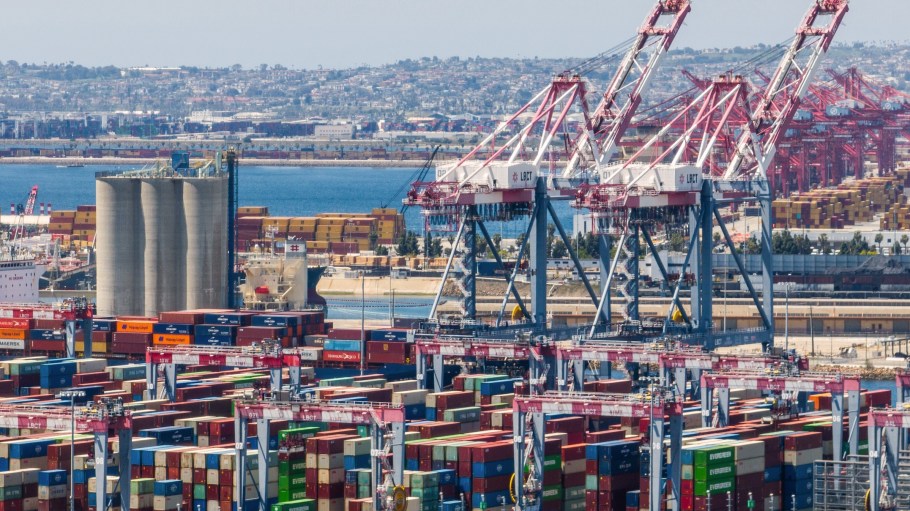
Much of the concern has derived from the expected decline in volumes at America’s largest port complex. The Port of Los Angeles expects imports to drop annually by 35 percent for the week of May 4-10, with the Port of Long Beach expecting 38 percent declines.
Related Stories
The twin ports, which handle 40 percent of the country’s imports, say they expect 59 blank sailings between May 1 and June 30. Blank sailings, when vessels cancel a call at a port, have become more of a commonality on the trans-Pacific trade lane as exports out of China continue to see a massive slowdown. On top of the blank sailings, major container vessels like Mediterranean Shipping Company (MSC) are also resorting to scrapping full services on the China-to-U.S. route amid the drop-off in cargo demand.
Fewer cargo containers unloaded from vessels bring a trickle-down effect to truckers who will be competing for fewer loads, which translates to less product on railroads and in retail warehouses and stores.
Port of Long Beach CEO Mario Cordero said during a virtual press call Thursday that despite the front-loading of goods in recent months, most shippers are “only stocked up for the next six-to-eight weeks.”
“That’s going to be depleting in a very short time,” said Cordero, who also noted that retailers have a 30-to-60-day window to get better clarity on the tariffs before they can feel comfortable about moving forward with orders for the back-to-school and holiday seasons.
The Port of Long Beach, in moving the most containers of any U.S. port in the first three months of 2025, directly supports 2.7 million jobs throughout the country, according to the CEO.
“If you’re one of the millions of Americans whose job depends on cargo moving through the Port of Long Beach—our workers in longshore, truckers, logistics workers, retailers, farmers and factory workers—any sort of long-term sustained downturn in shipments caused by the tariff will be detrimental to the job market,” Cordero said. “Companies are going to be moving less cargo and will have less work for their workforce throughout the supply chain.”
Cordero called the changing trade dynamics “a wake-up call” for consumers and “a time of radical uncertainty” for businesses.
The California ports aren’t the only hubs already being impacted from the major duties, particularly the 145-percent tariffs on Chinese goods. Also joining the call was Port of Seattle Commissioner Ryan Calkins and Port of Tacoma Commissioner Dick Marzano.
Calkins said he expects a 40 percent reduction in container volume at the Port of Seattle in the second half of May, with the volume also being reduced on a per-ship basis.
“It’s probably a pretty direct one-to-one ratio. If we’ve got a 40 percent drop in in vessel calls or container traffic, we’re going to have a roughly equivalent drop in the number of longshore hours and the number of truck trips,” said Calkins. “Keep in mind that most of those truckers are independent operators and they are paid on a per-trip basis. It’s not an hourly job, they’re paid by the trip. If there are fewer trips to make, it means fewer opportunities for their paycheck.”
The port leaders are following in the footsteps of union dockworkers across the 29 West Coast hubs, who already slammed President Donald Trump’s “reckless, shortsighted” tariffs and trade policy.
The International Longshore and Warehouse Union (ILWU) didn’t hold back in their statement, saying it “unequivocally condemns” the duties on the basis that they harm American workers and jobs, economic sectors and trade partner relations.
Representing the three West Coast states, Senators Alex Padilla (D-Calif.), Patty Murray (D-Wash.), and Ron Wyden (D-Ore.) hosted the press call to share their perspective on concerns held by their constituents.
Wyden spoke to worries from small businesses in his state.
“Every single one warned of damage from tariffs in the near future,” Sen. Wyden said. “Small businesses are 88 percent of our state’s exporters.”
The Thursday call came a day after a congressional push to limit President Trump’s power to impose the sweeping tariffs was struck down with a 49-49 vote, with Vice President J.D. Vance breaking the tie.
Sen. Murray said in response that “we need a lot more” Republican co-sponsors to potentially pass legislation.
“More of our Republican colleagues are becoming extremely worried about just what we’re talking about today, that we have decreased product coming into this country which means empty shelves and higher prices because of these trade wars,” said Murray. “We are seeing our domestic manufacturers and growers losing their markets overseas. This is very damaging to our economy. That is going to hit home to a lot of our Republican colleagues in their home states over the next month or two.”
Despite the previous attempt getting swept aside, Murray hinted at an extended push from the Democrats, saying that the lawmakers have ways to pass legislation to “put the hands back in Congress to oversee tariffs.”