The U.S. Trade Representative (USTR) is again softening more of the fees it initially slapped on international vessels docking at U.S. ports.
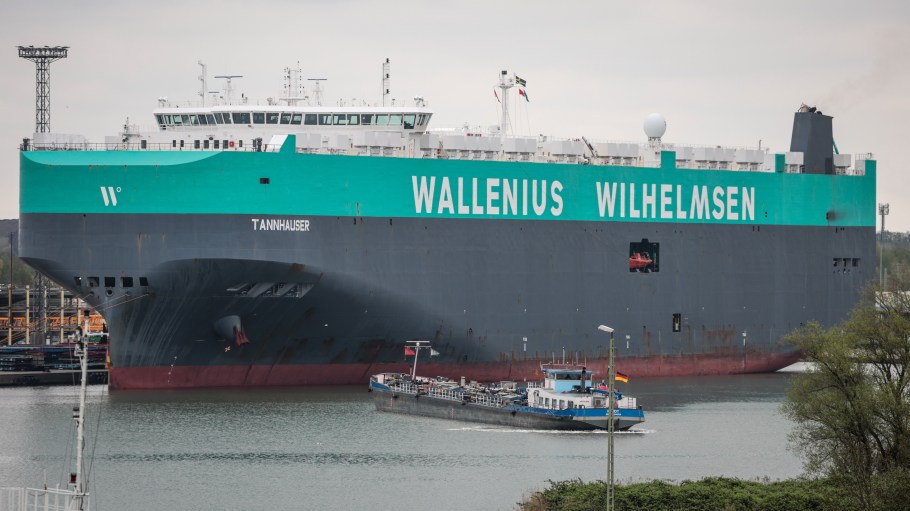
On Friday, the USTR proposed revisions that would reduce port fees for non-U.S. car carriers like Wallenius Wilhelmsen and ease restrictions on liquefied natural gas (LNG) tankers. The new rules would scrap the requirement that American LNG be transported on domestically built vessels, relieving pressure on some U.S. exporters.
Under the revisions, ships of pure car and truck carriers calling at U.S. ports will be charged $14 per metric ton, down from the previously proposed $150 per car equivalent unit.
Related Stories
With the new structure, the port fees for a 5,000 CEU car carrier—with a net tonnage of about 15,000 metric tons—would drop from $750,000 to $210,000. The USTR said in a 10-page notice that the modification was “appropriate to address administrability and in light of the potential for fee evasion.”
Additionally, LNG exporters will no longer have to commit to moving 1 percent of exports on U.S.-built ships by 2029 “in order to allay concerns about the provision’s impact on the U.S. LNG sector,” the notice read. That change eliminates a provision which would have allowed for the suspension of LNG export licenses, if not compliant.
The U.S. LNG industry was rattled the initial plan, with Charlie Riedl, the executive director for the Center for Liquefied Natural Gas (CLNG), calling the requirement “simply not feasible” in an April statement.
No U.S.-built ships are currently capable of carrying LNG.
Although these specific penalties weren’t exclusively targeting Chinese-built ships, the duties are an extension of the USTR’s Section 301 investigation into China’s maritime, logistics and shipbuilding sectors. The office determined in January that China had an “unreasonable” dominance over the industries, largely on allegations that state-owned and state-subsidized resources increase foreign dependence on the country and harm global competition.
The public comment period for the proposed modifications has begun and will run through July 7.
Fees are expected to go into effect Oct. 14.
In April, the USTR pared back its first proposal to impose port docking fees on Chinese container ships after hearing significant backlash from American industries and global shipping firms alike. That proposal called for vessels operated by Chinese companies to pay up to $1 million per port call, while operators of ships built in China would have to pay as much as a $1.5 million fee per port call.
That proposal was amended to benefit carriers leveraging non-Chinese ships, and now calls for fees based on net tonnage (starting at $50 per net ton) and number of containers carried.
For the most part, ocean carriers have indicated that they will be able to skirt the current fees. Companies like Maersk, CMA CGM and Hapag-Lloyd have said that their fleets will not incur any additional costs, as they will not deploy any Chinese-built ships to U.S. ports after the Oct. 25 deadline.
Chinese carriers Cosco Shipping and subsidiary Orient Overseas Container Line (OOCL) will have to work around the fees by replacing ships on U.S. trade lanes with fee-exempt ships operated by their Ocean Alliance vessel-sharing partners, including CMA CGM and Evergreen. The carriers could also opt to sail more fee-exempt ships below 4,000 TEUs.
Ahead of Wednesday’s tariff truce between the U.S. and China, a Chinese official took a shot at the port fees during a shipping conference in Athens.
Fu Xuyin, vice minister at China’s ministry of transport, called the port fees and tariffs a “selective implementation of discriminatory measures.”
“Port fees and tariffs…seriously disrupt the world economic and trade order and cause severe challenges the shipping industry,” Fu added at an international conference co-organized by the International Chamber of Shipping (ICS).
Despite the fees in place, it doesn’t appear that many of the major carriers have been completely deterred from placing orders for Chinese ships since the first USTR proposal back in February.
Based on analysis on data from Clarksons, between Feb. 21 and June 8, 151 out of 343 newbuilding orders were placed by shipowners in Chinese yards. In terms of “compensated gross tonnage,” a measure of work required to build a ship, Chinese shipbuilding won 48 percent of newbuild orders in the period while 52 percent went to yards in other countries.
Shipbuilding orders have slid in the first five months of 2025 compared to the record pace of 2024, with Clarksons data saying that total orders were down 55 percent.