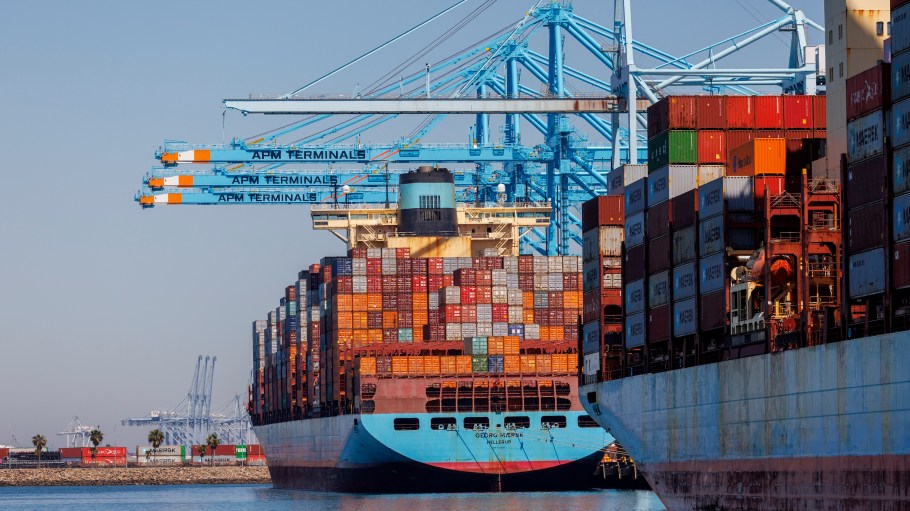
With the U.S. and China agreeing to scale back their tariffs imposed on each other for 90 days, expect cargo on the trans-Pacific trade lane to kick back up imminently—facilitating an earlier peak shipping season.
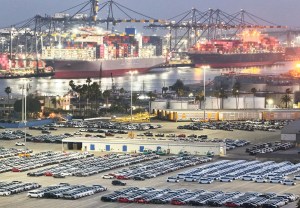
While import volumes into the U.S. cratered more than 35 percent at the San Pedro Bay port complex in early May after tariffs on Chinese goods escalated to 145 percent, with retailers cancelling bookings and carriers blanking sailings, the new agreement breathes new life into trade between both countries.
Related Stories
Lars Jensen, CEO of container shipping consultancy Vespucci Maritime, expects an immediate surge in containers exiting China, which saw exports to the U.S. decline 21 percent in April due to the tariffs.
“The 90-day pause expires in the middle of the usual peak season for holiday-related goods going to the U.S,” said Jensen in a LinkedIn post Monday morning after the announcement was made. “We should therefore expect a possible pull-forward of cargo creating a shorter, sharper, peak season from basically right now.”
Jensen noted that there is “already a large amount of cargo ready to go” due to the “wait-and-see” strategy U.S. importers have adopted over the past month. With that in mind, Chinese exporters and manufacturers have had high levels of finished goods already ready to ship.
“With the expected surge in cargo, we should also expect that the U.S. ports, which are right now facing a massive drop in cargo volume, will in three to six weeks switch to face a surge of cargo with a substantial risk of bottleneck issues and delays as a consequence,” Jensen said.
The outlook for U.S. ports through the early fall looked bleak, according to data from the monthly Global Port Tracker released Friday by the National Retail Federation (NRF) and Hackett Associates.
In May, forecasts for inbound cargo volume were down 12.9 percent year over year to end 19 consecutive months of year-over-year growth, at 1.81 million 20-foot equivalent units (TEUs).
But the TEU numbers were expected to tank even further once summer fully kicked in. June had a 20.2 percent year-over-year drop projected, while July cargo was anticipated to tank 23.4 percent.
In August, inbound cargo volume forecasts were down 21.5 percent, while September’s container declines were estimated at 21.2 percent.
According to Jensen, carriers will reinstate many of the blank sailings announced in recent weeks. Across April and May, blank sailings accounted for 19 percent of the total Asia-to-North America West Coast planned capacity, as well as 17 percent of Asia-to-North America East Coast capacity, said maritime advisory firm Sea-Intelligence.
“The question is how quickly this can be done. That depends in part on where the vessels are physically,” said Jensen. “How quickly this can happen will also determine to which degree there might be a short-term capacity shortage on the Pacific resulting in escalating spot rates.”
Peter Sand, chief analyst at Xeneta, agreed that the 90-day window would pressure shippers to move as many goods as possible in the interim, “putting upward pressure on freight rates.”
Since late March, ocean freight rates have largely remained level to both U.S. coasts, largely due to the blank sailings cancelling out the collapse in imports.
“It takes time to shift capacity back again, so a revival in volumes from China to U.S. may mean shippers have to pay a little over the odds in the short term,” said Sand in a blog post.
According to Freightos’ head of research Judah Levine, rates will rise, but aren’t expected to reach 2025 peak season levels experienced on both coasts due to new carrier alliances and fleet growth. China-to-U.S. West Coast spot freight rates reached as high as $8,121.75 per 40-foot container in early July 2024 and are now $2,395.25 as of Friday, according to the Freightos Baltic Index.
“We might not see last year’s $8,000/FEU highs due to a more competitive, well-supplied carrier landscape already keeping rates lower year on year,” Levine said.
Even if the freight rate escalation is more manageable, the American Apparel & Footwear Association (AAFA) still shared concerns of the temporarily cut tariffs’ impacts on consumers.
“If freight rates spike due to the tariff-induced shipping disruptions—which will take months to unwind—we could see costs and prices creep up even further,” said Steve Lamar, AAFA CEO and president, in a statement.
Sand also shared Jensen’s assessment that a peak shipping season, which typically lasts from August to October, would arrive earlier. But he said a resurgence in demand may be slower for some low-margin goods amid the remain tariff.
“It must not be ignored there is still a 30-percent tariff on imports from China to the U.S. and this will be prohibitive for some businesses with lower-margin goods, so there will still be an adverse impact on ocean container shipping demand,” Sand said. “It may also take shippers a little time to ramp up sourcing and manufacturing in China again if they took the foot off the gas following the 145-percent tariffs announced on April 9.”