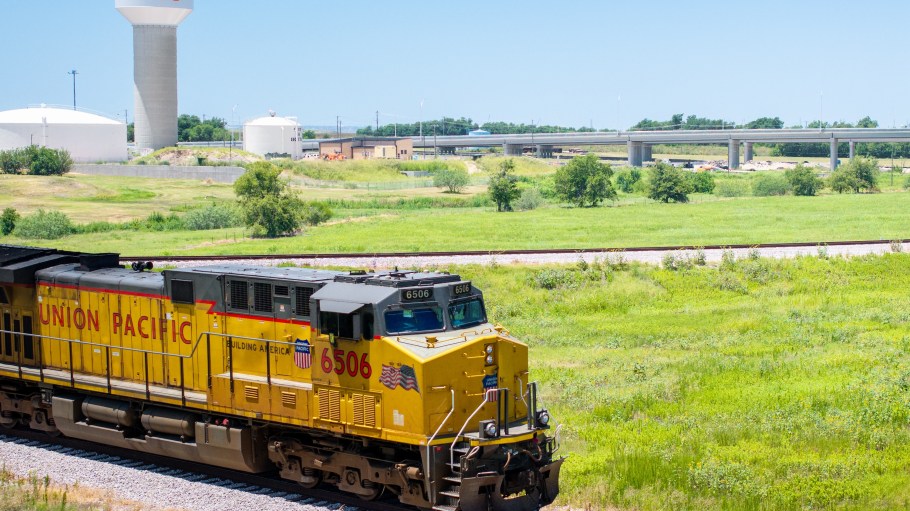
Union Pacific is hustling to file its application to merge with Norfolk Southern to government regulators well ahead of schedule.
In an earnings call Thursday, Union Pacific CEO Jim Vena said that the railroad plans to have the application ready for the Surface Transportation Board (STB) by late November or early December.
When the pending $85 billion takeover was first announced in late July, Union Pacific initially said it would submit papers to the regulatory body by Jan. 29.
Related Stories
The STB would either approve or reject the proposal within 30 days of its submission. If approved, the review process is expected to take anywhere between 12 and 18 months.
Vena said in the call that more than 400 customers of Union Pacific have written letters in support of the acquisition, “and there’s still a pipeline behind that.” Public comments were able to be submitted to the STB before Oct. 16.
Critics of the deal-in-waiting come from both shippers and rivals alike. The Rail Customer Coalition (RCC), which represents various U.S. manufacturing, agriculture and energy associations, sent its own letter to the STB in September sharing concerns over possible cost increases and service changes.
BNSF has been the merger’s largest high-profile critic, with the Berkshire Hathaway-owned railroad sharing the same worries, and calling on its own customers to make their voices heard in opposition to the deal. BNSF and CSX would be impacted the most from a competition standpoint, being the two remaining Class I railroads in the U.S. But the former has shown no interest in making an acquisition of its own, while the latter’s new CEO Steve Angel insisted that his firm will operate as a standalone company.
BNSF and CSX have taken the countermeasure of partnering up to roll out their own coast-to-coast service as a way to combat the expected transcontinental railroad to be formed by a combined Union Pacific and Norfolk Southern.
Canada’s CPKC and Canadian National have also come out in favor of more cooperative agreements instead of mergers.
But the looming acquisition also has some big backers, including the largest railroad union in the U.S.—SMART-TD—which also showed support after securing job protection guarantees for its members.
“We’ve guaranteed jobs for every unionized employee on the day that the merger closes,” Vena said in the call. “The SMART-TD agreement would just formalize what we had in place that we had already guaranteed. We are in discussion with other unions to formalize it, and I’m more than willing to formalize it.”
More importantly, President Donald Trump and other members of his administration have spoken in favor of a deal. Trump’s commentary, and some of his changes to the STB since his return to the Oval Office, have suggested that the board’s regulatory framework could be amended to make for more merger-friendly conditions.
In a note to employees posted publicly on Thursday, Vena further defended the deal, and its implications on the wider railroad industry, by singling out the trucking industry.
“The rail industry’s main competition for most of our business is trucks. Trucks do not fully compensate for their use of our nation’s highway system,” said Vena. “The upkeep of roads falls on the shoulders of U.S. taxpayers. America does not need more trucks congesting roads in large population centers. The new Union Pacific will replace those trucks with steel wheel hand-offs on the rails.”
As both Union Pacific and Norfolk Southern state their case for the merger, both railroads ended their third quarter with flat volumes on light revenue growth. Stagnant volume growth has been a wider concern among the industry, and a major justification for the merger itself.
UP saw revenue growth of 3 percent to $6.2 billion in the period, while NS revenues jumped 2 percent to $3.1 billion.
Union Pacific earned $1.8 billion, or $3.01 per share, in the quarter, marking an improvement from $1.7 billion, or $2.75 per share, a year ago. The railroad incurred merger costs of $41 million.
Norfolk Southern generated $711 million, or $3.16 per share, down 35 percent from last year’s $1.1 billion, or $4.85 per share. The figures from the two third quarters were affected by one-time issues such as merger costs, restructuring charges and insurance payments related to the East Palestine, Ohio train derailment in February 2023.