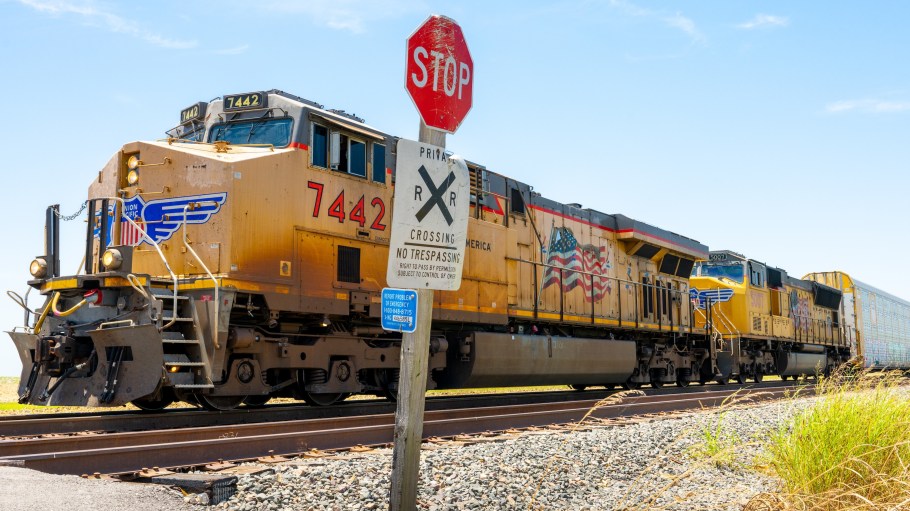
Soft demand is holding down revenue at Union Pacific and CSX.
The Class I railroads both saw annual revenue declines of 1 percent, with Union Pacific’s operating revenue coming in at $6.1 billion and CSX reeling in $3.5 billion. Both companies say poor volumes more than offset pricing gains and higher revenues from fuel surcharges.
Revenue carloads at Union Pacific fell 4 percent to 2.1 million, while volumes at CSX grew 1 percent to 1.6 million units.
Related Stories
Despite the slowed volume, net income at Union Pacific jumped 5 percent to $1.8 billion. CSX was less fortunate with a 2 percent profit decline to $720 million.
Both railroads, and their competitors, are still reeling from Winter Storm Fern, which disrupted logistics operations throughout the U.S.
In Tuesday’s earnings call, Union Pacific executive vice president of operation Eric Gehringer said that the railroad expects to be fully recovered by Thursday, with the most impacted areas in southern states like Texas, Louisiana and Arkansas 70 percent recovered from the storm.
CSX sent out its own advisory Tuesday that it was actively working to restore operations, although it did not give a time frame. Operations are stabilizing in the Southeast, while across the network, some terminals and corridors are operating at reduced capacity due to road conditions and crew availability. All intermodal terminals have reopened, while a transloading terminal in Memphis, Tenn. remains closed.
Rival BNSF Railway does not expect full recovery from the winter storm until early next week, the company said in its own customer advisory. Traffic moving across the railroad’s Southern Transcon line is expected to moderate midweek, while the rest of the network is expected to be in a more balanced position by the end of the week.
Looking ahead to 2026, both Union Pacific and CSX are guiding to a year defined more by execution and cost discipline than by a meaningful freight rebound.
Union Pacific is targeting mid-single-digit earnings-per-share (EPS) growth off its 2025 base amid volume and cost headwinds. On a three-year basis, the railroad still aims to attain an annual growth target of high-single digit to low-double-digit EPS growth through 2027.
The railroad is planning $3.3 billion in capital expenditures next year.
According to chief financial officer Jennifer Hamann, margin expansion may not be driven primarily by rate increases, noting that Union Pacific expects rail inflation to increase 4 percent in 2026. Rather, the railroad is instead leaning on productivity gains including improved asset utilization, workforce efficiency and network fluidity to support earnings expansion.
“While we absolutely believe that we will and have a plan to improve our operating ratio in 2026, we don’t think that we’re going to get any help from price,” Hamann said.
CSX offered more explicit 2026 targets, expecting low-single-digit revenue growth in 2026 based on flat industrial production, modest GDP growth and fuel and coal prices consistent with current levels.
The railroad forecasts operating margin expansion of 200 to 300 basis points. That improvement is tied directly to structural cost actions already underway, including workforce reductions, lower overtime and improving asset utilization and maintenance efficiencies.
CSX also projects capital expenditures below $2.4 billion, “a substantial reduction from last year,” said CEO Steve Angel. The company expects free cash flow to rise at least 50 percent year over year, supported by higher earnings and lower spending.
Union Pacific’s proposed $85 billion merger with Norfolk Southern is still stuck in limbo after the Surface Transportation Board (STB) rejected the companies’ filing, calling it incomplete.
“Our response will take a few weeks to prepare, and then we will refile our application as soon as possible,” said Union Pacific CEO Jim Vena in the call. “We view this as a short-term blip and do not expect a significant change to the timeline, as we are still targeting closing in the first half of 2027.”
Although BNSF doesn’t host its own earnings calls, as it is a subsidiary of Berkshire Hathaway, the railroad unveiled a $3.6 billion capital investment plan for 2026.
The company says the investments are aimed at preventing unscheduled service outages that can slow down the rail network and reduce capacity.
Roughly $2.8 billion of that funding is going to infrastructure maintenance projects. The projects will include replacing and upgrading railroad tracks, track infrastructure like ballast and rail ties and maintaining rolling stock. It will consist of approximately 13,000 miles of track surfacing and/or undercutting work, as well as replacement of 2.5 million rail ties and more than 400 miles of tracks.
Another $358 million within the plan is designated for expansion and efficiency projects, such as track expansions at its Galesburg, Ill. and Winslow, Ariz. yards, alongside developments for the planned 4,500-acre Barstow International Gateway rail facility in Southern California.