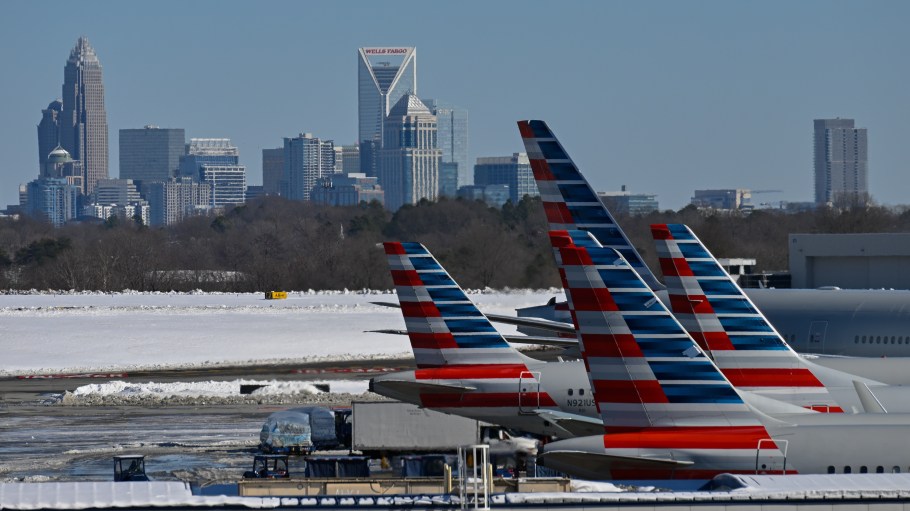
Just days after Winter Storm Fern had swept across much of the central, southern and eastern U.S., the southeastern part of the country dealt with a follow-up storm over the weekend that resulted in as many as 2,000 flight cancellations Saturday.
Winter Storm Gianna resulted in heavy snowfall of as deep as 18 inches in North Carolina, according to the National Weather Service office in Raleigh. On Sunday, the storm resulted in a massive 100-car pileup on the state’s Interstate 85. At least four deaths across North Carolina, Tennessee and Georgia were attributed to the storm, with more than 100,000 homes and businesses remaining without power, according to Poweroutage.us.
Related Stories
FedEx noted in an update released Monday that services across the Mid-Atlantic and southeastern U.S. have been impacted by the winter weather.
In North Carolina, FedEx Express is not providing service in nearly 121 ZIP codes, while FedEx Ground has no service in 426 ZIP Codes. Five ZIP codes in South Carolina are still awaiting the FedEx Ground operation to resume service.
FedEx Ground has limited service in 3,339 ZIP codes across Alabama, Arkansas, Delaware, Georgia, Kentucky, Louisiana, Maryland, Mississippi, North Carolina, Oklahoma, South Carolina, Tennessee, Texas and Virginia
All FedEx Freight facilities are operating.
UPS has the same alert it had in place after Winter Storm Fern, with both logistics giants emphasizing that contingency plans are in place to help minimize service impacts.
Winter Storm Gianna’s impacts exacerbated the chaos already inflicted on U.S. supply chains the week prior due to Fern’s breadth.
According to data from FourKites, Winter Storm Fern brought significant parts of the North American freight network to a standstill during the week of Jan. 20-26, with the supply chain visibility provider reporting national shipment volumes were down more than 55 percent week over week.
The Texas Gulf Coast saw the steepest impact, with outbound freight dropping 69 percent and inbound down 73 percent, followed by the Southeast at a 68 percent decline.
“What we’ll be watching over the next week is how quickly the network clears the backlog,” said Stephen Dyke, principal solutions consultant manager at FourKites on Friday. “Recovery typically takes several days to a couple of weeks, depending on how quickly carriers can reposition capacity—and whether another weather system moves in. This storm hit an unusually wide geographic area, which could extend that timeline.”
On-time delivery also fell sharply across affected regions, including a 14-point drop in the Mid-Atlantic, FourKites said.
Trucking and railroad companies, which often must cover lengthy transportation hauls, have felt the pain of the storms.
In a Wednesday earnings call, Landstar System said the winter storm activity could have a negative impact to first quarter 2026 business capacity owner (BCO) utilization. This metric tracks how effectively independent owner-operators who provide capacity to the trucking company use its network to keep their trucks loaded and generate revenue.
Mark Rourke, the CEO and president of trucking company Schneider National, said in a Thursday earnings call that the first quarter has gotten off to “an interesting start” due to the weather condition and the ongoing disruption.
“Customers are also feeling the impact and have large backlogs,” said Rourke. “We are beginning to see premium opportunities to help them work through the disruption.”
On the railroads, CSX has seen the biggest impact from Winter Storm Gianna, temporarily closing intermodal terminals in North Carolina before resuming operations Monday morning. According to the railroad, its southeast region is the most heavily impacted, with snow-related delays and road closures extending from Petersburg, Va. to Rocky Mount, N.C.
Union Pacific said its operations would be back to normal by last Thursday, and was unimpacted by Winter Storm Gianna. BNSF Railway, UP’s chief competitor in the Western U.S. did not expect full recovery from Fern until the start of this week.
Shippers feeling backlogs across the U.S. supply chain could take some lessons from the storms, including front-loading critical inventory ahead of known risk periods and redistributing excess stock before any other transportation bottlenecks hit, said Barry Kukkuk, co-founder and chief technology officer of demand planning software Netstock.
“Extreme weather tends to expose where inventory strategies are already under strain,” said Kukkuk. “As lead-time variability continues to challenge SMBs, with 68 percent citing shipments arriving unpredictably early or late, reactive inventory planning becomes especially risky during storm season.”