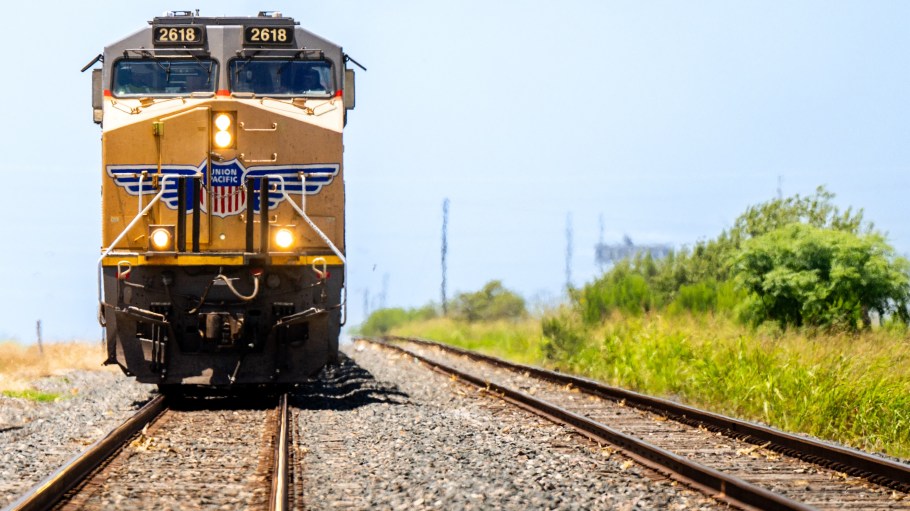
Union Pacific and Norfolk Southern are calling on the Surface Transportation Board (STB) to reject rival railroads appeals for the regulator to delay proceedings of their proposed $85 billion merger.
In a 36-page filing to the STB Friday, the two railroads insisted that their nearly 7,000-page application to the board was complete, countering recent filings from four North American Class I railroad competitors that contended the document did not include all the required information and data necessary for approval.
Related Stories
The merging railroads say BNSF Railway, Canadian Pacific Kansas City (CPKC), Canadian National Railway (CN), and CSX advanced “a number of baseless claims” when they called on the STB to reject the UP-NS application late last month.
According to the Friday filing, the board should “disregard the improper efforts of these same parties to litigate the merits of the application at this time, directly contradicting the board’s explicit instructions to” solely address whether the application is complete.
Union Pacific and Norfolk Southern sought to shoot down various claims made by the four Class Is, such as an alleged failure to provide evidence that it would both enhance competition and deliver public benefits. Those complaints say the two railroads did not address areas in the U.S. where the number of railroads would be reduced, and did not provide enough underlying data to prove that 2 million truckloads would be diverted to rail traffic.
Among a list of other concerns, the rivals claimed that the merging companies omitted some material from the merger agreement in their application. Additionally, the December filing had allegedly not contained the required information to address potential downstream effects of consolidation, and whether a merger could lead to a duopoly in the U.S.
The applicants defended themselves on all grounds, outright dismissing many of the arguments presented across the four rebuttals.
In one such defense against CSX, which claims that the applicants do not explain how single-line service enhances rail-to-rail competition, UP and NS cited the original application indicating that rail’s market share is materially greater where single-line service is available than where service is limited to interline routings.
The applicants quote CSX’s own past filings when it sought to merge with Pan Am Railways in 2021, noting that “a rail merger that creates an improved—and thus more competitive—rail alternative can also put competitive pressure on competing rail carriers to improve performance and can strengthen rail as a competitor with other modes of transportation.”
Both railroads called the arguments that they did not appropriately address downstream effects “misguided” on the grounds that applicants through the STB review process are only required to “initiate a commentary” about the impact of likely future mergers on the industry.
In their initial application, the two railroads noted that BNSF’s public statements that it did not intend to pursue a merger meant that a BNSF-CSX deal was not likely to be proposed in response to the proposed transaction.
“This plainly satisfies the rule’s requirement for applicants to ‘anticipate whether future Class I mergers are likely to be proposed,’” the filing said. “Even were BNSF to change its mind—a second transcontinental merger would not diminish the public benefits of the UP/NS merger so long as that second merger was essentially end-to-end, included competition-protecting conditions, and was undertaken with careful integration planning.”
Union Pacific and Norfolk Southern filed the joint application on Dec. 19, beginning a 30-day window for the STB to evaluate the filing before accepting or denying the request. If the board denies the application, it can seek more information or propose remedies that can later be amended by the railroads.
This occurred in May 2021, when the STB initially turned down CSX’s application to acquire Pan Am, before accepting an updated filing two months later. In November that year, the board also accepted the first filing of Canadian Pacific and Kansas City Southern to merge into CPKC, even though four rivals had called for its rejection.
With these examples in mind, the deal itself isn’t hanging in the balance based on the application. But it will determine when a formal review begins. That review would likely last more than 12 months and is expected to extend into 2027.
If the STB accepts the application as is, the board will open a 45-day window for public comments and a 90-day window for responsive applications. Responsive applications are designed for other parties to propose alternative transactions or remedies to the deal that would better serve the public interest.