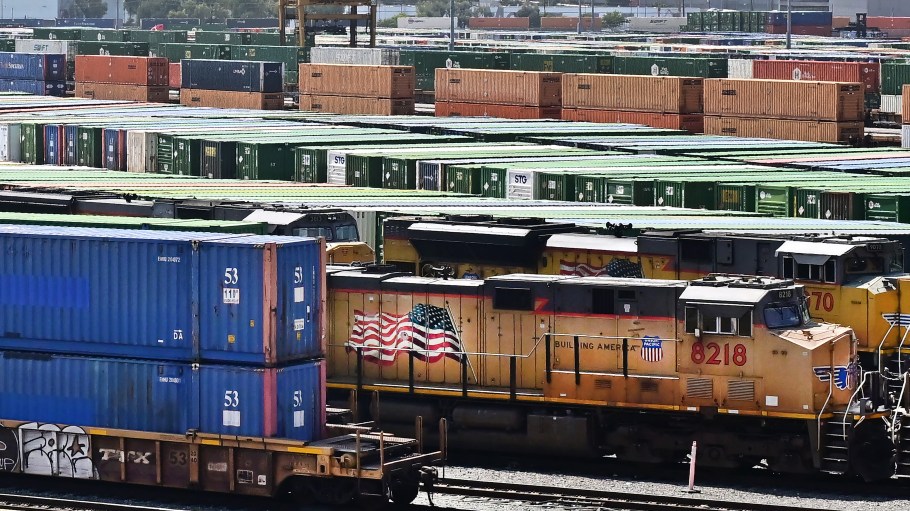
Union Pacific and Norfolk Southern filed a joint application to the Surface Transportation Board (STB) requesting approval for their proposed $85 billion merger in what would create the first modern transcontinental railroad in the U.S.
Filed in four parts, the roughly 7,000-page application states both Class I railroads’ cases for merger approval, arguing the deal would enhance competition by simplifying and standardizing pricing for shipments that must transfer between the two networks.
Related Stories
Additionally, a merger would enable railroads to compete more effectively with long-haul trucking due to the presence of a single-line service, as opposed to an interline service where interchange points can reduce service reliability.
The railroads also contend these changes would benefit the public interest, in that they would provide customers with a faster, more reliable and more efficient service.
The combined companies expect to transform “tens of thousands” of interline lanes into single-line services, and convert more than 2 million truckloads of traffic to rail annually.
“Adjustments to train routing and blocking patterns will reduce an estimated 2,400 daily rail car and container handlings and save approximately 60,000 car miles per day,” said Jim Vena, CEO of Union Pacific, during a Friday investor call. “This eliminates the unnecessary touches that can lead to incidents or delays.”
With the application now filed, the ball is in the STB’s court. The regulatory board has 30 days to decide whether the filing is acceptable, and can seek more information or propose remedies if they are unsatisfied. If accepted, there will be a 45-day window for public comments and a 90-day window for responsive applications.
The full review process is expected to extend into 2027.
The proposed acquisition has driven plenty of reaction from shippers, lawmakers and labor groups alike, with the Teamsters being the highest profile union voicing its opposition to the deal.
The Teamsters Rail Conference, which includes the Brotherhood of Locomotive Engineers and Trainmen (BLET) and the Brotherhood of Maintenance of Way Employes Division (BMWED), said in a statement that executives from both carriers “refused to make real commitments” to protect union jobs and worker concerns.
The BLET and BMWED represent nearly 20,000 Union Pacific and Norfolk Southern workers, or over half of their unionized employees.
“Union Pacific and Norfolk Southern have worrying histories when it comes to protecting workers and communities,” read the statement. “This includes causing a shocking number of accidents on the tracks, like the catastrophe in East Palestine, as well as trying to give away American jobs to Mexican rail crews. They have given us every reason to believe these problems would only grow worse if the merger is approved under its proposed terms.”
Union Pacific has reiterated that it would protect all union jobs after merger, saying “every employee with a union job at the time of the merger will continue to have one” in the press release accompanying the filing.
By the third year of the filing, Union Pacific and Norfolk Southern say they will create about 900 net new union jobs.
The railroad industry’s largest union by total membership, SMART-TD, has backed the deal after securing lifetime job protection guarantees for its members. The union represents roughly 125,000 active and retired railroad, bus and mass transit workers, and covers conductors, switchmen and ground crews among others.
“No one has ever done that,” Vena boasted during the call.
Four other unions have reached similar deals with Union Pacific, including the National Conference of Firemen and Oilers, the International Brotherhood of Boilermakers, the Brotherhood of Railway Carmen and the United Supervisors Council of America.
The assurances are significant in cities where the two railroads’ interchange points heavily overlap, including Chicago, Kansas City, Mo., Memphis, Tenn., New Orleans and St. Louis, as terminals in the area are expected to be consolidated.
Whether the STB approves the deal is still up in the air, despite the Trump administration’s apparent support.
Union Pacific’s largest competitor, BNSF Railway, said the filing does not change its staunch opposition to the deal.
In a statement, BNSF president and CEO Katie Farmer echoed earlier complaints that the railroad merger would leave shippers with fewer options that escalated freight rates and led to higher prices for consumers. She said she was confident the railroads have not met the STB’s requirements.
“This didn’t begin with customers asking for this merger, and the claimed public benefits appear to accrue primarily to shareholders. Past mergers demonstrate the risk of serious service failures with destructive impacts to customers, the U.S. rail network and the American economy,” said Farmer. “UP has a long history of making promises in past mergers that they back away from once they’ve secured approval.”
The Rail Customer Coalition, a collection of trade associations representing the manufacturing, agricultural and energy industries, also said in a statement that the merger fails to meet the STBs standards of enhancing competition. The coalition called on the board to “apply the hard and costly lessons of past mergers and reject any deal that fails to enhance freight rail competition.”
Despite the ongoing backlash, Union Pacific and Norfolk Southern collected 2,000 letters of support from stakeholders that were included in the application. Shareholders at both companies who cast votes that were 99 percent in favor of the merger.