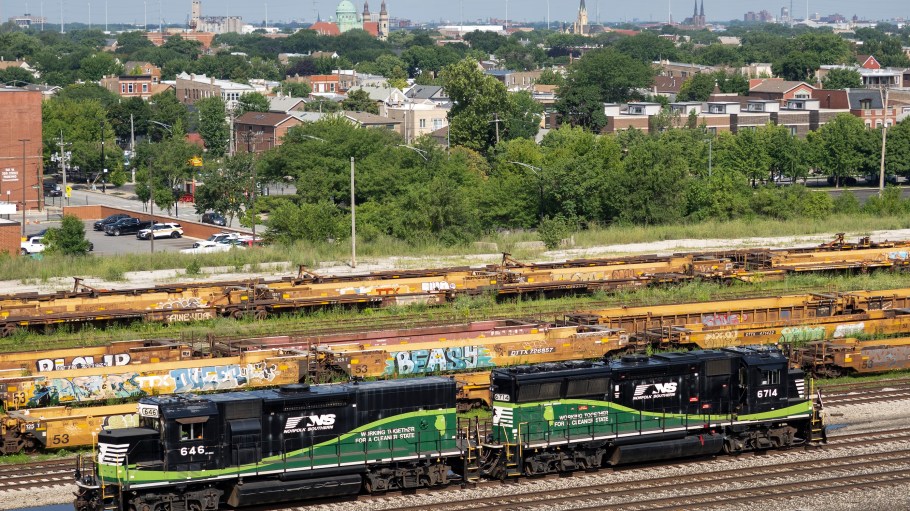
A merger for Union Pacific and Norfolk Southern wouldn’t just take a step toward creating a transcontinental railroad—it would bring the lion’s share of the industry’s intermodal container traffic under one roof.
According to data from the Surface Transportation Board’s (STB) Rail Service Metrics, 46 percent of intermodal containers shipped on a Class I U.S. railroad in 2024 rode on a Union Pacific or Norfolk Southern railroad car.
After the railroads already confirmed Thursday that they were in “advanced discussions” about a potential merger, Bloomberg reported on Saturday that a tentative agreement between them could take place as soon as this week.
Related Stories
The combination of Union Pacific and Norfolk Southern would usurp the current market share leader, BNSF. That railroad had a 30-percent stranglehold on containers across all rail carloads in 2024.
While BNSF had 5.07 million carloads carrying containers last year, Norfolk Southern filled 3.94 million, while Union Pacific had 3.75 million.
BNSF would be falling behind on both container market share, and overall carload market share (27 percent for BNSF, 43 percent for the potential merging companies).
The surfacing of the UP-NS unification talks and the fight for market share has put BNSF in a spot where its own West-East deal may make the most sense for the company.
In the wake of the initial reports of the merger, another report came out tying BNSF to a possible takeover of another railroad, with the company supposedly partnering with Goldman Sachs to prepare for a deal. While Warren Buffett, the chairman of BNSF parent Berkshire Hathaway, shot down the Goldman speculation, that hasn’t quelled chatter that CSX may be in the railroad’s crosshairs as an acquisition target.
CSX carried 2.8 million carloads with containers in them, or nearly 17 percent of total market share in 2024. Combined with BNSF’s total, a potential merger would outperform the UP-NS total container market share by a percentage point, at 47 percent.
Across all metrics, BNSF and CSX would surpass Union Pacific and Norfolk Southern for total market share across all commodity types, at 44 percent of all carloads.
The Union Pacific-Norfolk Southern fusion would lead the way in other major commodities including chemicals (49 percent), metals (54 percent) and motor vehicles and equipment (49 percent).
A day after both railroads confirmed the merger talks, the STB launched a merger resources page on its website. Under federal law, rail mergers involving Class I railroads must be formally submitted to the STB for review.
The STB’s information includes a sample timeline that depicts how a Class I railroad merger application might flow through the regulatory review process.
However, as it currently stands, even a tentative agreement between Union Pacific and Norfolk Southern would require more than a year for any final decision was approved.
Such a review starts when the railroads notify the board of their intent to merge, with applications filing their application between three and six months after that notice. When accounting for the application’s acceptance or rejection, as well as comments on the application decision, recorded filings from interested parties and a possible hearing, a final board decision would be made over a 19- to 22-month period.
After BNSF and Canadian National Railway called off their own merger in 2000, rail deals throughout the U.S. stalled out. After the companies axed the plans, the STB adopted the tougher consolidation rules, noting that future M&As would be required to enhance competition and serve the public interest.
Only one major merger has materialized in the time since. Canadian Pacific’s $31 billion acquisition of Kansas City Southern that formed Canadian Pacific Kansas City (CPKC) was finalized in March 2023, two years after the companies announced plans to merge.
This deal was largely able to go through the STB’s regulatory process due to the small size of KCS, with the merging companies remaining the smallest of the Class I North American railroads. The combination also had the fewest overlapping routes compared to if KCS merged with another large railroad.
With the Trump administration and appointed STB chair Patrick Fuchs holding meetings focused on updating the agency’s framework and reducing regulatory barriers, it remains a possibility that the timeline for a regulatory review could shorten.
As more questions come into play regarding the possible merger, Norfolk Southern is set to report its second quarter earnings on Tuesday morning.
The company recently had a major change at the top in June, indicating another shift in direction less than a year after former CEO Alan Shaw was ousted. Last month, the railroad’s board of directors appointing former Delta Air Lines CEO and executive chairman Richard Anderson as the railroad’s new independent board chair.