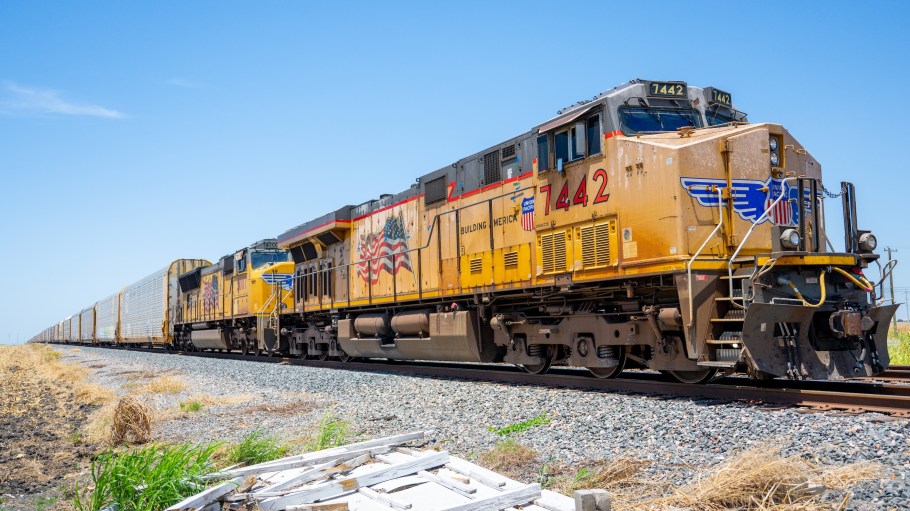
Union Pacific CEO Jim Vena stated his case that the railroad giant’s acquisition of Class I rail rival Norfolk Southern will intensify freight competition, pushing back on the idea that the $85 billion deal would narrow shipper options.
Speaking at Morgan Stanley’s Laguna Conference on Wednesday, Vena pointed to new partnerships between other major North American railroads that have been forged in the wake of the UP-NS mega-merger as an indicator that competition is firmly heating up.
Related Stories
In August, CSX unveiled a partnership with Berkshire Hathaway-owned BNSF Railway that introduced a coast-to-coast intermodal rail service expected to rival the anticipated transcontinental railroad network from Union Pacific and Norfolk Southern.
On Tuesday, CSX followed up with another announcement that it partnered with Canadian National Railway (CN) to provide a rail service for containers moving from Canada’s West Coast ports through Memphis, Tenn. directly into Nashville.
Vena contrasted a roughly 2,700-mile CN–CSX routing from Vancouver to Nashville against the 2,000-mile path UP and NS could offer, with the CEO arguing those solutions could not replicate the efficiency of a single-system railroad.
“You tell me what you think is going to be the better product as we move ahead,” he said. “I love it. “They want to compete. They’ll use price or whatever to drop their price to be able to compete with us. I think it helps us with the Surface Transportation Board (STB) about what’s out there.”
The merger will ultimately hinge on how the STB views it, with Vena acknowledging the scale of that challenge, describing the application as over 4,000 pages. But he anticipates getting approval by 2026, and that the UP team is aiming to avoid pushing the review to the maximum allowable time.
Going by anticipated timelines, the STB’s review process would expect to be completed by early 2027.
“Do I think we’re going to get it approved? The answer is yes,” said Vena. “It’s going to remove trucks. Forty percent of our business is intermodal, and it might be a little bit more when the merger happens. We’re going to be able to make sure that we can take trucks in that watershed area and convert more people to rail. We can go longer haul with the business that’s coming out of the ports.”
Norfolk Southern CEO Mark George, who also participated in a chat during the Morgan Stanley conference, shared Vena’s desire to get the deal done “as soon as possible.” George commented on the changes at the STB, with President Donald Trump designating board member Patrick Fuchs as chairman earlier this year, before more recently firing another board member that had dissented from a 2023 decision to approve the Canadian Pacific-Kansas City Southern acquisition.
“We think that the members are pragmatists, and they’ll be open and receptive,” George said.
During the conversation, Vena indicated that he met with senior officials of the Trump administration on Tuesday, without name them.
“They understand the value of what we’re proposing. They think it’s an absolute win for the country. On the revenue side, we see growth,” said Vena. “We see opportunity in the business that we have with the customers we have. We also see opportunities with that watershed, that business that we don’t have today.”
Speaking on Fox News Friday morning, President Trump indicated that he had met with Vena, saying the CEO encouraged him to pick Memphis as the next National Guard deployment during a recent conversation.
Trump did not share his opinion of the acquisition.
At the Morgan Stanley event, Vena also sought to reassure concerns about labor at both companies if the STB approves the deal.
“It’s real important for us to make sure our employees aren’t worried that we see this purely as a cost play. We see this as a growth play,” said Vena. “That’s why we guarantee jobs for every unionized person that has a job the day we announced and we get it approved.”
The CEO acknowledged natural attrition and internal redeployments were both likely outcomes of the transaction, instead of direct layoffs.
Union Pacific chief financial officer Jennifer Hamann added that the company has been negotiating with its unions in parallel to the merger. Eleven unions have tentative agreements or ratified deals, representing 46 percent of total employees and the twelfth received a three percent wage increase effective September 1.
Norfolk Southern’s chief, Ed Elkins, reinforced the point by recalling past industry service meltdowns and warning against running too lean.
“We have to have a buffer of resources so that we can absorb those supply chain shocks that are inevitable,” he said. George echoed that sentiment, adding, “When you’re too thin on resources, you can’t respond. It takes you not just months, it takes you quarters to catch up and to rebalance yourself.”