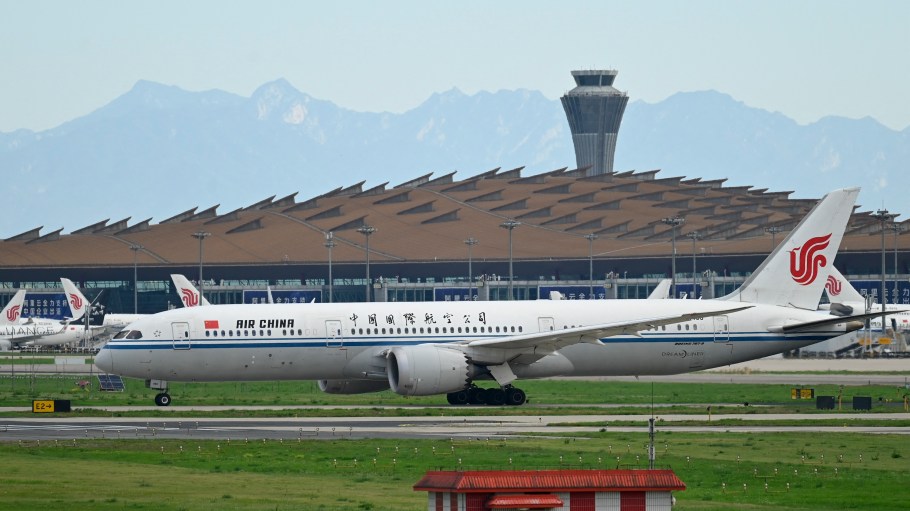
With Typhoon Ragasa’s landfall in South China last week grounding hundreds of flights in the region, the air cargo capacity crunch briefly sent rates skyrocketing on the Asia-to-Europe trade lane.
A report from supply chain publication The Loadstar, air freight rates out of China to Europe have soared anywhere between 30 percent and 50 percent in a two-week span, depending on the destination. In one instance, average rates to ship cargo on Air China and China Cargo Airlines to Amsterdam increased to $3.15 per kg, up 43 percent from Sept. 10 totals. Rates to Paris soared 49 percent to $2.89 per kg.
Related Stories
That report attributed the acceleration to both the disruption to air freight from Ragasa, and the looming “Golden Week” holiday from Oct. 1-7, when all factories and businesses shut down. Air freight rates tend to see a brief spike ahead of the holiday as goods are rushed out of China and take up more capacity.
When the storm hit South China early last week, Seko Logistics said it expected inventory clearance delays of three-to-seven days out of Guangzhou Airport, with two-to-three-day delays out of Shenzhen Airport.
On Saturday, air cargo market research firm WorldACD acknowledged the potential freight rate gains, saying in an update that anecdotal reports indicated spot rates out of China “have spiked significantly” in the early part of the week.
Freightos Air Index data indicated that China-to-Europe rates were up 2 percent in the week to $3.72 per kg, and “have been about stable since mid-July and about even with last year,” Levine said.
But the index expects an uptick to about $4 per kg, which would be a 7.5 percent increase on the trade lane. This would reflect some increased air demand due to a border closure in Poland that is disrupting China-to-Europe rail.
Air cargo heading toward the U.S. is not expected to see this kind of spike, namely since the trade route has declined in the wake of the closure of the duty-free de minimis provision at the end of August. In the time since, dozens of international postal operators paused their shipments into the country due to the lack of clarity surrounding the new policies, as well as the short time to get compliant with any of the new customs regulations.
In the week before the typhoon, overall tonnages from the wider Asia Pacific region to the U.S. ticked up 2 percent week over week, and were 5 percent higher from the year prior, according to WorldACD.
There were week-on-week rises in tonnages from some Asia Pacific markets, such as South Korea (14 percent), Thailand (10 percent), Singapore (8 percent) and Hong Kong (7 percent) to the U.S., but those mostly follow declines in the previous two or three weeks in an otherwise volatile market.
Judah Levine, head of research at Freightos, pointed out in a Thursday note that disruptions to ocean logistics due to Typhoon Ragasa could cause some short-term shift to air.
As for the impact on China-to-North America, Freightos data says prices increased 4 percent week over week to $5.44 per kg.
“More broadly, the industry continues to feel impacts from trade war-driven shifts in sourcing and demand,” Levine said. “Some reports, for example, show that as China-U.S. volumes have declined, Vietnam-U.S. capacity has doubled. Asia-Europe lanes have also seen volume growth as some manufacturers explore a ‘US+1’ strategy, with carriers likewise shifting capacity to where demand is growing.”
Air cargo carriers like DHL are contributing to the doubling of capacity out of Vietnam, with the company’s DHL Express segment adding more than 300 tons of weekly air cargo capacity to its existing flight schedules out of Hanoi to handle the increasing demand.
In the first half of 2025, DHL Express saw double-digit increases in technology-related exports from Hanoi.
“Vietnam’s role in global trade is accelerating, fueled by geographic advantages, a skilled workforce, and consistent inflows of foreign investment,” said Peter Bardens, senior vice president for network operations and aviation, Asia Pacific at DHL Express, in a statement. “It has risen as a tech manufacturing powerhouse in recent years, especially in the northern region where Hanoi is seeing a boom in high-tech exports. By enhancing our air network in Hanoi, we are reinforcing Vietnam’s role in global trade and ensuring that our customers can also capitalize on the country’s growth momentum.”