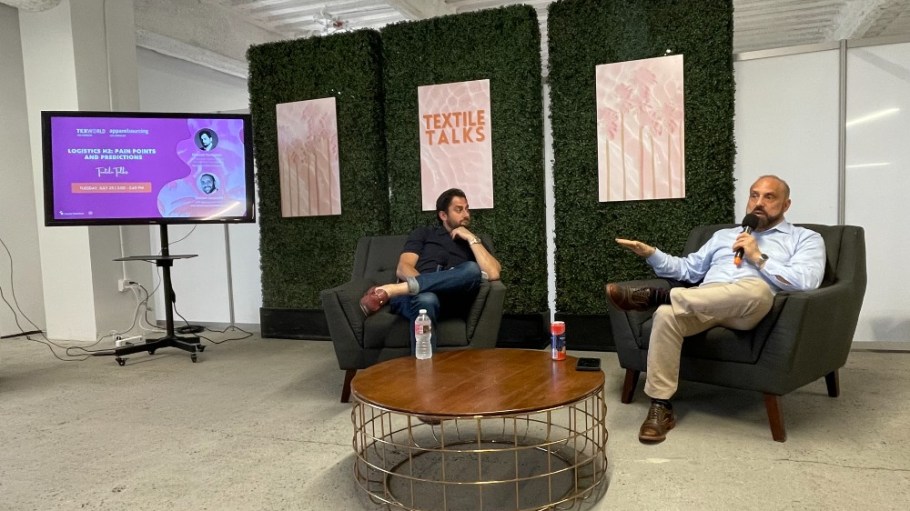
At Texworld Los Angeles this week, Hertzman Global Ventures CEO Edward Hertzman spoke with Alba Wheels Up executive vice president of growth and strategy Vince Iacopella about what to expect with sourcing and logistics in the months to come.
The container rates that soared past $20,000 during the pandemic have bottomed out, averaging $1,536.86 for a 40-foot container as of July 20, down 77.5 percent year on year, according Drewry. Everything from inflation to the war in Ukraine is making it difficult to predict what the future holds and guard against unpredictability, Hertzman said.
Related Stories
Alba Wheels Up, a freight forwarder and customs brokerage firm, has seen imports rise despite concern that last year’s famous inventory bloat would curb business. “I don’t know that we can say that inventories are lower, but what we can say is that people are producing and buying again. Importers are producing more in Asia and bringing it over,” Iacopella said.
“Regardless of what their inventory level is, there is demand for certain SKUs and [retailers] are selling leaner and smarter than before,” he added, pointing to their “targeted, surgical production of SKUs.”
“When you speak to the manufacturers overseas, there’s still a lot of capacity open, whereas a year and a half ago, there was a supply issue,” Hertzman added. Brands and retailers are looking to just-in-time manufacturing to avoid being saddled with inventory they might not be able to sell. “They’re trying to be a lot more cautious with booking things six months or nine months out,” he said.
With shipping prices at near-record lows, importing smaller batches of product more often may be a winning strategy, but companies can’t count expect these rates to last forever. “The $20,000 container was not sustainable, but neither is the $1,800 container,” said Iacopella, who sees rates settling around $5,000 per container. “You cannot build a three-to-five-year plan on $1,800 containers, or you’re going be very disappointed.”
China was another hot topic. While the country’s economy is faltering, China is working to maintain its status as a leader in global commerce, with big names like Temu, the marketplace wunderkind carrying everything from food to apparel and electronics, and fast-fashion phenom Shein, which uses the de minimis loophole to dodge tariffs, responsible for much of its image.
Iacopella said companies like Shein don’t just ship to U.S. shoppers from their factories in China—they use bonded warehouses in countries like Mexico to avoid not just the Trump-era punitive tariffs, but all customs duties. The practice ramped up during the famous supply chain meltdown of 2021. “Companies realized that they liked having inventory in the Western Hemisphere,” he said.
“They’re legally taking advantage of Section 321, and probably not paying $2 billion in duties,” Hertzman said of China-based exporters. Customs and Border Protection (CBP) is struggling to enforce the Uyghur Forced Labor Prevention Act (UFLPA) since it became law in June 2022. While still subject to the law—which bars products made in Xinjiang from entering the U.S. on the rebuttable presumption that they’re made with forced labor—parcels shipped directly to shoppers under the de minimis law are harder to trace.
U.S. companies doing business with Chinese suppliers often run into problems when their shipments are detained. “From what I can see, if your goods get stopped, the likelihood they’re getting released very quickly is low—they’re as good as gone,” Hertzman said. That’s because there’s no one system in place to prove the origins of goods made in China. Providing purchase orders and similar documentation isn’t “moving the needle” for companies, Iacopella added, recommending that they instead invest in machine learning and artificial intelligence tools to track and trace their goods throughout the supply chain.
Earlier this year, Alba Wheels Up partnered with Measur.io, a technology company recommended by CBP that focuses on supply chain traceability. Its Earthstream platform integrates a brand’s unique data with open-source intelligence (OSINT) related to raw materials availability, disruption, supplier practices and more to identify risks and ensure compliance.
“It has to be an automated solution,” Iacopella said, urging brands sourcing from China to get out ahead of the issue before they run into problems at the U.S. border. “This is not a big company problem. It’s an any size company problem.”