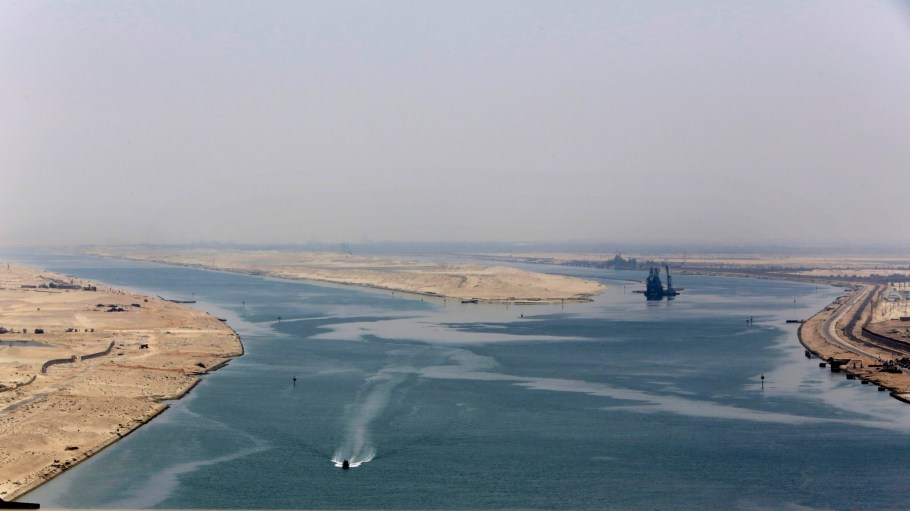
The yearlong attacks on commercial ships in the Red Sea are continuing to take their financial toll on the Suez Canal and the Egyptian economy.
According to a statement from Egypt’s presidential office, revenues for the Suez Canal declined more than 60 percent in the 2024 calendar year, amounting to nearly $7 billion loss for the country. The office did not provide total figures, or tonnage numbers.
Admiral Ossama Rabiee, the chairman and managing director of the Suez Canal Authority, briefed President Abdel Fattah El-Sisi on the news Thursday.
Related Stories
In July, at the conclusion of the 2023-2024 fiscal year, revenues had fallen 23 percent to $7.2 billion from $9.4 billion the year before.
The statement said the meeting between El-Sisi and Rabbie also touched on ongoing projects to modernize the Suez Canal’s navigation route, which are still active despite the continued missile and drone attacks from Houthi militants based in Yemen.
One project aims to expand a 30-kilometer (18.6-mile) navigation route to allow for larger vessels, while another looks to duplicate a 10-kilometer (6.2-mile) channel to help increase cargo volume and speed up the movement of vessels in both directions.
Vessels traversing the Red Sea and Bab el-Mandeb Strait have endured the attacks since last November, forcing major ocean carriers to avoid the area. In November 2024, 115 container vessels passed through the Suez Canal, a full 72 percent drop from the 422 that passed through in the year-ago month, according to data from supply chain visibility platform Project44.
In the time since, ships have instead diverted their primary East-to-West route around southern Africa’s Cape of Good Hope, which typically adds on anywhere between seven and 14 days to a voyage. Shipments from Southeast Asia to the U.S. East Coast have a 47 percent increase in transit time and a 33 percent increase to Europe, Project44 says.
A December earnings call for J.Jill revealed that the women’s specialty retailer still ships goods approximately one week early to offset delays related to the rerouting of shipping away from the Red Sea. Earlier in the year, many apparel brands, particularly those directly on the Asia-to-Europe route, like Adidas, Inditex and Next, noted they had been experiencing similar shipping delays.
The mass rerouting has sent ocean freight rates soaring throughout 2024, peaking at $5,927 per 20-foot equivalent (TEU) on July 18, according to Drewry’s World Container Index (WCI). As of Dec. 19, the WCI across eight major trade lanes was $3,803 per TEU, skyrocketing 129 percent from the year prior. As is likely the case of many brands, Guess said in a November earnings call that it expected freight costs to still be impacted by the Red Sea crisis into the fourth quarter.
These costs are likely to increase as more imports continue to be rushed into the U.S. ahead of a potential East and Gulf Coast port strike, President-elect Donald Trump’s inauguration and Lunar New Year in late January.
Although Asia-to-Europe rates had recent declines in December, “carriers will attempt to push rates up further on mid-month general rate increases (GRIs) as Red Sea diversions drive shippers to move pre-Lunar New Year orders early, with some congestion at East Asian container hubs already being reported,” said Judah Levine, head of research at Freightos, in a December freight update.
For now, major ocean carriers like Maersk and Hapag-Lloyd have dedicated their new Gemini Cooperation vessel-sharing network to exclusively taking the Cape of Good Hope route upon its Feb. 1 launch, spurning the Red Sea due to the ongoing safety concerns.
At this point, most container shipping giants haven’t committed to returning to the Red Sea other than by the typical case-by-case basis that many of the liners have adapted to. Mediterranean Shipping Company (MSC) initially said its new standalone service would return to the Red Sea in 2025 by offering both a Suez Canal and a Cape of Good Hope option. The Switzerland-based carrier has not given an official update on whether it will scrap the return.
As the Red Sea uncertainty continues, it appears the scope of the Houthi attacks has widened. As well as assaulting ships, the Iran-backed designated terrorist group is now firing drones and missiles on Israel. On Thursday, Israeli air forces struck multiple Houthi-linked targets, including Yemen’s Sanaa International Airport, and hit military infrastructure at the country’s ports of Hodeidah, Salif and Ras Kanatib.