More than a year after Yemen-based Houthi rebels began an onslaught of missile and drone attacks on commercial vessels sailing through the Red Sea, the U.S. Navy is still fending off attempted strikes in the region.
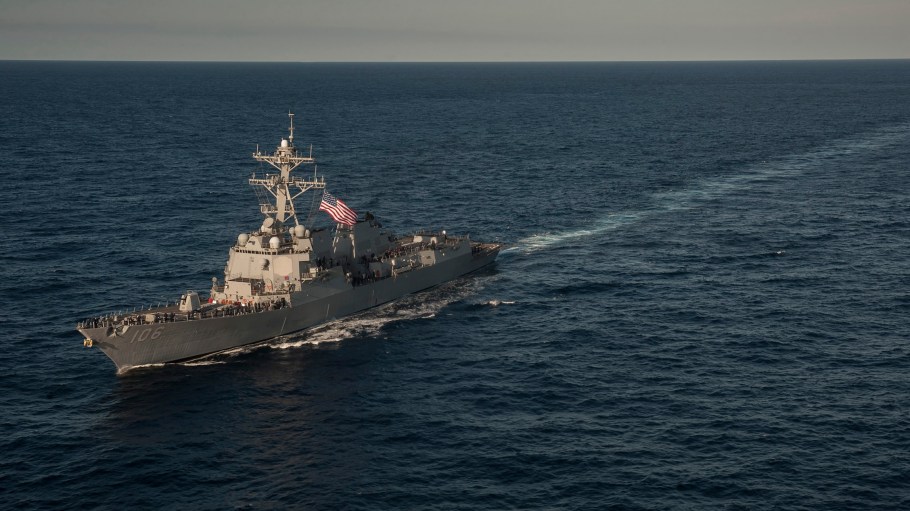
U.S. Naval ships successfully resisted two instances of Houthi-launched attacks in the Gulf of Aden in a two-week span. The two destroyers, USS Stockdale and USS O’Kane, defeated a range of weapons launched at them, once during a Nov. 30-Dec. 1 transit bound for the Port of Djibouti, and again during a Dec. 9-10 voyage departing from the port.
Related Stories
In both attacks, the Stockdale and O’Kane were escorting three U.S. owned, operated and flagged merchant vessels, according to statements from U.S. Central Command.
The attacks on the ships resulted in no injuries and no damage to any vessels, civilians or U.S. Naval members.
Overall, there have been 136 attacks on commercial vessels since last November, according to data from the Armed Conflict Location and Event Data Project, a crisis monitoring organization. The attacks have lingered for so long that American Apparel & Footwear Association (AAFA) president and CEO Steve Lamar recently penned a letter to President Joe Biden calling on the federal government to bolster efforts to protect commercial shipping in the conflict-ridden waterway.
The Iran-backed militant group has claimed the attacks will be maintained until Israel ends its war with Hamas, although many incidents have had no ties to Israel or its allies.
Ocean carriers at large have still not committed to bringing container vessels back to the Red Sea until safety in the waterway is guaranteed. The most public stance has come from Gemini Cooperation partners Maersk and Hapag-Lloyd, which are officially debuting their new vessel-sharing alliance on Feb. 1 without returning to the Suez Canal.
Maersk has said separately that it doesn’t expect to return to the Suez until “well into 2025,” but at this point, industry analysts seem to believe any timetable is anyone’s guess. Maritime research consultancy Drewry isn’t expecting full-scale Suez Canal transits to resume until 2026.
According to data from supply chain visibility provider Project44, 115 container vessels passed through the Suez Canal in November, a full 72 percent drop from the 422 that passed through in the year-ago period.
As the Red Sea crisis carries on, container ships at large will continue to take the long route around southern Africa’s Cape of Good Hope, which is tacking on an average of seven to 14 days of travel time and roughly 3,500 extra nautical miles.
Shipments from southeast Asia to the U.S. East Coast now take 47 percent longer, says Project44, while shipments to Europe take 33 percent more time to arrive. Transit times from China to Europe have risen by 25 percent.
These container lines are burning through emissions for the effort. Supply chain consulting firm Inverto calculates that the Red Sea crisis has led the industry to pump out an extra 35.7 million metric tons of carbon dioxide in the past 12 months, equivalent to the emissions of 7.8 million cars.
While Hapag-Lloyd benefited from 5 percent more cargo volume in the first nine months of 2024, the longer voyage distances increased the liner’s total fuel consumption by more than 17.5 percent.
Maersk saw the same 5 percent boost in loaded volumes for the nine-month period, along with 15.7 percent more fuel consumption.
According to Hapag-Lloyd chief financial officer Mark Frese in a November earnings call, the company’s fuel costs increased following the inclusion of the shipping sector into the E.U.’s emissions trading system (ETS).
Under Europe’s ETS in 2024, ocean carriers are being taxed on 40 percent their carbon emissions. That number will increase again to 70 percent in 2025 and will jump to 100 percent by 2026.
Frese said costs from the EU ETS get passed on to customers at a separate surcharge of $8 per 20-foot equivalent unit (TEU).
Passing on these costs to consumers via surcharges is ultimately how carriers will be able to navigate such rapid year-over-year increases in added taxes.
Ironically, container shipping firms have been the biggest beneficiary of the Red Sea crisis due to the ensuing elevation in ocean freight rates throughout 2024. As of Dec. 5, ocean spot freight rates have soared 142 percent to $3,533 per 40-foot container, according to the Drewry World Container Index (WCI).
According to container shipping expert John McCown, the industry generated a total net income of $26.8 billion in the third quarter, up a whopping 856 percent from the $2.8 billion profit raked in during the year-ago period.