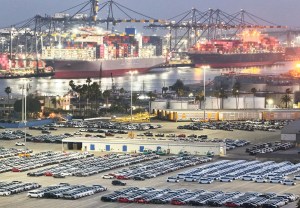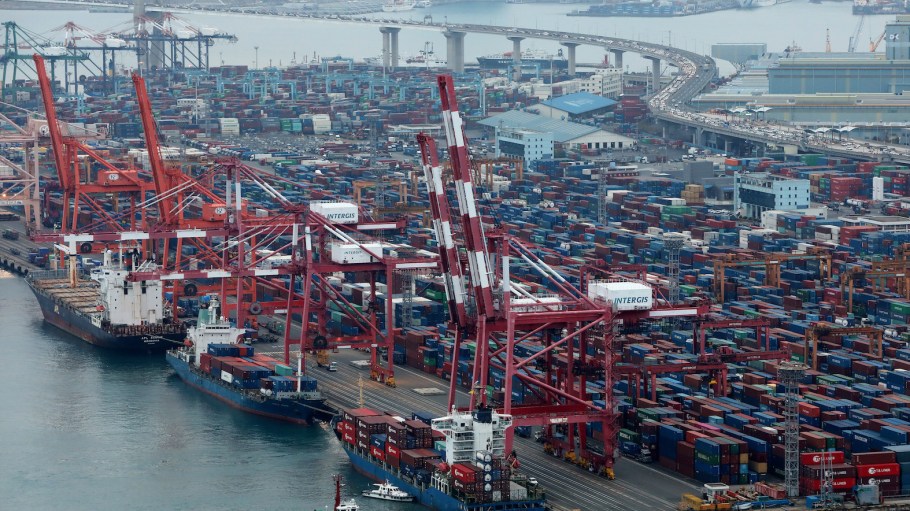
As container shipping giants continue to reroute their vessels away from the conflict-ridden Red Sea, government agencies across Asia are looking to help local exporters secure more space as container capacity tightens up.
In South Korea, the country’s Ministry of Ocean and Fisheries (MOF) said earlier this month that it would preemptively secure freight space at shipping operators to minimize the impact of the Red Sea disruption on exports and imports.
The government branch said mainline operators would reserve 400 20-foot equivalent units (TEUs) of spot capacity on each Asia-to-Europe route, prioritizing SMBs. Another 1,040 TEUs of capacity would be guaranteed for cargo owners seeking to enter long-term contracts, the ministry said in a statement Friday.
Related Stories
MOF would provide alternative ships for auto exports, as well as additional storage yards, since the auto sector is expected to face the biggest disruption.
South Korea secured the use of four container ships for North European and Mediterranean routes running from mid-January to early February, the ministry said. Container shipping giant HMM would deploy the extra ships, with one 11,000-TEU vessel scheduled for the Asia to Northern Europe route and three more between 4,000 and 6,000 TEUs prepping for the Asia to Mediterranean trade lane.
“We’re continuing to provide support to ensure there are no disruptions in domestic outbound and inbound logistics,” said oceans and fisheries minister Kang Do-Hyung in a statement “We have an emergency response for all possible scenarios.”
Meanwhile, Vietnam’s Ministry of Transport instructed the Vietnam Maritime Administration to help exporters by negotiating with liner operators to increase connections between Vietnam, Europe and the U.S.
The Maritime Administration also was tasked with asking carriers to justify the accelerating freight rates on European and North American services. The administration estimated that long-haul rates out of Vietnam had gone up roughly 60 percent since December.
Rates per 40-foot container are approximately $2,650 for Vietnam to the U.S. West Coast, $3,900 for Vietnam to the U.S. East Coast and $4,900 for Vietnam to Europe, according to the agency.
Additional measures include encouraging carriers to return empty containers to Vietnam and simplifying customs clearance procedures for export and import cargo.
Vietnam’s ministry is making its decisions as more shippers are turning to ship cargo out of the country via air freight.
Air cargo volumes from Vietnam to Europe surged 62 percent in the week ending Jan. 14 from the previous week, and rates increased 10 percent, according to Niall van de Wouw, chief air freight officer for air and ocean freight rate benchmarking platform Xeneta. Volumes are 16 percent higher than 12 months ago.
“Routes from Vietnam to Europe are used heavily for apparel, a sector we have been told is switching more goods from ocean to air due to the Red Sea crisis, so it is particularly noteworthy we are seeing volumes increase to such an extent on this trade,” said de Wouw. “We should also recognize that the upcoming Lunar New Year may also be contributing to the increase in volumes.”
The efforts come as volume remains tepid throughout the Red Sea and its chokepoint, the Bab el-Mandeb Strait, occurring due to lingering attacks from Yemen-based Houthi militants on commercial vessels.
Volume in the Suez Canal for the week of Jan. 14-18 fell 68 percent to an average of 4.7 vessels per day compared to the 15 vessels per day that passed through prior to the Houthi attacks, which began in mid-November.
The number is up from the week prior’s average of 3.4 vessels daily, according to data from supply chain visibility platform Project44.
As of Tuesday, Project44 is estimating 345 vessels have rerouted around Africa. Two other vessels are opting to drift, meaning they are staying stationary and trying to wait out the conflict.
Carbon emissions jump on longer routes
In a recent release, maritime consultancy Sea-Intelligence said diversions around southern Africa are on average 31 percent longer for the Asia-to-Northern Europe route, and 66 percent longer for the Asia-to-Mediterranean route, respectively—meaning carbon dioxide (CO2) emissions will increase by these factors, at minimum.
Since the rerouting is going to add more mileage to the trip, container vessels are likely going to sail at a faster pace. Increasing speed by just one knot along the new route would likely burn CO2 at a 14 percent quicker clip.
On a TEU-basis, some smaller, less fuel-efficient vessels see an increase in carbon dioxide emissions of 141 percent, compared to conventional ultra-large container vessels.
When combining the components, Sea-Intelligence says the CO2 emissions could increase 260 percent for the Asia-to-Northern Europe vessels, and 354 percent for Asia-to-Mediterranean vessels.