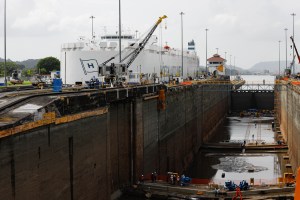
A potential return to the Red Sea for ocean carriers could be looking less likely if the Israel-Hamas ceasefire comes to an end.
In response to Hamas’ suspension of the release of Israeli hostages held in Gaza since Oct. 7, 2023, Israel Prime Minister Benjamin Netanyahu warned Hamas that the country would end the ceasefire if the group does not return the captives by Saturday. President Donald Trump followed that up by threatening that “all hell is going to break out” in the region if all the remaining hostages are not released this week.
Related Stories
Since December 2023, container ships have largely avoided the waterway and the neighboring Gulf of Aden due to ongoing missile and drone attacks from Houthi militants based out of Yemen. The Houthis had begun the onslaught on commercial vessels the month prior in response to the conflict between Israel and Hamas.
The January ceasefire didn’t seem to have the container shipping industry convinced that a Red Sea return was feasible just yet, even as the Suez Canal Authority claimed it expected “further stability” in the coming weeks. Authority chief Osama Rabie said Monday that if a ceasefire holds up, that the Egyptian waterway would gradually return to normal by late March and fully recover by mid-year.
There haven’t been any incidents since the Iran-backed group announced a cessation of the attacks last month, but the number of vessels sailing through the Gulf of Aden remains unchanged, according to the Joint Maritime Information Center, which collates information on the militants’ attacks from multiple navies.
Maersk CEO Vincent Clerc shared the sector’s wider concerns about a safe return in the company’s earnings call on Feb. 6.
“We need to be sure that it is not only safe today, but that we won’t have to go back a few months later because a certain situation has reignited,” Clerc said. None of the major shipping lines have committed to a full-scale return in the time since.
At the Manifest supply chain and logistics conference in Las Vegas on Monday, container shipping expert and Vespucci Maritime CEO Lars Jensen called the Red Sea crisis one of two parameters that will determine 2025 ocean freight rates—with the other being the current phasing in of the new ocean carrier vessel-sharing alliances.
“A lot of the networks are turmoil right now, as we expected. That’s not unusual. We always see seasonal [rate] declines after Chinese New Year, but it’s also sharper than what we would normally expect, and I expect that to continue for a little while longer, as carriers try to hold on to the market share,” said Jensen during a panel. “If the Red Sea crisis continues, we’re going to see rates rebound when we get into late spring, early summer, into peak season. We won’t see them reach the same extreme peaks as we saw back in 2024 because now we still got more capacity coming in, but they will still be solid rates, absolutely for the carriers coming into the season, if the Red Sea persists.”
Spot freight rates have largely fallen off since the 2024 peak season. As of Feb. 6, the Drewry World Container Index (WCI) decreased 3 percent to $3,273 per 40-foot container across eight major East-West trade lanes analyzed. This is down 45 percent from $5,937 per container as of July 18, 2024.
Jensen said if the Red Sea situation got resolved, that it would create massive congestion problems at European ports, and some congestion on the U.S. East Coast, “but a lot less.”
“You’re going to have a period where you might see spot rates start to decline, but at the same time, the carriers will very likely introduce a lot of congestion surcharges,” Jensen said. “You could be in the peculiar situation that you might see the spot rate indices decline rapidly and assume rates have gone down because these congestion surcharges might be interpreted not as ocean-related charges, but as land-related charges, and therefore not captured in the spot rate indices out there.”
Once the congestion alleviates, which would still take several months, Jensen said spot rates will decline more rapidly to Q4 2023 levels due to the overcapacity of ships at sea. He noted that the rates which drop to “loss-making levels,” for one or two quarters, forcing ocean carriers to pull capacity out of the market and even begin scrapping older ships.
“Rates will then rebound to a level that is probably reasonable compensation for the carriers, which will be higher than what we were doing pandemic, but nowhere near the extreme highs that we’ve seen in the last year,” Jensen said.