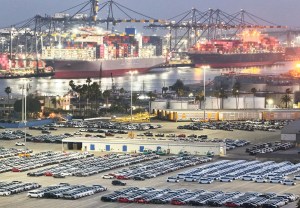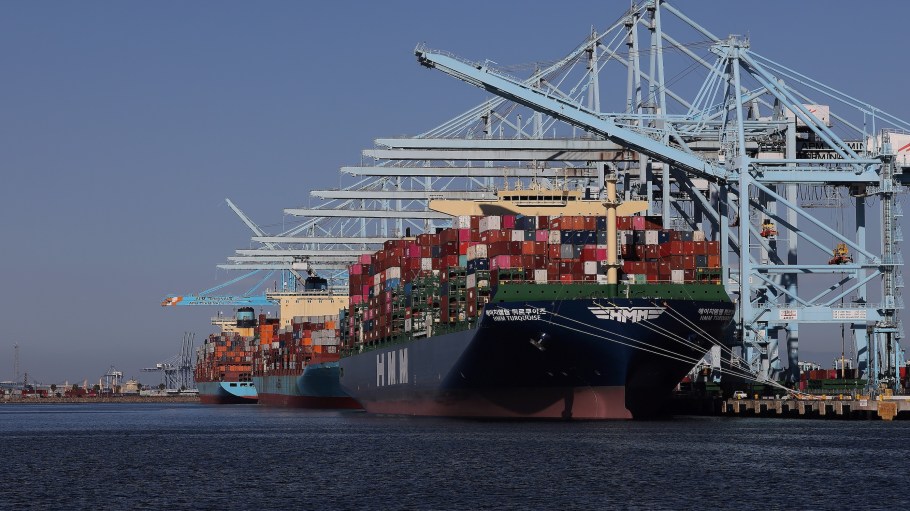
The Port of Los Angeles handled 9 percent fewer imports in May than last year as inbound cargo volumes into the California gateway were hampered by tariffs implemented by the Trump administration in April.
With fewer ships entering the port due to mass blank sailings in the weeks after the tariffs were imposed, the L.A. port brought in 355,950 20-foot equivalent units (TEUs) of loaded imports. On a month-over-month basis, these import numbers declined 19 percent from April, despite May volumes typically being stronger during most years as the traditional peak shipping season approaches.
Related Stories
The import total was 25 percent less than what the port forecasted on April 1, a day ahead of President Donald Trump’s “Liberation Day” tariffs that threw the supply chain out of sorts, namely on the trans-Pacific trade lane out of China.
The duty rate on imports from China escalated as high as 145 percent before the countries agreed to a 90-day pause in May. Earlier this month, the countries were able to settle on a 55 percent tariff on Chinese goods, along with China keeping a 10 percent duty on American exports.
After the initial shock of the 145 percent tariff, “many importers just simply slammed on the brakes and halted any movement of cargo,” said Port of Los Angeles executive director Gene Seroka during a Friday briefing.
For the month, 17 canceled sailings amounted to 225,000 TEUs that didn’t show up at the port, according to Seroka. He noted that truckers hauling four or five containers prior to the Liberation Day announcement are currently hauling two or three loads. And for every two longshore workers reporting to the hiring hall in late May, one left without work, he said.
“It’s very slow here seasonally, as we’ve already blown past summer fashion and are looking forward now to back-to-school and Halloween before the all-important year-end holidays,” Seroka said. “Cargo for those micro seasons needs to be here on the ground right now. I don’t necessarily see that in inventory levels.”
The port director predicted there would likely be higher prices and fewer selections for both the back-to-school and Halloween seasons.
“We will see a little bit of a peak season in the month of July trying to get ready for the Christmas and year-end holiday season,” Seroka said. “But again, retailers are not telling me that they’re boosting inventory levels to have wide selections on products beginning that Thanksgiving week and running to the end of the year.”
Ernie Tedeschi, director of economics at The Budget Lab at Yale, said during the briefing that the tariffs would raise average prices by 1.5 percent, which would cut purchasing power of nearly $2,500 per household per year.
But not all tariffs are made equal, he warns.
“Products that Americans are more likely to import are going to be pinched much more than other products. In particular, products like leather goods, things like shoes and handbags, products like apparel and consumer electronics—we believe will all see double-digit price increases in the short run over the next year or two,” Tedeschi said.
According to The Budget Lab’s estimates, leather products could see price increases of 30 percent, while apparel’s price tag would jump 28 percent. Textiles could see a price hike of 15 percent, Tedeschi said.
In April, apparel imports already saw a 20.1 percent tariff rate worldwide, according to U.S. International Trade Commission data.
Seroka again downplayed any potential cargo surge that analysts have expected would flood the Ports of Los Angeles and Long Beach in June and July, pointing to recent Global Port Tracker projections. During the summer months of June, July and August, U.S. ports are expected to see inbound cargo declines of 6.2 percent, 8.1 percent and 14.7 percent, respectively.
During the Friday briefing, Seroka said there were 12 ships at the L.A. port, “which is a good number for this time of year” and “one of the few double-digit ship days we’ve had in weeks.”
Additionally, he highlighted upcoming import projections over the next two weeks of 122,000 and 124,000 TEUs, both figures of which he said “are pretty average for where we should be.”
Loaded exports at the Port of Los Angeles totaled 120,196 TEUs, a 5 percent drop from 2024. The port processed 240,472 empty container units, 2 percent more than last year. Across the board, the port handled 716,619 TEUs in May, 5 percent less than last year. Coincidentally, last month marks the first year-over-year decline in throughput since the year-ago month.
“There’s less than 30 percent of the cargo on the docks today than was at the peak during Covid,” said Seroka. “We got plenty of room to manage the cargo.”
After five months in 2025, the Port of Los Angeles has handled 4,063,472 TEUs, 4 percent more than the same period in 2024.