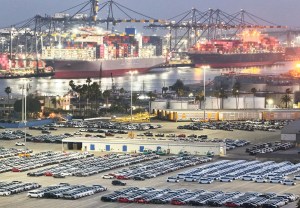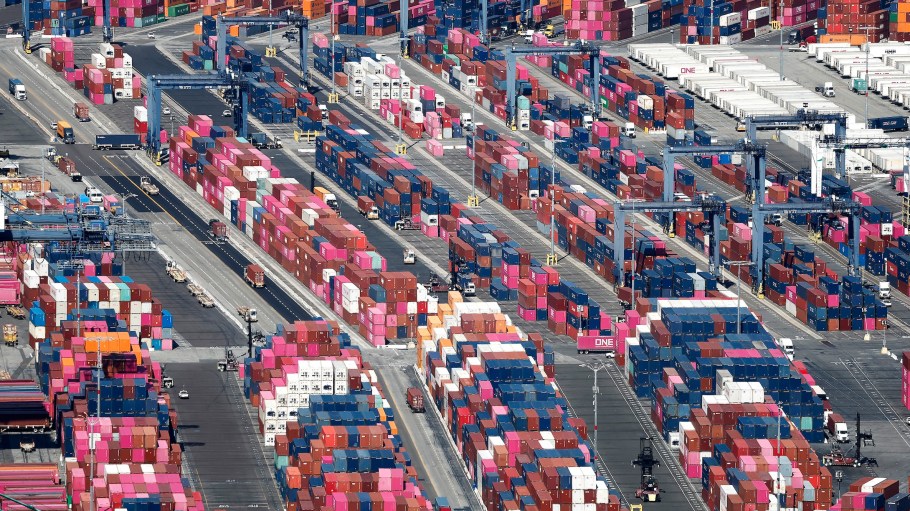
As tariff drama unfolds and threatens to snarl the movement of goods into the U.S., the San Pedro Bay ports of Los Angeles and Long Beach could see steeper-than-anticipated drop-offs in cargo volume to kick off the first full week of May.
According to the L.A. port’s Port Optimizer, inbound cargo volume for the week of May 4-10 is forecast to plummet 32.8 percent from the year prior to 74,925 20-foot equivalent units (TEUs).
In March, Port of Los Angeles executive director Gene Seroka projected a 2025 second-half volume decline of 10 percent, before indicating earlier this month that the drop-off could start as early as May.
Related Stories
When including Long Beach, the full complex could see a much deeper year-over-year drop in total vessel calls, with Port of Long Beach CEO Mario Cordero citing a 44 percent decline in ships projected to enter both ports that week.
Cordero had already been more bearish than Seroka about the rest of the year, previously saying that total cargo volumes into the Long Beach port would sink 20 percent in 2025’s second half.
The Port Optimizer indicates a current flood of cargo into the L.A. port ahead of the downturn, representing much of the remaining product that has been out on the ocean for weeks, ahead of President Donald Trump’s “Liberation Day” announcement of country-specific “reciprocal” tariffs and a repeatedly escalating series of duties on goods out of China.
For the current week of April 20-26, TEUs are up 56 percent from the year prior to 119,784 containers. The product rush is immediately expected to subside 28.6 percent on a weekly basis next week (April 27-May 3) to 85,486 TEUs.
This would mark a 10.5 percent dip from the year prior, and be the first week the tariffs will significantly impact volume into West Coast ports.
The China tariffs in particular, which have since ran up to 145 percent, have spooked U.S. importers into cancelling or postponing shipments en masse until the situation is clearer.
The ripples from the cancellations and delays have manifested out on the Pacific Ocean, first with a slowdown in export activity out of major China ports including Shanghai, Ningbo and Shenzhen and a slew of blank sailings from ocean carriers on the trans-Pacific trade lane.
As much as 28 percent of weekly cargo capacity on the Asia-to-U.S. West Coast route is expecting to be blanked on the week of April 28-May 3, says Sea-Intelligence.
One of the world’s largest ocean carriers, Hapag-Lloyd, said its customers have cancelled 30 percent of China-to-U.S. shipments. While the shipping firm is keeping the number of passages unchanged, it is using smaller vessels on the trans-Pacific.
For now, it appears demand is coming from elsewhere as the 145-percent tariffs remain in effect.
“There is substantial cargo from China being held back and a big increase in bookings from Southeast Asia like Thailand and Cambodia,” said Nils Haupt, a spokesperson for the German container shipping liner. “This is the most unpredictable period we’ve ever been in.”
Thailand and Cambodia are currently both subject to the 10-percent baseline tariffs Trump slapped on all countries after putting his original country-specific tariffs on pause for 90 days.
If the China tariffs are lowered, which has been hinted at by both Trump and Treasury Secretary Scott Bessent, container shipping would likely bring a sudden surge in Chinese cargo volumes back to the West Coast ports.
“This will in part be cargo which has been held back over the past three weeks, and in part an effect of U.S. importers being wary that tariffs changes tend to happen very quickly and therefore would want to get the peak season volumes moved as fast as possible lest the tariffs should suddenly rise again,” said Lars Jensen, CEO of Vespucci Maritime, in his daily LinkedIn update Wednesday.
However, a positive turn of fortunes would not make supply chain operations any easier.
“Given the rash of blank sailings in recent weeks, a sudden sharp lowering of U.S. tariffs and surge in volume is likely to cause short-term hiccups in the supply chain with possible capacity shortage and resultant escalating rate levels,” said Jensen.
The unpredictability out at sea is inevitably expected to cascade over to U.S. logistics industries like trucking, rail and warehousing.
Trucking companies have largely avoided the California ports in recent weeks due to the tariffs, as truck drivers anticipate fewer volumes for transportation.
On the rail, Union Pacific noted in an earnings call that the company expects decreased international intermodal volume in the second half of the year as customers diversify back to East Coast and Canadian ports. CSX, which doesn’t operate on the West Coast, remained optimistic that volumes on the East Coast would possibly benefit due to the West Coast ports’ high concentration of Chinese imports.
And in warehousing, Prologis has already seen a stockpiling of inventory levels and a search for overflow space, with one prominent customer increasing their warehouse utilization from 83 percent to over 90 percent.
“Even with the pause in some tariffs or a resolution of others, customers simply lack a steady backdrop upon which to plan their businesses,” said Prologis chief financial officer Tim Arndt in a recent earnings call.