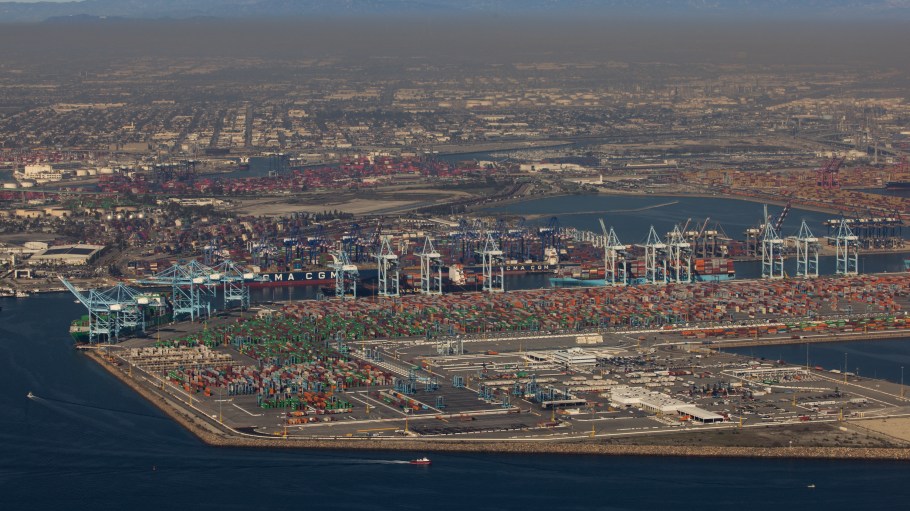
The Port of Los Angeles handled 11.5 percent fewer containers in November compared to last year, processing 782,249 20-foot equivalent units (TEUs).
Loaded imports came in at 406,421 TEUs, 11.2 percent less than last year, while loaded exports saw an 8.4 percent drop compared to 2024 levels with 113,706 TEUs.
Imports slowed down as China’s exports to the U.S. declined 28.7 percent year over year in November, the eighth straight month of an annual downturn. Roughly 40 percent of imports that are processed at the Los Angeles port originate in China.
Related Stories
For the first 11 months of 2025, the Port of Los Angeles saw a 1.8 percent increase in overall throughput to more than 9.4 million TEUs. This forecasts the gateway to cross 10 million TEUs for the second year in a row, and for the third time ever.
“In a word, 2025 was a roller coaster,” said Gene Seroka, executive director of the Port of Los Angeles. Exports out of the port have declined in seven of the last 11 months, setting the gateway on a pace to have its first year-over-year decline in outbound shipments since 2021.
“Exporters are hurting,” Seroka said, noting that American farmers have been harmed “irreparably” due to China’s months-long boycott in buying U.S. soybeans.
“If exports can edge up, that’s a positive impact to GDP,” he said. “We’re just not seeing that yet.”
Seroka said the port will probably see single-digit declines in import volumes next year. Although the NRF’s Global Port Tracker predicted double-digit dips in inbound cargo across major U.S. ports for the first four months of next year, Seroka doesn’t see his port’s volume “falling off a cliff” as the full year develops.
Like the Global Port Tracker, Seroka attributed any potential declines to the high inventories retailers have accumulated throughout the country.
“With some warehouse levels still elevated, importers are pacing their orders a bit more carefully,” said Seroka, during a Tuesday briefing. “Retailers don’t want to start doing deep discounts on products after the holiday season, so this is going to be a pretty important point in time when it comes to the replenishment concept.”
NRF’s holiday forecast calls for retail sales to surpass $1 trillion across November and December for the first time, with the first month’s annual sales jumping 4.5 percent. But Seroka noted that the trade association baked in inflationary pressures that were helping the totals reach those highs.
Despite concerns over inflation, the Supreme Court’s awaited ruling on tariffs, consumer sentiment and recent unemployment news, Seroka said “nobody’s cancelling a lot of purchase orders right now.”
Constance Hunter, chief economist at the Economist Intelligence Unit, predicted during the briefing that the economy will grow in the first half of 2026, as consumers receive tax refunds via the Trump administration’s One Big Beautiful Bill Act. The second half, Hunter said, will see slower growth amid the impact of tariffs.
“[Businesses] have absorbed some of that tariff cost because there was uncertainty. They didn’t want to lose market share,” Hunter said, noting that some businesses have since their margins eaten into as a result. “We don’t expect that to continue in 2026. We expect firms to try to pass on as much as they can.”
During the briefing, Seroka also addressed last month’s fire at the port. In late November, the Ocean Network Express (ONE) Henry Hudson caught ablaze at Yusen Container Terminal and had to be moved to anchorage for nearly four days.
In the wake of the successful firefight, a Los Angeles firefighter cautioned that although there are currently five fireboats that safeguard the port, they are in poor condition and would have a tougher time containing a stronger blaze.
Despite the concerns, the port director expressed his confidence in the Los Angeles Fire Department to handle another potential incident.
“From my vantage point over the past dozen years, L.A. firefighters and their equipment have performed to perfection every time we’ve needed them,” Seroka said. “And in that spot, Los Angeles Fire Chief Jaime Moore was asked if he believes the Port of L.A. is adequately protected. And his answer was, I quote, ‘Absolutely.’ We will continue to make sure that the equipment is in a state of good repair.”