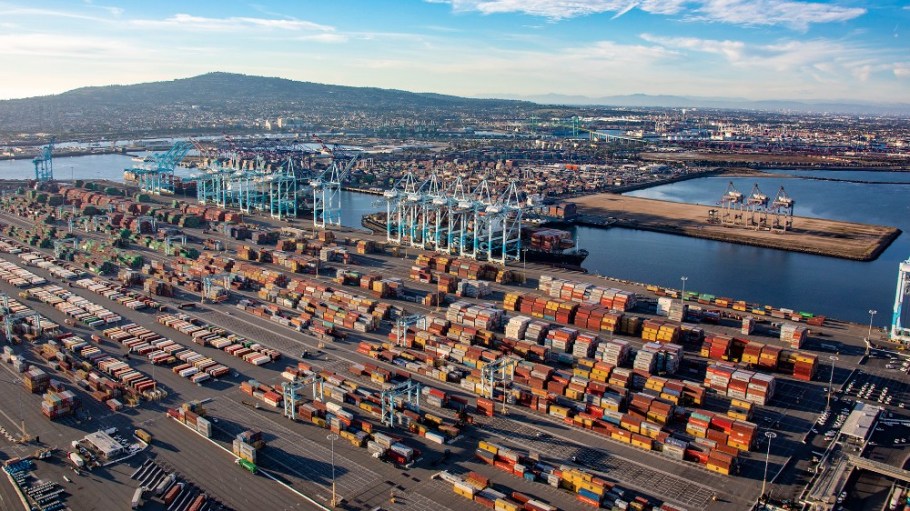
Southern California gateways had a banner 2024, with the Port of Los Angeles announcing that the 12-month period was the second busiest on record in its 117-year history.
The port moved a total of 10.3 million containers last year—a jump of about 20 percent from 2023. Loaded imports grew by 26.4 percent to 460,915 twenty-foot equivalent units (TEU), while loaded exports fell 9 percent to 110,483 TEU.
Port of L.A. executive director Gene Seroka spoke to these metrics at the 10th annual State of the Port Address on Thursday. “Today we celebrate a remarkable milestone: 25 years—a quarter century—as the busiest container port in the Western Hemisphere,” he said.
Related Stories
The percolating labor tensions that plagued East Coast ports along with an array of tariff threats levied by then-President-elect Donald Trump drove a rush of business to the West Coast as shippers and importers sought to avoid the impacts of potential port strikes and looming duties.
More recently, devastating wildfires have decimated hundreds of thousands of acres and thousands of homes and structures across L.A. Mayor Karen Bass acknowledged the Port’s role in recovery and relief initiatives currently underway across the county.
“The City is moving forward on a massive recovery effort to rebuild homes, businesses and communities, and we must also ensure the Port of Los Angeles remains well positioned to move essential goods for this effort,” Bass said in a statement. “I am confident this will be the case—the busiest port in America is a leader that continues to break cargo records while simultaneously driving air emissions down to 20-year lows.”
Bass also specifically thanked members of the International Longshore and Warehouse Union (ILWU) “for getting the job done every day.” After a protracted negotiation period, the union and the Pacific Maritime Association (PMA) agreed to a six-year contract agreement in late 2023.
Meanwhile, the threat of strikes at U.S. East and Gulf Coast ports throughout 2024 drove more business to West Coast gateways. The standoff ended earlier this month with the establishment of a tentative six-year contract between the International Longshoremen’s Association and United States Maritime Alliance.
Seroka also praised longshore laborers for taking on the high volumes of business, along with the other stakeholders in attendance including terminal operators and shipping lines and members of the San Pedro Bay community. He outlined a plan for 2025 and beyond that will prioritize workforce development, including a recently launched $16 million ILWU-PMA Maintenance and Repair Training Center and a new Goods Movement Training Facility on Terminal Island, the man-made industrial space off the SoCal coast shared by the Port of Long Beach.
Such initiatives, alongside efficiency-boosting Port projects and investments, have accelerated the flow of goods through the gateway, Seroka said. For example, the Port of L.A. recently put the finishing touches on a $73-million Pier 400 On-Dock Rail Expansion project that was designed to improve the flow of cargo while driving down emissions and making the terminal a safter place to operate.
The project will create additional cargo capacity for all the terminal operators at the Port, while also driving down demand for truck transport. As rail capacity and demand continues to ramp up, the Port of L.A. estimates the Pier 400 project will lead to the elimination of 1,200 truck trips per day by 2040. Another similar rail project is now breaking ground at Fenix Marine Pier 300.
Like its neighbor in the complex, the Port of Long Beach (POLB), the Port of L.A. has leaned into data optimization to drive performance improvements in recent years, investing in a Port Optimizer—a digital platform for cargo planning based on up-to-the-minute data. Launched in 2017, Seroka said the platform recently debuted a Universal Trucking Appointment System that allows the 20,000 truckers doing business at the port to manage their terminal appointments virtually.
“Everything we do to speed containers through the Port pays off, because for every four containers we move, it equals one job,” Seroka said.
When it comes to driving down emissions—a shared goal between the San Pedro Bay ports—the Port of L.A. has doubled down on its zero-emission commitments. Diesel particulate matter has been slashed by 91 percent and sulfur oxides reduced by 98 percent since 2005, even as cargo processing increased by 15 percent during that period.
“Our goal isn’t fewer emissions, it’s zero emissions,” the Port director said. “It’s about setting a new standard for ports worldwide, proving that economic growth and environmental stewardship can go hand in hand.”
In addition to prioritizing rail projects, the Port plans to ramp up the volume of zero-emissions electric trucks in service and invest $640 million in new zero-emissions cargo handling equipment and charging stations to support the switch. The Port of L.A.’s Hydrogen Hub is focused on producing that equipment and creating green shipping corridors with other ports around the world.
Millions more—$500 million, to be exact—has been committed to a project with the Los Angeles Department of Water and Power (LADWP) that will allow the Port to run more electricity-powered equipment and transition to clean power within the terminals.
“It’s up to all of us to create a Port that is better for people, better for the planet, and better for performance,” Seroka said.