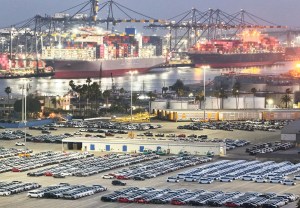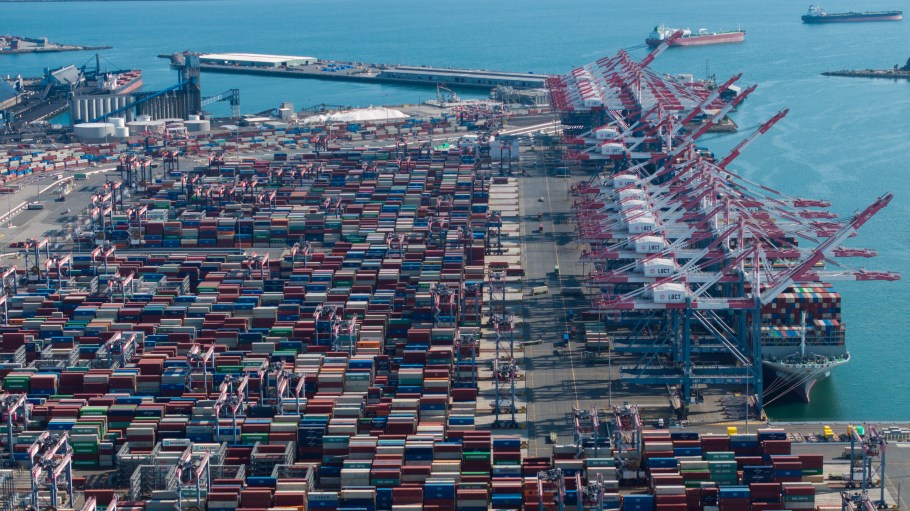
The Port of Los Angeles expects cargo volumes to drop 10 percent in September, two months after the port handled an all-time record of containers amid tariff-driven front-loading into the U.S.
“We’ve already seen the peak of the peak,” said Gene Seroka, executive director at the Port of Los Angeles, during a Wednesday media briefing.
Seroka said he expects container volumes to ease through the rest of the year against “unusually high” comparisons in late 2024, in line with trends projected by the monthly Global Port Tracker from NRF and Hackett Associates. That report, which tracks inbound cargo volume, said September imports would decline 6.8 percent year over year across major U.S. ports.
Related Stories
Cargo numbers at the Port of Los Angeles were relatively flat in August, declining 0.2 percent to 958,355 20-foot equivalents (TEUs).
Loaded imports during the month came in at 504,514 TEUs, 1 percent less than last year. Loaded exports saw a 5 percent improvement from 2024 at 127,379 TEUs. The port also processed 326,462 empty container units, 1 percent less than last year.
Eight months into 2025, the Port of Los Angeles has handled 6,934,004 TEUs, 4.5 percent more than the same period in 2024.
As the port’s throughput totals are expected to decrease in the coming months due to the tariff-driven changes in order cadence, Seroka emphasized the elevated costs importers have had to pay now that the “reciprocal” tariffs have gone back in effect.
Most U.S. importers now pay tariffs ranging anywhere from 15 percent to “almost double what they were paying at the beginning of the year,” depending on the origin country and category of the product.
“Large retailers were able to build some inventory level in advance, but once those goods cycle through the inventory system, added costs will probably hit us as well,” said Seroka. “Smaller and midsize companies, meanwhile, didn’t have that cushion. Many are dipping into cash reserves just to cover tariffs, but they didn’t budget or foresee.”
Beyond the tariffs, shippers and end consumers alike have to worry about potential cost increases due to the other major U.S. trade policy shifts under the Trump administration, including the scrapping of the duty-free de minimis provision and the expected introduction of fees for Chinese ships docking at U.S. ports.
Vincent Iacopella, president of trade and government relations at freight forwarder Alba Wheels Up International, said the end of the trade provision—which let companies import small packages into the U.S. worth less than $800 tax-free—would favor larger marketplaces that have the capital and resources to make to shift to a duty-paid model.
Under a deliver duty-paid model, merchants can calculate and collect duties via a third-party before remitting payment directly to Customs and Border Protection.
Iacopella also said “there probably will be” a rise in container shipments entering the U.S. due to the de minimis closure.
“I haven’t seen it yet, but I’m sure we will,” Iacopella said. “With the duty paid [model] and more time to plan, you can deal with a longer transit time on the trans-Pacific.”
With ocean freight possibly picking up more of the slack from air freight kicks into gear, that could leaves more room for carriers to feel the brunt of the U.S. port docking fees, which are scheduled to go into effect Oct. 14.
About 30 percent of the 2,000 vessels that annually call at the Port of Los Angeles are China-built and -operated ships, according to Seroka.
While most of the major container shipping firms have reshuffled their vessels so a Chinese ship doesn’t travel to the U.S., there is still uncertainty over how much of the costs will be passed on to consumers.
“I’ve seen sliding scales of 10 percent to 40 percent of the ocean freight as you start this year, 2025, as you go into 2028 (the last year the port docking fees escalate),” said Iacopella. “It is a cost on top of the tariffs.”
Seroka said ships docking at L.A. port could see added costs ranging between $125 and $300 per container, depending on size.
“That cost per box may be lower than other entry points, simply because of the average volume we have on every ship that comes in, smaller ships will have a higher cost per box,” Seroka said.
Although the U.S. Trade Representative-levied fees are scheduled to begin in less than four weeks, the port hasn’t noticed any significant vessel schedule changes, Seroka said.
Despite the increase in customs activity related to duties collection at the port, operations have gone smoothly, according to the director. Turn times on trucks are “about an hour” at the Port of Los Angeles and Long Beach. Dwell times for containers set to be loaded on a truck are at or under three days, while container dwell times set for rail are below four days.