With ongoing tariff uncertainty shaking up supply chains across the globe and impacts already being seen and felt at the country’s busiest gateway, it will take “weeks, if not months, to untangle the backlog and stabilize the system.”
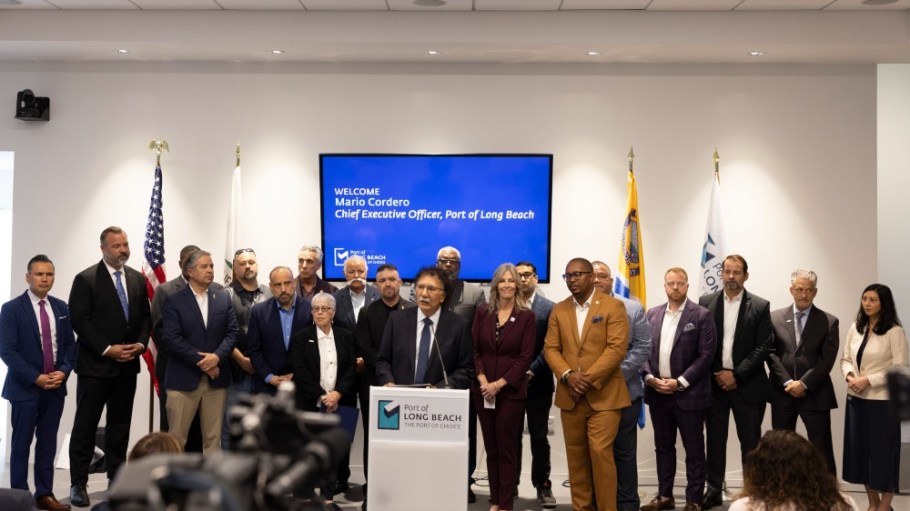
That’s according to Mayor of Long Beach Rex Richardson, who convened with officials from the Port of Long Beach (POLB) to unveil a study on the gateway’s economic impact. The assessment revealed that the San Pedro Bay port complex handled 9.6 million TEUs in 2024, contributing $300 billion to the United States’ GDP and supporting 2.7 million jobs across the country, including 1.1 million in California. But recent tariff policy announcements have led to a 30-percent reduction in cargo volumes, impacting 100,000 jobs in California alone, according to Richardson.
Related Stories
“There’s no denying it; we’ve entered the reality of a new tariff era,” he said at a press conference on Monday. “A reduction in trade in our ports doesn’t just affect dock workers, truckers, local businesses—it threatens American jobs and economic security all across our country.”
The SoCal city’s mayor alluded to the administration’s announcement that tariffs on China-made goods would be reduced from 145 percent to 30 percent, saying that stakeholders throughout the supply chain, from business owners to supply chain managers, are “not going to celebrate” a conclusion to the crisis.
“This is still a crisis of our own making that we need to address through long-term, long-range, strategic and stable policy making,” he added. The mayor, who met with workers and business leaders earlier in the day to understand the impact of the tariffs and tariff threats, said, “Damage is done.”
“We’ve seen ships that never sailed. We have containers that sit empty. We have American businesses and consumers that are preparing and beginning to pay the price for these policies. The rollback is a step that should be acknowledged, but recovery will not be immediate,” he added, estimating that it could be months before the system returns to normal.
POLB executive director Mario Cordero illustrated the sobering scope of the issue. “In 2024, we had record cargo at the Port of Long Beach—9.6 million, the best in our 113-year history. And… first quarter 2025, we moved the most container volume of any port of country.” During those high-volume, peak periods, one might see 20 vessels arrive at the port on a given day.
“The low point that we saw in the first week of May—that number was 14,” Cordero said. And on Friday, the Maritime Exchange (which monitors the flow of incoming and outbound cargo) reported zero container ships leaving China bound for U.S. ports. “The ports in China are essentially 24/7, so to have a 12-hour period where there’s no vessel departing from any Chinese port to the U.S.A., that should be concerning. That is a big red flag,” Cordero said.
The U.S. and China have reached a ceasefire in the trade war for now, but that doesn’t mean operations will rev back up immediately. “If this gets resolved in a way that the shipper has confidence to not only book their cargo, but pay for the cargo to come out to the West Coast, at the very least, that takes two weeks right there,” he said.
Sailing from any port in China to the West Coast takes an additional 14 days. Accounting for any complications that might take place at the port of origin adds still more time to the meter. “I would say, in a good scenario, four weeks, in a bad scenario, six to eight weeks” until normal operations at the port resume in earnest, he projected.
According to Richardson, the cancellation or pause of in-progress orders has disrupted the “entire logistics and supply chain continuum.”
“That means fewer people being called into work. That means fewer shifts that they can count on, fewer people,” Richardson added. “And it ripples not only from the docks but to the warehouses and to the trucks and to all of that. That creates an economic impact with Ground Zero here in the city of Long Beach.”
Gary Herrera, president of the International Longshore and Warehouse Union (ILWU, Local 13) underscored that point. “The facts are the facts: the work was here two months ago, three months ago—we were breaking records,” he said, comparing that timeline to the reality that has solidified following Trump’s reciprocal tariff announcements.
For ILWU’s registered dockworker workforce, work opportunity has dwindled from five to six days a week to two to four days. “For our part-time workers, there’s absolutely zero work opportunities for them,” he added. Cargo containers are sitting empty at the terminals and workers are not being hired to move them in the event that volumes begin to surge—a factor that could lead to future backlogs.
And the instability caused by the administration’s vacillating trade policy is radiating throughout the local logistics network. Weston LaBar, chair of the Long Beach Economic Partnership and chief strategy officer of Waterfront Logistics, which operates 600,000 square feet of warehousing space near the POLB, said the group has seen “huge demand right now for bonded warehousing” from anxious companies grappling with the implications of the tariffs.
But now, the group worries that working through the “long and cumbersome process” of securing the bonds needed to operate the spaces from U.S. Customs and Border Protection (CBP) will be for naught. “Our biggest fear in that process is that we may get permits…right about the time they’re not needed anymore.”
“If we permit our facility to be bonded, and there’s no bonded cargo, not only did we miss out on helping the shippers coming into the nation that are trying to navigate the trade war, but then we have a whole bunch of space that we can’t use,” he added.
Meanwhile, Customs broker and freight forwarder Alba Wheels Up has already seen a “huge” surge demand from shippers—and that was just based on “whispers of the news last week” that the administration might be working on a trade deal that would lower the China tariff rate, according to president of trade and government relations Vince Iacopella.
“Especially because we have this 90-day kind of reboot… they want to frontload and get as much inventory as they can at 30 percent,” he said. “It’s a little harder to make longer-term investments and sourcing decisions without the long-term certainty, but there is a short-term advantage,” he added. Long Beach also enjoys the shortest transit time of any American port from Asia—another advantage.
Business may be ramping up at far-flung sourcing locales and ports, but Richardson said he believes the 90-day tariff pause is just that—a respite, not a solution or a guarantee that the supply chain will return to optimal health over the course of four weeks, or four months. Without an end to the trade war, uncertainty will still reign supreme.
“Last week, what we said was we’re sounding the alarm. This is important. People count on the port and they don’t know it. They just know they click and buy and it shows up. They have no idea how these decisions impact their ability to provide the basic needs for their family,” he said.
“And so the point of today is demonstrating the economic impact. This is real. These are real numbers,” he added. “These are jobs, economic impact… we all should be concerned about trade policy and errors, because they will have an impact on your ability to procure goods, on how much those goods cost.”