With the U.S. Trade Representative (USTR) watering down its fees on Chinese ships set to dock at American ports, major ocean carriers aligned with the most impacted shipping firms will likely have to pull more weight.
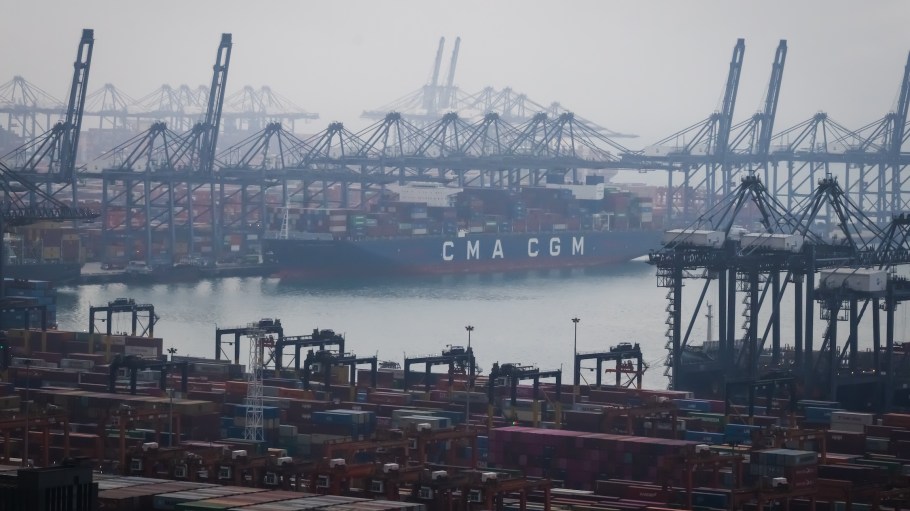
While China-based Cosco Shipping and its subsidiary Orient Overseas Container Line (OOCL) are expected to pay up the most, the overflow from President Donald Trump’s “anti-China tax” expected to cause a “major headache” for Ocean Alliance partners CMA CGM and Evergreen, said Alphaliner in a weekly report.
Related Stories
According to the shipping research tool and database, Cosco should arrange so that CMA CGM and Evergreen vessels increase their trans-Pacific sailings within the vessel-sharing agreement so that the Ocean Alliance members don’t see a significant hit to their service capabilities.
The Ocean Alliance recorded 54.1 percent schedule reliability in February, ahead of the launch of its updated “Day 9” network which into effect in April. The ocean carriers officially deployed a combined 390 container vessels with an estimated total nominal capacity of nearly 5 million 20-foot equivalent units (TEUs) across 41 weekly service loops and more than 520 direct port pairs. Twenty-two of the weekly loops are trans-Pacific services that call at U.S. ports.
The companies have never specified how many vessels they individually have provided to the alliance.
Cosco may be able to skirt the port fees if the liner withdraws their ships and replaces them with slots on fee-exempt ships operated by the alliance partners, according to Linerlytica.
“Although port fees on Chinese-operated and Chinese-built ships are retained, carriers will be able to circumvent the fees by swapping out all of the affected ships in the next 180 days as the fee will no longer apply on the operators’ fleet composition or prospective orders but only on ships calling at U.S. ports on a per-voyage basis (changed from the initial per-port call charge),” said Linerlytica in a post Monday.
Given that exemptions were granted for smaller ships below 4,000 TEUs or 55,000 deadweight tons (dwt), Cosco could also opt to sail more ships within that limit. According to its website, the Chinese carrier operates 11 vessels that fit under that threshold.
Based on Linerlytica’s analysis, “all of the main carriers have sufficient exempt ships available to make the switch without severe operational disruptions.”
World Shipping Council president and CEO Joe Kramek still called the USTR’s decision “a step in the wrong direction” on the grounds that it would raise prices for consumers and weaken U.S. trade. The Council also said that structuring the fees based on ship size “disproportionately penalizes larger, more efficient vessels” that deliver essential goods, including components used in U.S. production lines.
Only 20 percent of the current fleet of container ships calling at U.S. ports are affected by the remodeled port fees, and they are expected to be swapped with exempt ships over the next six months.
“If all major carriers were equally affected by the cost increase, shipping lines might take a ‘wait and see’ approach, and just pass on the additional cost to the cargo owners and—ultimately—consumers,” said Alphaliner. “This is, however, not the case since Chinese carriers have been targeted in a way that leaves them with limited options, while others could try and move Korean- and Japanese-built tonnage to U.S.-related services.”
South Korea’s HMM (Hyundai Merchant Marine) and Taiwan’s Evergreen and Yang Ming would all be likely be major beneficiaries of the new port fee structure, as the companies have a minimal presence of China-built ships.
The USTR’s action indicated that Chinese-built ships calling at U.S. ports will be charged $18 per net vessel tonnage, or $120 per container discharged depending on which is higher, starting Oct. 14. By April 2028, the charge will have risen incrementally to either $33 per net tonnage of the vessel, or $250 per container discharged.
Chinese vessel operators like Cosco must pay an additional $50 per net tonnage, regardless of where its ships were built, which will gradually increase to $140 by April 2028.
These fees are still an improvement over the initial proposal, which observed that Chinese-built ships would be hit with a fine of up to $1.5 million per port call. These fees would have also been cumulative for each individual port call, instead of the modified fee per total U.S. voyage.
Clarksons Research calculated that only 9 percent of U.S. port calls in 2024 by container ships would have been subject to the new scope, down significantly from the 43 percent estimated under the previously proposed actions.
The research firm says the final proposal could theoretically generate annual fees of $12 billion in 2026, before rising to $18 billion in 2028 based on current vessel deployment patterns. This is down from estimates of between $40 billion and $52 billion under the previously proposed measures.