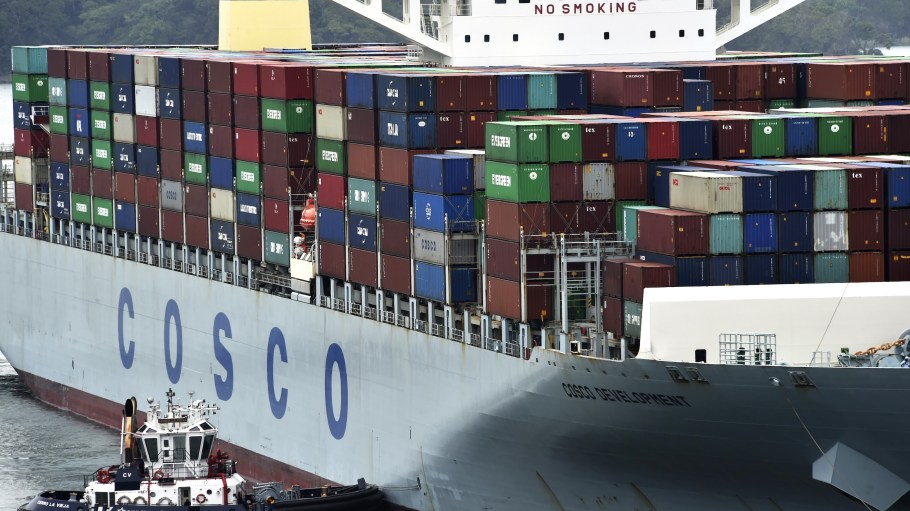
Cosco Shipping could potentially be a new partner in the deal that would transfer two ports on the sides of the Panama Canal to Mediterranean Shipping Company (MSC) and BlackRock.
China’s largest container shipping company is one of multiple Chinese state-backed companies that is in discussion to invest in the consortium to buy more than 40 ports from port operator CK Hutchison Holdings, according to a report from Bloomberg.
The addition of Chinese investors emerged as a potential option as the current iteration of the deal has hit regulatory roadblocks in the country amid a power struggle with the U.S. over influence on the trade artery. The Panama Canal Authority acknowledged the sale could put the waterway’s neutrality at risk.
Related Stories
China’s antitrust body is currently probing the deal after reports that President Xi Jinping was unhappy with the port sale by Hong Kong-based CK Hutchison.
It is unclear what stake Cosco would have if a port deal took place, or what ports it would gain control over.
The deal itself followed President Donald Trump’s rhetoric that the U.S. should “take back” the canal, partly due to Washington’s worries that Hutchison’s ownership of the adjacent ports poses national security concerns for U.S. trade interests.
But according to the Bloomberg report, the idea to include Chinese investors in the MSC/BlackRock consortium came to be after high-stakes tariff negotiations in Switzerland concluded last month between Chinese and U.S. officials.
Cosco’s—or any other Chinese company’s—involvement could still sound off some bells due to their state-owned status, according to analysis by Drewry provided after a webinar on the deal held Thursday.
“This will be problematic in many jurisdictions, for example Cosco was limited to taking only a 24.99 percent stake in Container Terminal Tollerort in Hamburg” in 2021, Drewry said.
A previous Financial Times report from early June indicates that Hutchison is also considering exploring a sale of some or all of its remaining 10 ports in greater China in a separate deal as a way to appease the U.S. and China.
“We would expect that if sold that both Cosco Shipping Ports and China Merchants Ports would be likely candidates, but there may be competition concerns here given existing strength of these companies in the Chinese port sector,” according to Drewry.
A 145-day period for exclusive talks between Hutchison and the consortium ends in late July. The parties have already missed an initial goal of signing an agreement on the Panama part of the deal by early April.
If a deal goes through as initially planned, it would cost $22.8 billion for the ports to switch hands, with CK Hutchison netting more than $19 billion in cash from the transaction.
Deal could take a year to pass regulatory scrutiny
MSC would be the lead investor in this acquisition through its Terminal Investment Limited (TIL) terminal operator subsidiary, various reports have said. The ocean freight giant is setting itself up as the dominant figure across container shipping and port terminals if a tentative deal to acquire the Panama ports clears approval.
But that remains a big if—and a resolution isn’t going to come quick.
“We’re going to be talking about this deal for at least a year, if not longer, while it makes its way through regulatory approvals,” said Eleanor Hadland, senior associate of ports and terminals at Drewry, during the webinar.
An approved deal would thrust MSC into the position of largest global terminal operator worldwide, up from its rank of seventh in 2023, Drewry said.
When including the 43 ports from Hutchison, which comprise 199 berths in 23 countries, MSC would have a terminal capacity of 196 million 20-foot equivalent units (TEUs), giving the firm equity interest in more than 15 percent of global capacity.
“While it’s unlikely that MSC/TIL will be allowed to take over all of Hutchison’s assets due to market concentration concerns from the relevant competition authorities, it’s also unlikely that this would make a large enough dent in the combined portfolio to affect this final outcome of going up to first place in the rankings,” said Eirik Hooper, senior associate of ports and terminals at Drewry.
The MSC shakeup would spark an uptrend of “hybrid” global terminal operators (GTOs), Hooper pointed out. For the first time, three hybrid operators would be represented among the top five GTOs, including MSC, Cosco (fourth) and Maersk (fifth) through its APM Terminals division.
Hooper acknowledged the risks of consolidation within the industry, namely for liners without terminal-operating capacity, noting that the larger ports will typically see greater alignment between ownership of the terminal and the customer base of the terminal.
However, these carriers can still reap benefits in a hybrid-dominated environment, he said.
“In small-medium ports, even where terminals are operated by a hybrid GTO, they are catering to all liners calling at the port. While this may sound less than ideal, terminal service agreements specify the berth windows, productivity and price therefore minimizing the risk of ‘preferential treatment’ for aligned carriers,” Hooper said. “In some markets, the investment by a hybrid operator may be motivated to improve service levels for their own shipping services, but equipment upgrades and service level improvements will benefit all users.”