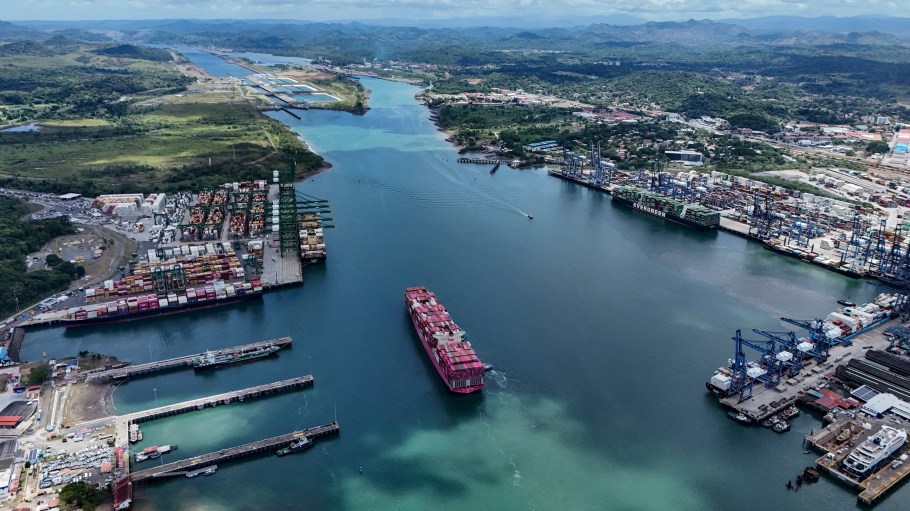
The Panama Canal is experiencing an uptick in traffic and generating more lucrative bids to transit the trade artery, aligning with a spike in demand for its reservation system as the Iran war lingers and uncertainty persists regarding the safety of the Strait of Hormuz.
Panama Canal Administrator Ricaurte Vásquez Morales stressed during a market update that the waterway is “open and reliable,” while officials maintained there is no queue to pass through despite the traffic growth.
Related Stories
In the first half of the waterway’s 2026 fiscal year from October through March, the canal recorded 6,288 transits, an increase of 224 transits from the year prior. Over the period, 254 million net tons moved through the waterway, a 4.5 percent increase from the volume tracked in the year-ago period.
“The expectation is that this will continue until the situation in the Middle East is resolved,” the Panama Canal Authority (ACP) finance chief Victor Vial said in a market update last week.
The canal offers options such as last-minute reservations and an auction mechanism for vessels that don’t book in advance. The auction makes three to five slots available through daily.
According to Vial, the average auction price before the war in Iran was between $135,000 and $140,000. Following the conflict’s outbreak, that average climbed to approximately $385,000 between March and April.
Vial said while some vessels have paid over $1 million dollars at auction, these figures reflect only temporary conditions driven by heightened demand.
The averages followed prior confirmation from Vásquez that one company had paid an extra $4 million to traverse the canal.
“It was a ship carrying fuel to Europe, and they redirected it to Singapore, and it needed to get there because Singapore is running out of fuel,” Vásquez told the Associated Press.
Bloomberg first reported the $4 million payment in mid-April, indicating that vessels were facing delays of up to three-and-a-half days to transit due to heavy congestion.
But the canal authority downplayed the report, pushing back on the congestion claims. During the presentation, Vial indicated that there is no queue to enter the Panama Canal since most vessels already are booking their transits in advance.
Using the long-term reservation process, vessels pay a flat rate. But companies without a booking can pay more to cross through an auction that awards slots to the highest bidder.
Auctions are conducted using specific time slots already built into the Panama Canal’s schedule, with no impact on vessels holding confirmed reservations or on the established transit order.
The auction process was commonly used during the months-long drought at the canal from mid-2023 into early 2024, which forced the authority to restrict daily capacity allowed to pass through.
Container ships have largely been immune to the concerns of other vessels, since they get first booking priority over other segments such as dry bulk carriers and LNG/LPG carriers.
U.S. coalition calls out China for “economic pressure” on Panama-flagged ships
On Tuesday, the U.S., along with various Latin American nations including Bolivia, Costa Rica, Guyana, Paraguay and Trinidad and Tobago, asserted their support for Panama’s sovereignty in a joint statement.
The statement published by the U.S. State Department followed China’s recent decision to detain Panama-flagged vessels throughout March and April. The U.S. has accused China of taking the action as retaliation for a Panama Supreme Court ruling in January that invalidated Hong Kong-based CK Hutchison’s contract to operate the canal-adjacent Balboa and Cristóbal terminals.
“We are monitoring with vigilance China’s targeted economic pressure and the recent actions that have affected Panama-flagged vessels,” the joint statement read. “These actions…are a blatant attempt to politicize maritime trade and infringe on the sovereignty of the nations of our hemisphere. Panama is a pillar of our maritime trading system, and as such must remain free from any undue external pressure. Any attempts to undermine Panama’s sovereignty are a threat to us all.”
Panama-flagged vessels have accounted for 80 of the 102 vessels detained at Chinese ports for inspection in April, according to Tokyo MOU, a regional ship inspection association consisting of 22 port authorities in the Asia-Pacific. The month prior, 93 of 125 vessels detained by China were registered in Panama.
The high percentages dwarf the numbers in the first two months of 2026. In January, 23 out of 72 detained ships were flagged in Panama. One month later, Panamanian ships represented just 20 out of 48 China-apprehended vessels.
During a Wednesday morning press conference, China’s Foreign Ministry spokesperson Lin Jian reiterated the sourcing superpower’s frustration with the allegations, calling them “completely unfounded and merely distortion of facts.”
According to Lin, Chinese authorities conducted routine inspections of vessels in accordance with laws and regulations. Lin also called out the U.S.’s history with Panama, as well as prior rhetoric from President Donald Trump, who has previously stated his desire to “take back” the Panama Canal.
“Who exactly exerted long forcible control of the Panama Canal, invaded Panama and trampled on Panama’s sovereignty and dignity? Who exactly is coveting the Panama Canal, attempting to own an international waterway that should be permanently neutral, and disrespecting the sovereignty of countries in the region?” said Lin. “The answer is rather clear. It is the United States that has framed normal affairs concerning relevant terminals as issues about politics and security. It is the United States that has been making pretenses and slandering others with rumors.”