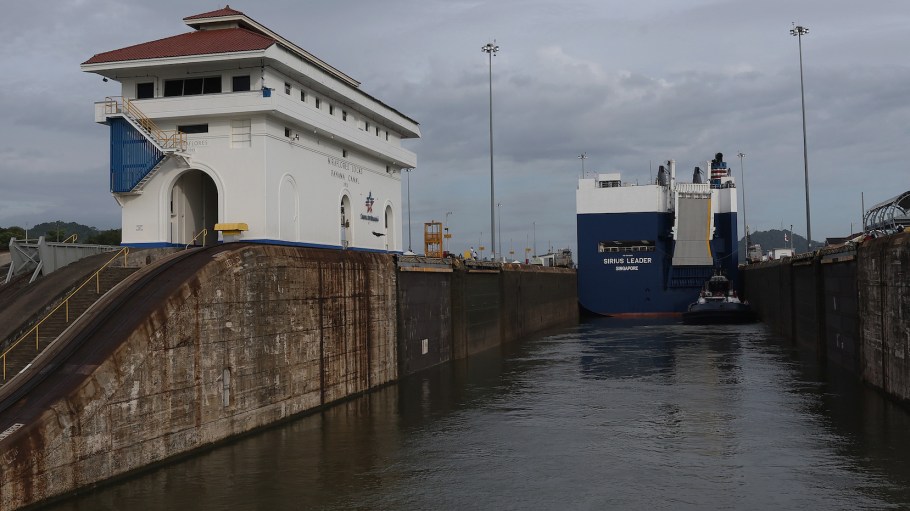
The Panama Canal Authority (ACP) has issued a stark warning to shippers: vessels without reservations may experience “indefinite delays” amid a months-long drought that is forcing the gateway to restrict daily capacity.
On Dec. 1, the number of reservation slots available for vessels will drop to 22 from the current 24, as part of the canal’s efforts to curb the impacts of Panama’s upcoming dry season and preserve fresh water. This total will drop to 18 by February 2024, half of the typical 36 vessels that could be booked ahead of time before the first set of restrictions were implemented July 30.
Related Stories
The ACP continues to urge customers to make reservations ahead of time to ship as scheduled. On Saturday, the agency opened up an additional, temporary special auction slot. This slot is being limited to regular vessels and “super” vessels—which have beams of more than 91 feet—that have been waiting for at least 10 days before the auction and do not have a booking slot.
“The purpose of this measure is to provide greater opportunities to obtain a place for vessels in the Panamax locks that have been waiting in the transit queue for an extended period of time,” the ACP said.
While the initial bid for the first auction was $55,000, a chemical tanker was awarded the special slot to traverse the canal Monday for $1.1 million. The next auction date has not been announced, but will be revealed three days prior to the next transit date.
Two major container shipping firms have already taken steps to add surcharges in advance of the restrictions, with Mediterranean Shipping Company (MSC) implementing a $297 per 20-foot equivalent (TEU) surcharge for cargo going from Asia to the U.S. East and Gulf Coasts on Dec. 15. CMA CGM will apply a $150 per TEU fee for all vessels starting Jan. 1, 2024. Both companies cited that the canal congestion had an impact on their operations.
As of Thursday morning, 110 vessels were waiting to pass through the Panama Canal, with 51 pre-booked vessels in queue for transit, and another 59 non-booked ships seeking passage.
But for non-booked vessels across the board, wait times have dramatically increased over the past four weeks.
Northbound vessels are averaging 10 days in the queue, up from an average of 2.9 days on Nov. 3. Ships going southbound have also seen an escalation in wait times, jumping to 11.2 days in queue from the 2.8 days on Nov. 3.
While the drought poses plenty of uncertainty to the global supply chain, apparel retailers and brands are still largely in the clear compared to other industries that ship via chemical tankers, liquefied natural gas (LNG) carriers, liquefied petroleum gas (LPG) carrier and dry bulk carriers.
Container ships, which most apparel sellers are using to move ocean freight, still have initial booking priority ahead of the other vessel types. This means retail cargo is less likely to experience multi-day slowdowns, especially if shippers reserve a spot more than 30 days in advance.
According to the canal, 70 percent of container ships transiting the waterway are able to proceed with the 44-foot draft limitation, down from 50 feet at the beginning of 2023. This means that shippers’ largest concern with these vessels is lightening their loads.
Each foot reduction results in a “loss” of 400 TEU of capacity, shared Christian Roeloffs, co-founder and CEO of container logistics platform Container XChange in a customer advisory, noting that an average container vessel can now transport 2,400 fewer TEUs than normal.
“At present, container shipping trade flows remain unencumbered,” Roeloffs said. “However, anticipating increased pressure on the U.S. East Coast, the Suez Canal and the Cape Horn in the coming months, shippers are likely to explore alternative routes to circumvent potential disruptions.”
In the advisory, the container logistics firm said carriers are redirecting more volume to the U.S. West Coast or opting for routes via the Suez Canal.
The booking process has cost a pretty penny for some businesses, with one Japanese oil conglomerate, Eneos Group, reportedly spending nearly $4 million to jump the line. Another unidentified company forked over $2.4 million to skirt the congestion in August.
Shipping companies have paid a total of $235 million through late November to skip the line at the canal, according to data from Waypoint Port Services Ltd. That amount is 20 percent higher than what companies paid during all of 2022 for expedited passage.
Official water depth levels at Lake Gatun, the rainfall-fed artificial lake that provides the water to move ships through the Panama Canal’s lock system, were 81.8 feet Thursday, down nearly five feet from the five-year average of 86.7 feet.
The drought, which persisted throughout Panama’s May-to-November rainy season, is linked to El Niño, the climate pattern that typically brings higher temperatures and less rain to the central and eastern Pacific Ocean.