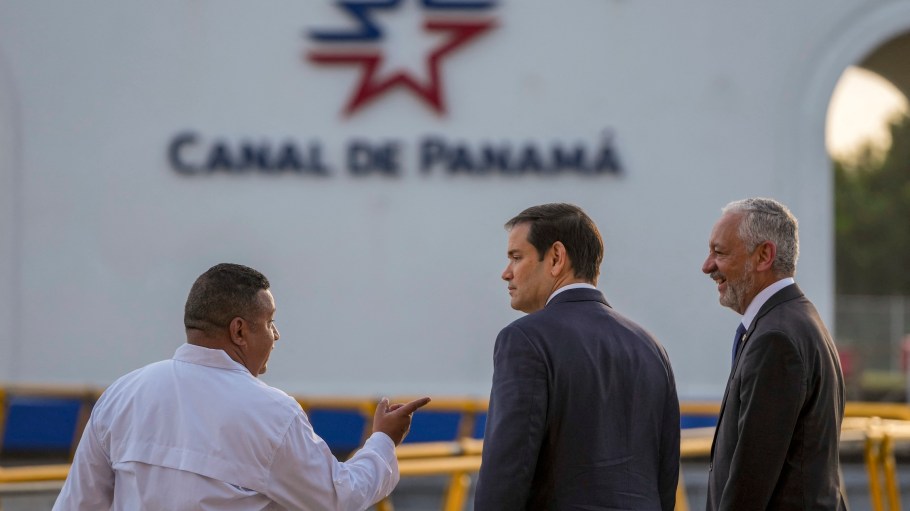
Secretary of State Marco Rubio appeared to walk back comments made by the U.S. Department of State that the Panamanian government agreed to no longer charge fees for American military vessels to transit the Panama Canal.
On Friday, Rubio retreated from the State Department’s position after Panama President José Raúl Mulino fiercely denied the comments, calling the statement “lies and falsehoods” and referring to the claim as “simply and plainly intolerable.”
The Panama Canal Authority (ACP) asserted Thursday that it has made no adjustments to fees to travel the canal.
Related Stories
“With absolute responsibility, the Panama Canal Authority, as previously stated, is willing to engage in dialogue with the relevant officials of the United States regarding the transit of military ships from that country,” the authority said in a press release.
At a joint press conference with Dominican Republic President Luis Abinader on Thursday, Rubio said it was “absurd” that the U.S. would have to pay fees to transit a zone that “we are obligated to protect in a time of conflict,” before explaining his position with a more diplomatic rationale.
“Those are our expectations. They were clear. They were clearly understood in those conversations,” Rubio said. “But I respect very much the fact that Panama has a process of laws and procedures that they need to follow as it relates to the Panamanian port—the Panamanian canal authorities. We’ll allow them to work through those processes. We intend to make it amicable, the way our visits were.”
The ACP says the U.S. has paid $25.4 million in transit fees for its military ships over the past 26 years.
Rubio had met with Mulino, Panamanian government officials and ACP officials alike on the first stop of his tour of various Latin American countries in the wake of President Donald Trump’s threats to “take back” the 51-mile trade artery.
Although the canal was transferred to Panama in 1999 via the Panama Canal Treaty and Neutrality Treaty, President Trump believes the country violated the dual treaties under unsubstantiated claims that China still controls the waterway.
Tying in with the back-and-forth on fees, the Commander in Chief also has held issues with what he claims are “exorbitant” prices for American ships to sail the canal, something the ACP has denied.
Trrump’s claims of Chinese influence likely stem from Washington’s concerns that two ports adjacent to the canal are operated by the subsidiary of a Hong Kong-based port operator, CK Hutchison Holdings. In an effort to appease Trump’s aggressive approach, Panama audited the subsidiary, Panama Ports Company.
After Rubio’s visit, Panama agreed to exit China’s Belt and Road Initiative, with the ACP also indicating that it would prioritize the transit of U.S. Navy vessels sailing through the canal. Panama could potentially push Chinese influence away even further if it decides to cancel its agreement with Hutchison altogether, which currently lasts until 2047.
On Thursday, President Mulino said he had instructed diplomats at Panama’s embassy in Beijing to submit the required 90-day notice of withdrawal from the Belt and Road Initiative, which it entered in 2017.
Naturally, China did not take kindly to American involvement in Panama’s decision.
Lin Jian, the spokesperson for China’s Ministry of Foreign Affairs, said at a Friday briefing that China “firmly opposes the U.S. smearing and undermining the Belt and Road cooperation through means of pressure and coercion.”
Panama Canal transits down historically, but container ships break the trend
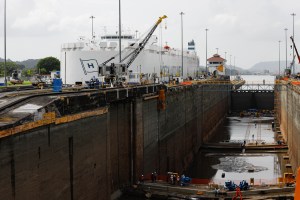
As the drama among the U.S., Panama and China unfolds, traffic at the canal itself is still recovering from the months-long drought that began in summer 2023. Low water levels at Lake Gatún, which provides the water necessary to float the ships throughout the canal’s lock system, forced the ACP to restrict the number of vessels that could transit the waterway into the winter of 2024.
Ship capacity transiting through the Panama Canal was 10 percent lower between September 2024 and January 2025 than the 2019-22 average, measured in deadweight tonnage, according to the Baltic and International Maritime Council (BIMCO).
“Transit fees, changes in trade patterns and the establishment of a new normal could all be keeping ships from fully returning to the canal,“ Filipe Gouveia, shipping analysis manager at BIMCO, said in a Thursday statement. “Furthermore, for the sectors which haven’t fully returned, this has resulted in increased tonne-mile demand as sailing distances have increased. Instead of transiting through the canal, ships sail around the Cape of Good Hope or Cape Horn.”
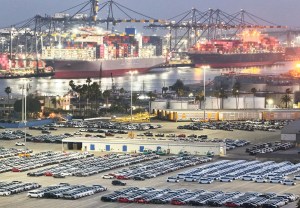
However, the good news for apparel brands is that container ships are not experiencing the same issues as their brethren across dry bulk carriers, liquefied natural gas vessels and chemical tankers.
Even under the most stringent daily transit restrictions in December 2023, container vessels operated under the most favorable conditions.
The ships largely avoided the long queues and expensive transit auctions at the Panama Canal, mainly because they operate on fixed schedules, giving them initial booking priority ahead of other vessels.
“Transits of container, liquefied petroleum gas (LPG) and car carriers are already above historical levels and could continue growing,” said Gouveia.