The tariff-driven front-loading of goods into the U.S. this year is expected to keep daily transits through the Panama Canal below pre-drought levels.
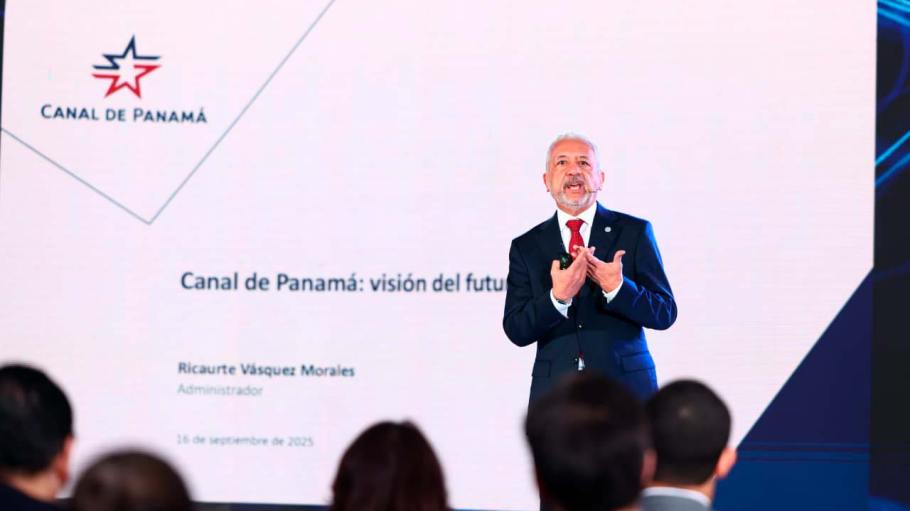
The Panama Canal Authority (ACP) expects average daily transits to decline to 33 next year, below the waterway’s full capacity of 36, canal administrator Ricaurte Vásquez Morales said in a presentation Tuesday.
Last month, the Panama Canal hosted an average of 32.5 daily transits, down from the 35.97-per-day average in August 2022—the last August before a months-long drought in early 2023 forced the ACP to impose restrictions on vessels passing through the waterway. Those restrictions were held in place through mid-2024.
Related Stories
Container shipping, an industry that has endured changes along major trade lanes in 2025 due to the U.S.-levied tariffs, represents about 45 percent of the canal’s revenue, according to the ACP.
Such a high percentage requires the ACP to adjust its budget based on the tonnage, since the canal contributes 20 percent to 25 percent of the Panamanian government’s overall revenue, according to Vásquez.
The authority has already adjusted its budget proposal to Panama’s National Assembly, anticipating a reduction of 40 million Panama Canal Universal Measurement System tons (PC/UMS tons) in fiscal 2026, which begins Oct. 1. Under this metric, one PC/UMS ton equals 100 cubic feet of net ship capacity. The canal recorded 423 million PC/UMS tons in fiscal 2024.
“In this volatility, we need to be careful not to generate expectations that are beyond what is reasonable,” Vásquez said.
At the presentation, Vásquez and several other ACP officials unveiled a new 10-year plan to modernize the canal, which will include investments of roughly $8.5 billion across major projects such as a new reservoir on the Indio River and a 76-kilometer (47-mile) pipeline for liquefied petroleum gas.
“The volatility of the markets is such that it is highly unpredictable what will happen tomorrow,” Vásquez said. “That uncertainty makes it essential for the canal to expand its capacity and remain competitive.”
The Indio River reservoir project will cost an estimated $1.6 billion and is slated to begin construction in 2027. Launched in response to the 2023 drought, the project aims to supplement the main supply of water from Lake Gatún, the artificial lake that feeds the canal’s lock system.
This project aims to add capacity for an additional 11 to 13 daily transits and enhance the canal’s reliability, as well as guarantee water supply for over 50 percent of the country’s population.
The gas pipeline is part of a larger development known as the Interoceanic Energy Corridor, which will also include two maritime terminals on the Atlantic and Pacific coasts that could facilitate the movement of up to 2.5 million barrels of energy products per day without sailing them through the canal.
Another project intertwined with the larger plan is the Corozal Port, located near the Atlantic Ocean side of the canal. The long-stalled terminal is expected to host 5 million TEUs and will be open to all container lines, Vásquez told the Journal of Commerce in May.
The ACP hopes that the buildout of that complex would quell concerns of some ocean carriers that think the canal’s existing terminals are too concentrated across a select group of operators.
Vásquez himself has acknowledged the worries of capacity concentration putting the canal’s neutrality at risk—namely in the wake of a controversial pending mega-deal that has thrust the waterway and Panama into the ongoing trade war between the U.S. and China.
In March, a consortium of BlackRock and Mediterranean Shipping Company (MSC) entered a deal to acquire two Panama ports from Hong Kong-based CK Hutchison for $22.8 billion, as part of a larger transaction that would see 43 ports change hands.
While that move was considered a massive win for U.S. President Donald Trump in his bid to rid the canal of alleged Chinese influence, it has had numerous hurdles that will likely prevent it from being closed until 2026.
China stepped in with an antitrust probe that ultimately stalled the merger, while multiple lawsuits within Panama are challenging Hutchison’s current ownership stake in the ports.
A deal could still take place, but all signs point to different conditions, including the addition of a Chinese investor like Cosco Shipping also entering the fray.
Asked during Tuesday’s presentation whether Chinese or other state-linked companies would be allowed to compete for new terminal concessions, Vásquez declined to name specific countries.
“The selection criteria have not yet been defined,” he said. “The administration will present them to the board of directors, and they will decide.”
While the geopolitical back-and-forth keeps the Panama Canal and its adjacent ports in the spotlight, the ACP is seeking to sidestep any possible influence by an individual country or ocean carrier. In late August, the canal operator told the Wall Street Journal it plans to sell rights to two plots of land reserved for the construction of two new ports.