Freight rates out on the ocean have continued their consistent descent since the start of 2025, capped over the past week by significant declines on both major Asia-to-North America trade lanes.
According to the Drewry World Container Index (WCI), spot freight rates from Shanghai to Los Angeles decreased 11 percent to $3,477 per 40-foot container, closely followed by the rates on the Shanghai-to-New York route, which declined 10 percent to $4,593 on average.
The two routes were the driving force in the larger composite index, which saw a 6 percent decline to $2,629 per container. Since Jan. 2, rates across all trade lanes have declined nearly 33 percent.
Related Stories
Multiple factors had been holding up prices for containers entering the U.S., where imports were largely front-loaded throughout the winter. Shippers had brought in imports from China ahead of the inauguration of President Donald Trump in anticipation of additional tariffs, and had also flooded vessels with cargo ahead of a potential second union dockworker strike at the East and Gulf Coast ports.
As the front-loading has subsided, so have the rates. The slide also largely coincides with a normal years’ cadence, as shipping rates traditionally drop once Lunar New Year begins, when all of the Chinese factories are closed for two weeks at a time. As fewer ships exit Chinese ports to close out January, capacity out of the country opens.
While the steepest declines came out of the Asia-to-North America routes, Asia-to-Northern Europe routes have seen the largest decrease since the beginning of the year, as capacity wasn’t as impacted by the U.S.-based issues.
Since Jan. 2, Drewry says an average container from Shanghai to Rotterdam dropped 45 percent to $2,596 per 40-foot container, compared to a 31 percent decline on containers headed to Genoa in that same time frame, a 29 percent decrease in N.Y.-bound freight rates and a 28 percent dip for L.A.-destined boxes.
Market conditions prompt MSC to scrap a service line, reshuffle “megamax” ships
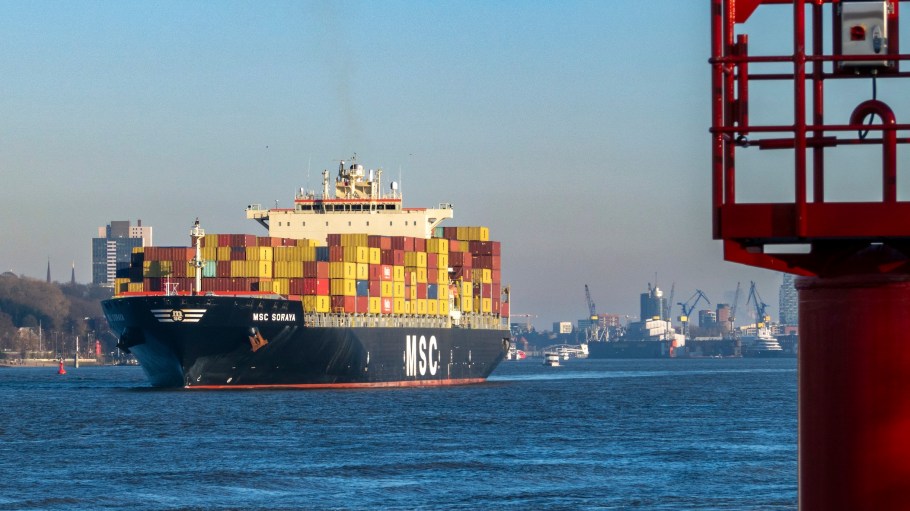
Mediterranean Shipping Company (MSC), the world’s largest ocean carrier by TEU capacity and the only major carrier unaffiliated in a vessel-sharing alliance, has made some shifts to its service in response to the demand.
MSC scrapped the Mustang service that it initially added in November as part of its standalone East-West network, which connected Asia to the Northwest U.S. and Canada.
That rotation would begin in Xiamen, China, and would stop at ports in Seattle, Vancouver and Portland, Ore., before traveling to Busan, South Korea.
“In response to the current market conditions for trans-Pacific trade, MSC has decided to deploy tonnage intended for our Mustang service to trades in other parts of the world,” the company said in a customer advisory Wednesday.
To cover the gap in schedules, two other Asia-to-North America services, Orient and Chinook, have added port calls in Busan, Ningbo and Portland.
A report from container shipping research tool and database Alphaliner indicated that MSC is also planning to switch all its 19,200-TEU to 24,300-TEU “megamax” ships from the Asia-to-North Europe trade lane to the Asia-to-Mediterranean and Asia-to-West Africa corridors.
Instead, MSC will now deploy ships averaging around 14,700 TEUs on the Asia-to-North Europe route.
“MSC has not formally announced the fleet reshuffle yet, but the changes might come as reaction to changing ocean freight spot rates,” Alphaliner said in its weekly newsletter. “Reducing capacity on this trade lane could be considered an attempt to reduce pressure on rates.”
The newsletter pointed to data from the Shanghai Containerized Freight Index, which painted the same picture as Drewry’s Shanghai-to-Rotterdam route. SCFI rates stood at 1,578 on the Shanghai to Northern Europe voyage, down 44 percent over the first seven weeks of the year.
MSC’s concerns may not end there, as overcapacity has been a concern throughout the container shipping industry in recent years as ocean carriers beef up their orderbooks. But the possible capacity problem was largely shielded throughout 2024 by the Red Sea crisis as ships had longer lead times.
The global container fleet grew 10.6 percent last year, with 59 percent, or 1.76 million TEUs, of this extra capacity absorbed by the Asia-to-Europe trade, Alphaliner says.
MSC would be proportionally affected more than most of its carrier counterparts, partially explaining the changes in service lines.
The Switzerland-based firm was the most aggressive acquirer of container shipping capacity in 2024, adding 692,000 TEUs to its fleet, a 12 percent increase, according to Alphaliner. On average, 12 of the companies included in the sample, bulked up their fleet by 7 percent.
Downward pressure on freight rates could still pick up, especially if the Red Sea situation abates and more carriers feel comfortable returning to the Suez Canal. That would compound the already expected new capacity that will flood the container shipping market. Across the industry, another 200 newbuilds are scheduled to be delivered this year adding 2 million TEUs to the fleet, Alphaliner said. That amounts to roughly 6 percent growth, after expected scrapping.