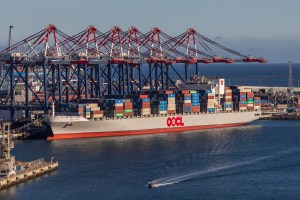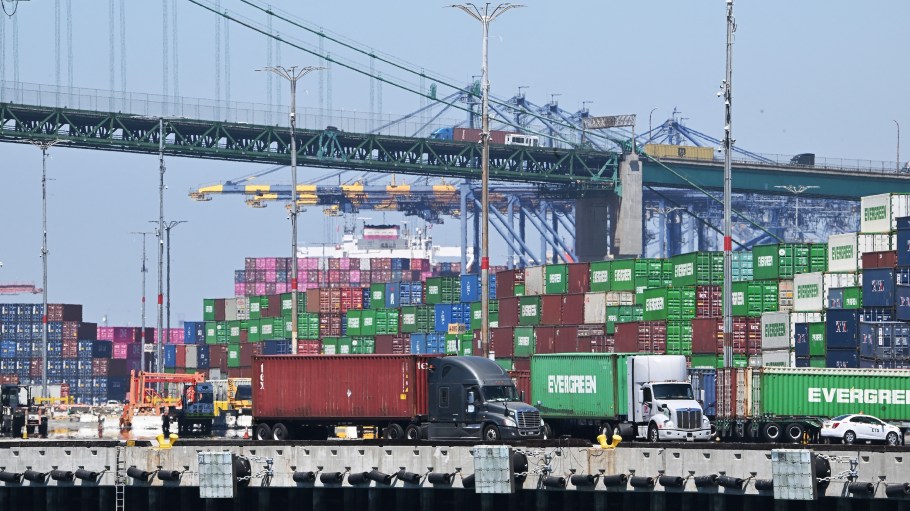
U.S. ports saw their second-busiest month on record for ocean-borne imports in July, but the 2025 peak is already setting up a substantial falloff for the fall season.
According to the monthly Global Port Tracker report released by the National Retail Federation (NRF) and Hackett Associates, major U.S. ports handled 2.36 million 20-foot equivalent units (TEUs) in July, up 1.8 percent year over year and up 20.1 percent from the month prior. The total is slightly above last month’s estimates of a 2.3-million-TEU quarter.
Related Stories
Only May 2022 saw more inbound cargo volume processed through the top American ports at 2.4 million TEUs.
Ports have not officially reported numbers for August, but Global Port Tracker projected the month at 2.28 million TEUs, down 1.7 percent year over year but higher than the 2.2 million containers expected before the postponement of the China tariffs and the new tariff on India.
Much of the July boost has been attributed to another level of front-loading ahead of multiple deadlines for U.S. trade partners to negotiate new trade agreements. Most trade partners had a deadline until Aug. 1, while China, whose exports were impacted the most by the tariff whiplash, had a countdown to Aug. 12.
Deals that were not agreed upon by the Aug. 1 deadline were subject to either their original tariff rate set in early April by President Donald Trump, or a new rate determined by the administration. The administration extended its trade with China for another 90 days, pushing back a possible escalation in tariffs until November.
“We have seen the implementation of reciprocal tariffs across the globe, with a number of key trading partners being subjected to tariffs higher than the earlier 10 percent tariffs,” said Jonathan Gold, vice president for supply chain and customs policy at NRF. “Retailers have stocked up as much as they can ahead of tariff increases, but the uncertainty of U.S. trade policy is making it impossible to make the long-term plans that are critical to future business success. These tariffs and disruptions to the supply chain are adding costs that will ultimately lead to higher prices for American consumers.”
Trump also announced an additional 25 percent tariff on India that took effect near the end of August, bringing the additional tariff rate to 50 percent.
September cargo numbers show the first major year-over-year cracks, with forecasts at 2.12 million TEUs, down 6.8 percent from 2024 volumes.
Inbound container totals further swandive in October, sinking 13.2 percent to 1.95 million TEUs, before another steeper decline of 19.7 percent to 1.74 million TEUs in November.
December is forecast at 1.7 million TEUs, down 20.1 percent year over year for the slowest month since 1.62 million TEU in March 2023.
“Tariffs have had a significant impact on trade,” Hackett Associates founder Ben Hackett said. “The trade outlook for the final months of the year is not optimistic.”
The full year is now forecast at 24.7 million TEUs, down 3.4 percent from 25.5 million TEUs in 2024, an improvement over the 5.6 percent decline anticipated last month.
Next year isn’t supposed to be start much hotter, with January 2026 forecast at 1.8 million TEUs, down 19.1 percent year over year.
But while tariffs carry a big portion of the blame for the sequentially deteriorating monthly imports totals, the year-over-year percentage declines are both because of this year’s early peak season and because imports in late 2024 were elevated by concerns about a second East and Gulf Coast port strike, the Global Port Tracker says.
The expectation of a slow fall for imports comes as there is still uncertainty over the status of the “reciprocal” tariffs after a federal appeals court ruled most of the duties illegal. While the court determined that the president overstepped his authority by using the International Emergency Economic Powers Act (IEEPA) to hit the trade partners with the duties, the tariffs are staying in place as the administration appeals the decision with the Supreme Court.
The Supreme Court has not yet taken the case, but is expected to pick it up this month. The administration asked for an expedited review of the lower court’s decision, and was hoping for a response on whether the court would take the case by Wednesday.