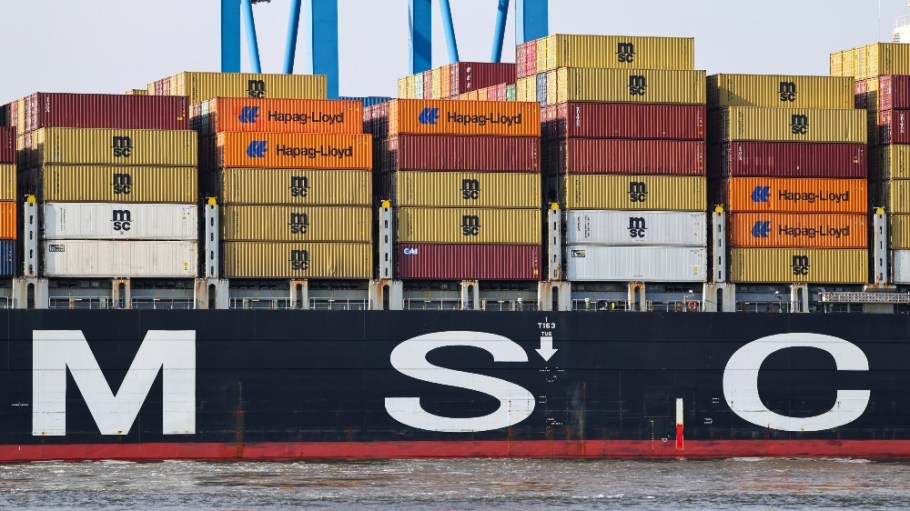
Proposed fees on China-built and -operated ships docking at U.S. ports could have “significant consequences” in the form of added costs and trade line constriction, according to Mediterranean Shipping Co. (MSC) chief executive Soren Toft.
Speaking at the TPM25 trade and logistics conference hosted in Long Beach, Calif. by S&P Global, the CEO of the world’s largest ocean freight firm said that the Trump administration’s proposal—which could raise fees up to $1.5 million per port—would force the shipper to “revise our network and withdraw coverage… or we will have to add that cost on top, and ultimately, the consumer will have to pay.”
Related Stories
The new fees could see container rates balloon by 20 percent to 25 percent, he estimated.
“The other thing that I think will happen immediately is that all the marginal ports will have to be re-looked that,” he added. “I mean, here we are in California today. We are typically calling at L.A.-Long Beach, and then proceed to Oakland. But we can’t proceed to Oakland if that costs another million dollars.”
Certain trade routes could easily become un-economical, and if MSC isn’t able to pass on costs to its customers, it will have to shrink its network. “I think a lot of the marginal ports—the peripheral ports—will be at risk, and we’ll have to adapt our services,” Toft said. The group may explore other trade routes that are “more attractive,” but that could still mean calling at fewer ports.
The MSC leader said his biggest concern if that were to happen is a re-acceleration of port congestion not unlike the conditions seen during the pandemic.
“We all know in North America that the port congestion that was there during Covid disappeared because demand came down; it didn’t disappear because the ports miraculously performed 30-40 percent better,” he added. “And I think we could very quickly re-enter a situation where there will be port congestion, because it’s typically the weakest link that drives this.”
Toft said the industry is too focused on the ever-shifting dynamics of supply and demand, when it should be more focused on the viability of the logistics infrastructure that transports goods from Point A to Point B. “No matter how many additional ships you add to the global network, if there’s port congestion, you will still have bottlenecks and choke points around the world,” he said.
While talk of tariffs could be heard throughout the hallways of the Long Beach Convention Center on Monday, Toft said he doesn’t believe the duties or their potential inflationary impacts will inhibit the movement of goods or put a damper on his industry.

“I’m not overly nervous about that, because I still believe that global trade has played, historically, a tremendous role in the world. We have connected producers with consumers like never before,” he said. “I don’t want to be too philosophical about it, but the reality is that our industry… has made it possible for producers in remote places the world to have the global world as their marketplace.”
If anything, the uncertainty surrounding trade relationships has contributed to greater globalization, he explained. Asked what’s different about the way clients are sourcing today versus Trump’s first term (and first rounds of Section 301 duties), he said, “I think ‘China Plus One’ is more real today than it was in in those days.”
Even in speaking with customers over the prior 24 hours, he said he noted a desire to continue to expand sourcing portfolios. “We are seeing real active steps for diversifying away from China and adding more sourcing points,” he said. “Maybe it’s diversifying away from tariffs, but maybe it’s also, in general, to diversify yourselves and have different lead times on your on your production,” he added, noting that MSC customers are seeking out sourcing relationships in Vietnam, Indonesia, Turkey and Africa, among other regions.
“The world is not becoming less global…the supply chain is becoming more distributed, meaning you may have had two or three sourcing points in the past, and maybe going forward, you have five or six,” Toft said. “I think that’s a big difference in 2018 till today.”