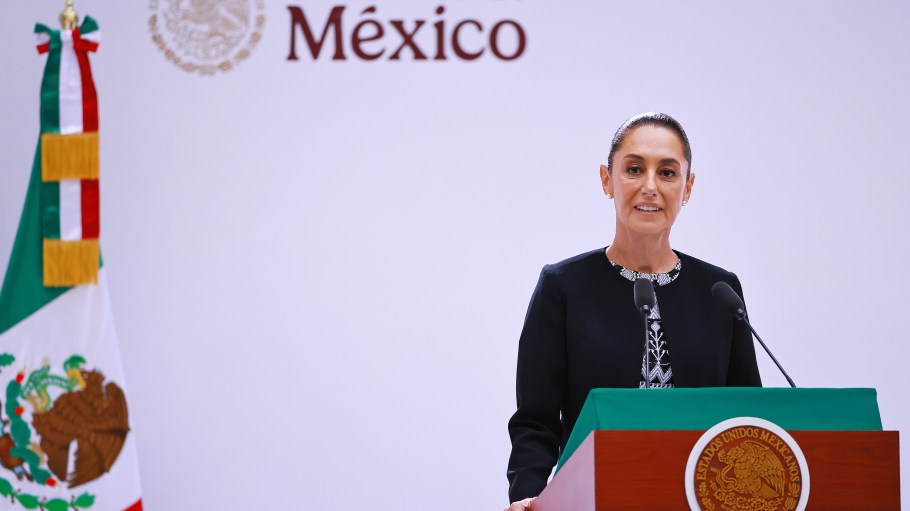
In her first state of the union address to the Mexican populace on Sep. 1, President Claudia Sheinbaum pledged to “make Mexico a port powerhouse” as part of wider investments in the country’s infrastructure.
During her six-year tenure, President Sheinbaum said 12 port projects will generate private investments of 264 billion pesos ($14.1 billion) alongside public investments totaling 142 billion pesos ($7.6 billion), tallying a combined 406 billion pesos ($21.8 billion).
The 18 billion pesos ($964 million) already invested by the state in 2025 are complemented by a private investment of 5.6 billion (roughly $300 million), the president said.
Related Stories
Sheinbaum pointed to 12 projects at major Mexican ports, including its largest container port, the Port of Manzanillo, as well as other major gateways including Lázaro Cárdenas, Altimara, Progreso and Veracruz among others.
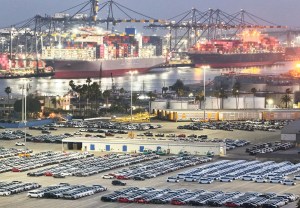
Many of the port projects have already been in the works, with the Port of Manzanillo beginning its 55-billion-peso ($2.9 billion) expansion late last year. Under this development, the expanded port would cover 4,448 acres, quadrupling from the 1,112 acres the port stretched cross ahead of the project.
Container capacity at the port is expected to be scaled from the 3.7 million 20-foot equivalent units (TEUs) it handled in 2024 to 10 million TEUs per year by 2030. The expansion would set the port up to be the busiest in Latin America, and would add two new container terminals to the complex and create a new rail terminal. As of July, dredging work is 30 percent complete, with an expected completion date of October 2027.
The infrastructure changes come as Sheinbaum and Mexico’s government maneuver a significant shift in American trade policy and an at-times tenuous relationship with the United States and President Donald Trump.
Intertwined with its linkage to the U.S., Mexico could potentially increase tariffs on imports from China as part of a budget proposal set to be submitted to the country’s Congress in September. Trump in particular has turned the heat on Sheinbaum to limit China’s influence on manufacturing in Mexico, with the Mexican president taking steps to curb imports on finished apparel and, more recently, footwear.
The investment in ports indicates an attempt to boost Mexico’s standing in global trade, while giving the country a wider stake in U.S. supply chains. The projects also are an extension of “Plan Mexico,” the economic strategy Sheinbaum released in January which heavily focused on boosting domestic manufacturing and jobs across the country.
A major part of this plan’s expected success is supposed to come from port modernization, according to Sheinbaum.
Julieta Juarez Ochoa, the Port of Manzanillo’s commercialization manager, told Reuters in April that the majority of imports arriving at the port come from Asia and are largely used in domestic manufacturing.
Mexican transportation and logistics magazine Grupo T21 criticized the port investment portion of Sheinbaum’s speech, noting a lack of transparency on timelines or additional capacity generated for the projects.
“In a context where both [Manzanillo and Lázaro Cárdenas] suffer from overcrowding and bottlenecks, this omission is not minor,” the article read. For one, Manzanillo had experienced a four-day customs workers strike in May that resulted in berthing backlogs for weeks after. And at Lázaro Cárdenas, truckers blocked key access points to the port for three days starting Wednesday, disrupting cargo movement in and out of the port, in protest of slow customs processing and poor working conditions for employees.
While Mexico aims to get its port modernization attempts off the ground, one of Canada’s largest ports is currently in growth mode as well.
As part of the Port of Montreal’s Contrecoeur expansion project, the Montreal Port Authority (MPA) entered into a joint venture with DP World, tapping the company to operate the new terminal. Over the next few months, the MPA and DP World’s Canadian operations will finalize the terminal’s design.
The Contrecoeur facility will have an annual capacity of 1.15 million TEUs, equivalent to 60 percent of the Port of Montreal’s current capacity of 2.1 million TEUs. It will include road and rail access linked to the Canadian National (CN) network, as well as two berths, a container yard, handling areas, an intermodal rail yard and a truck control zone.
Construction on the new terminal is set to begin in late September. The project is expected to cost $1.575 billion Canadian dollars ($1.14 billion) and is expected to be completed by 2030.