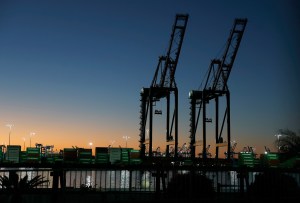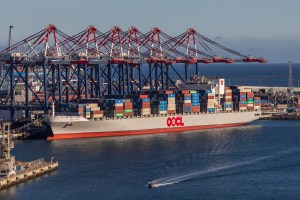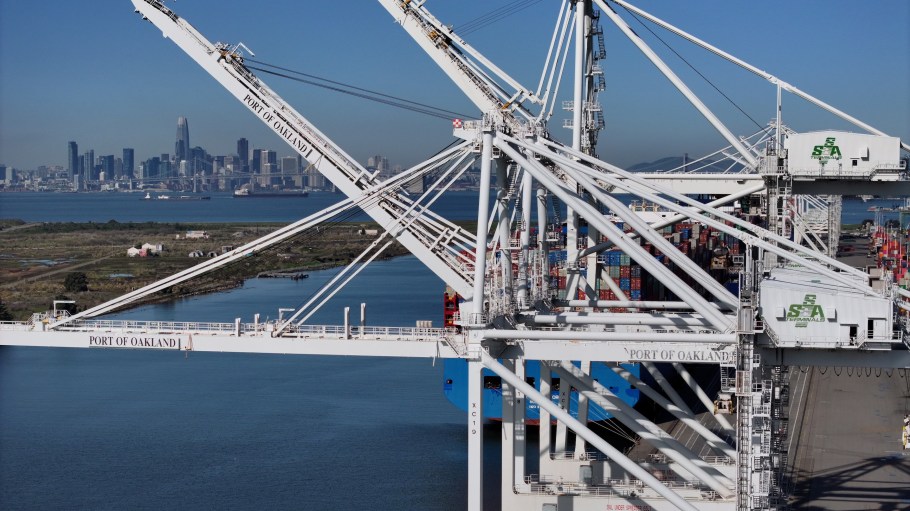
U.S. port operators are seeking to push back an intended 100 percent tariff on ship-to-shore cranes and other cargo-handling equipment from China that is expected to add billions in costs.
The National Association of Waterfront Employers (NAWE) is proposing a three-year transition period to implement the proposed penalty as the industry aims to adapt to purchasing and sourcing the equipment from other markets.
“Simply put, the existing market for non-Chinese manufactured ship-to-shore/cargo handling equipment is at present incapable of addressing the potential need in the U.S. domestic marine terminal operator market,” said NAWE president Carl Bentzel in a June 9 letter to U.S. Trade Representative Jamieson Greer and Secretary of State Marco Rubio.
Related Stories
Bentzel called for tariff exemptions on Chinese manufactured equipment that has been contracted prior to Dec. 31, 2024, as the ordering, production, transportation and installation processes constitute a multi-year endeavor.
“Several orders that were initiated as far back as 2023 are in various stages of delivery,” Bentzel said. “All these orders were well underway before there was any notice at all of potential penalties and should be exempted.”
The letter followed a similar note from the American Association of Port Authorities (AAPA) president and CEO Cary Davis in May, which called for a one- or two-year delay and sought to establish a tax credit to incentivize domestic crane production.
The Trump administration is proposing these tariffs as part of broader efforts to counter the sourcing superpower’s “unreasonable” dominance of the maritime industry, as determined by the U.S. Trade Representative’s (USTR) office.
Bentzel told the Wall Street Journal that he has visited the White House several times to urge senior administration officials to give ports more time to find alternative sources for cranes.
“We need some level of transition,” Bentzel said in the Wednesday report, noting that Trump administration officials had warned they would “put penalties as high as necessary” to ensure ports don’t buy equipment from China.
China’s Shanghai Zhenhua Heavy Industries (ZPMC) accounts for nearly 80 percent of STS cranes at U.S. ports. The remaining competitors including Finland’s Konecranes, Germany’s Liebherr and Japan’s Mitsui do not have the combined production capacity to replace ZPMC’s market share, according to Davis.
The Biden administration signed off on a $20 billion port investment in February 2024 aimed at jumpstarting the buildout of new cranes by a U.S.-based subsidiary of Mitsui. But both the NAWE and AAPA have said that effort will take years to develop due to a shortage of welders and the need for specialized parts not used in other types of equipment.
The expected tariffs are a heavy escalation of the 25 percent duties placed on the ship-to-shore cranes under the Biden administration in May 2024. Those tariffs came amid both the administration’s domestic manufacturing push, as well as mounting concerns that the U.S. had an overreliance on the China-built equipment in its supply chain.
At a hearing in Washington in May, Davis estimated that total tariffs on the cranes would cost a combined $6.7 billion in extra funds over the next decade.
But that had accounted for the 100 percent crane duties on top of the 25 percent tariffs instilled last year, as well as the then-145 percent tariff that had been imposed on all Chinese goods before the countries agreed to roll back the duties to 55 percent.
Before tariffs, ZPMC cranes cost about $15 million each. Without any tariffs attached, the 206 cranes either on order or planned for order would cost $2.48 billion, according to AAPA data.
Representatives from individual port authorities in New York and New Jersey, Virginia and Houston, Texas submitted comments to the USTR throughout May in agreement with the associations’ positions on holding off tariffs.
Bethann Rooney, the director of the ports at The Port Authority of New York and New Jersey, which hosts the largest port complex on the East Coast, requested that the implementation be delayed.
In a May 18 note, Rooney said any additional tariffs should be phased in until competitive domestic crane capacity can be established.
“The current domestic capacity to provide sufficient quantities of alternative equipment that is both readily available and cost-competitive, simply does not exist,” Rooney said. “The time required to develop the U.S. manufacturing industry capable of meeting demand must be considered in connection with the scale and timing of additional tariffs, in allowing the manufacturing industry the time and ability to adjust.”
Stephen Edwards, the CEO and executive director of the Virginia Port Authority, said the tariffs should be phased in over 12 months.
The crane tariffs aren’t the only punitive USTR measures on China causing a stir.
As the USTR finalizes its port fees targeting Chinese ships, the office is being urged to cut fees and restrictions on non-American auto carriers on liquefied natural gas (LNG) tankers.
While the USTR has already taken measures to reduce these fees, groups representing the car carriers and LNG-carrying vessels want the proposed changes scrapped altogether.
Despite the prior reduction in roll-on/roll-off “ro-ro” fees, costs are still high enough to force operators to limit U.S. calls and shift to smaller vessels, vehicle carriers warn.
Cheniere Energy, the largest producer and exporter of LNG in the U.S., called for the USTR to eliminate all its proposed restrictions on maritime transport of LNG exports entirely, citing that they are “inappropriate, impractical and counterproductive to the U.S. LNG industry’s growth.”