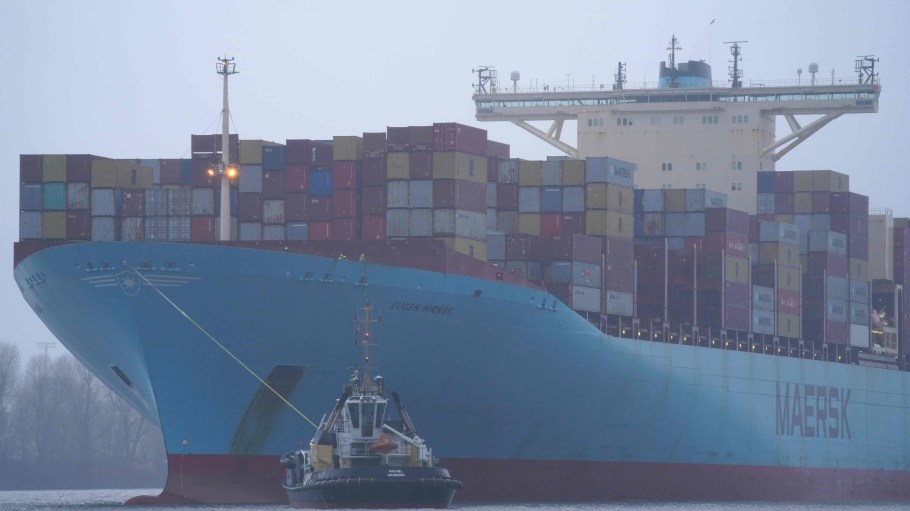
As more ocean carriers appear to show an openness to returning to the Red Sea on a limited basis, Maersk reportedly scrapped a long-time fee last month for one of its container vessels that transited the Suez Canal.
A “transit disruption surcharge” was dropped after the Singapore-flagged Maersk Sebarok passed through the trade artery late last month, according to a report from the Journal of Commerce. That transit took place on Dec. 23, marking the first time in two years a Maersk ship made the Red Sea voyage.
Related Stories
Maersk did not comment on the matter.
Maersk first tacked on these surcharges at the start of the Red Sea crisis in December 2023, when Houthi militants in Yemen began to launch drone and missile attacks against commercial ships passing through the waterway.
The surcharges were added due to the extended length of time Maersk’s vessels would need to sail around southern Africa’s Cape of Good Hope.
According to Maersk, those surcharges came in at $200 per 20-foot container equivalent unit (TEU), $400 per 40-foot container and $450 per 40-foot refrigerated container.
The surcharges impacted three major trade lanes that where Maersk ships passed through the Suez Canal, including Far East Asia to Northern Europe, Far East Asia to the Mediterranean and Far East Asia to East Coast North America.
“The move appears to mark a shift in how the Danish carrier is pricing routes involving the Suez Canal and Red Sea passage, which have been disrupted for the past two years,” said container shipping market research firm Alphaliner in an update.
War-risk insurance premiums have been a major issue preventing container shipping companies from coming back to the conflict-ridden region. These premiums have fallen in recent months, with the rate falling to around 0.2 percent of a vessel’s hull value from 0.5 percent before the Israel-Hamas ceasefire, according to a report from S&P Global Energy.
The dropping of the surcharge suggests that insurance companies could be getting more comfortable with lowering the premiums Maersk would pay to transit the Red Sea. But the costs are still higher than the less than 0.1 percent insurance premiums established before the crisis began, which could be a deterrent for many ocean carriers looking to make a full-time return.
According to the Baltic and International Maritime Council (BIMCO), to kick off 2026, Suez Canal transits were still around 60 percent below the same week in 2023.
Maersk, like its contemporaries that have made Red Sea sailings, is still focused on sticking to the Cape of Good Hope route despite the movement of the 6,445-TEU Sebarok.
The Sebarok operates on the liner’s MECL service, in which vessels sail from several Middle Eastern and Indian ports to and from stops on the U.S. East and Gulf Coasts. The vessel departed from India’s Jawaharlal Nehru Port on Dec. 12, and is scheduled to arrive at the Port of New York & New Jersey on Jan. 13. Additional calls will also be made at U.S. East and Gulf Coast ports in Charleston, Savannah and Houston.
The next vessel in the MECL1 westbound route is the U.S.-flagged 6,200 TEU Maersk Atlanta, which passed the cape on Jan. 3. That ship is anticipated to arrive in New York on Jan. 20. Another liner, the Singapore-flagged 6,650-TEU Maersk Senang, is currently traveling southbound off Africa’s east coast and should reach New York by Jan. 27.
The company still hasn’t set any public timeline for when more vessels are expected to take the Red Sea route, but said when the Sebarok first transited the waterway that the first sailing would be followed by a “limited number of additional trans-Suez voyages.”
That statement also indicated at the time that there were no currently planned sailings.
CMA CGM has remained the one ocean carrier that has kept testing the Red Sea’s waters.
In the days after the Sebarok passage, the CMA CGM Jacques Saade transited the canal southbound on its voyage from Morocco to Malaysia’s Port Klang. The liquefied natural gas (LNG)-powered carrier, which can carry 23,000 TEUs, became the largest container vessel to use the Suez Canal since the start of the Red Sea crisis when it made the voyage on Dec. 23. Following up that journey, the 15,500-TEU CMA CGM Adonis made a northbound transit.